Upper intermediate · JLPT N2
駈込み訴えKakekomi Uttae — Hear Me Out, Sir
- JLPT N2
- 13,487 characters
- 7 parts
- about 112 minutes
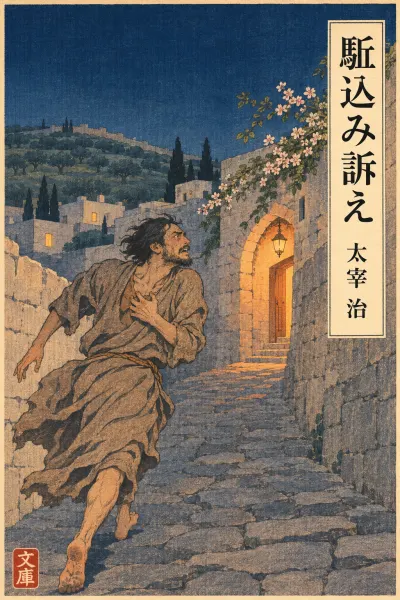
駈込み訴え is a single, unbroken spoken monologue. A man bursts in on an official, addressed throughout as 旦那さま, and offers to lead him to his teacher so that the teacher can be killed. Everything comes through his voice: no narrator, no scene-setting, only a stream of grievance, boasting, pleading and self-contradiction. He complains that he has fed and protected an ungrateful master and his useless followers, then breaks off to praise the man's beauty. He dreams of a quiet life alone with him, then swears to kill him with his own hands. The story's events will be familiar to anyone who knows the Gospels, but they are retold from an angle that makes them feel intimate, petty and painful. The speaker does not give his own name until the very end. For a learner the challenge is the voice itself. Polite humble keigo sits next to coarse masculine slang, sentences break off mid-thought, and the mood can flip within a line. Short passages of scripture appear in classical Bible Japanese. Because it is all speech, the text rewards reading aloud, and it is a strong exercise in tracking tone and attitude rather than plot alone.
Contents
Before you read
- Watch the register switches. Humble forms such as 申し上げます and 居ります mark moments when he addresses the official. Rough endings such as 〜やがる, 〜ねえ and ちきしょうめ mark moments when his anger takes over. Noticing which one is in use tells you his mood more reliably than the content does.
- The master is never named and is almost always just あの人. Keep track of whether あの人 or a disciple is the subject, because subjects are often dropped in the rush of speech.
- Learn the emphatic and conditional patterns that drive his arguments before you start: 〜どころか, 〜にちがいない, どれほど/どんなに〜ことか, 〜からには, 〜くらいなら, 〜たって and 〜やしない. They recur constantly as he justifies himself and then contradicts himself.
- Scripture quotations are in classical Bible Japanese (bungo), with old verb endings and forms like 〜なり and 〜べし. Don't get stuck on them. Read the surrounding speech for the gist and treat the quotations as set phrases.
- Many names are katakana renderings from old Japanese Bibles, such as ペテロ, ヤコブ, ピリポ, ベタニヤ and ゲッセマネ. Two people are called シモン and two are called マリヤ, so use context to tell which Mary or which Simon is meant.
Words to know
The most useful words from the notes across the story.
| Word | Meaning | JLPT |
|---|---|---|
| 出鱈目でたらめ | nonsense; lies; random talkThe kanji only show the sound. The word is usually written in hiragana. | N2 |
| さもしいさもしい | mean, petty, greedy | — |
| 申し上げましたもうしあげる | to say; to tell (humble)dictionary form: 申し上げるThe humble form of 言う. | N4 |
| 商人しょうにん | merchant; trader | N3 |
| けちけち | stingy; petty; meanBefore a noun it takes な: けちな商人. | N3 |
| もったいないもったいない | too good for me; I'm not worthyHere it expresses unworthiness of an honour, not the more common 'wasteful'. | N2 |
| 儲けもうける | to make a profitdictionary form: 儲けるHere it is causative: 儲けさせる, 'to let someone profit'. | N2 |
| 存じますぞんじる | to think; to feel (humble)dictionary form: 存じる有難う存じます is a very polite, old-fashioned 'thank you'. | N2 |
| 仇かたき | enemy; foeOld-fashioned and strong. Also appears in 敵討ち (revenge). | N1 |
| 白状はくじょう | confession; owning up | N1 |
| 吝嗇りんしょく | stinginess; miserlinessLiterary. The everyday word is けち. | N1 |
| 説かれるとく | to preach; to explain (a teaching)dictionary form: 説くHere 説かれる is the honorific passive form, used out of respect. | N1 |
| 復活ふっかつ | resurrection; revival | N1 |
| 施してほどこす | to give (alms, charity)dictionary form: 施すIts noun form 施し ('alms') appears in the master's reply. | N1 |
| 慕いしたう | to adore, to long for, to be devoted todictionary form: 慕うSuggests yearning affection or reverence for someone. | N1 |
Plot summary
Show the full summary (contains spoilers)
A man rushes to the authorities and offers to lead them to his master. He rants that he has supported the master and the other disciples without thanks, yet keeps admitting that he loves him more than anyone. He recalls Mary pouring costly oil on the master in Bethany. When he scolded her, the master rebuked him and called it preparation for his burial. The master then praised her, and his flushed cheeks stirred the narrator's jealousy. He scorns the master's entry into Jerusalem on a shabby donkey and his attack on the temple merchants as the bravado of a man who wants to die. At the Passover supper the master washes the disciples' feet, and the narrator is overcome with remorse. Then the master says that not all of them are clean, and the narrator realises he has been seen through. His shame turns to rage. The master foretells his betrayal and presses bread into his mouth, and the narrator runs off to inform on him. He first refuses the thirty pieces of silver, then accepts them, insisting he served only for money. Finally he gives his name: Judas Iscariot, the merchant.
About the author
Dazai Osamu (太宰治) was the pen name of Tsushima Shūji, born into a wealthy landowning family in Aomori Prefecture in northern Japan. He studied French literature at Tokyo Imperial University but did not graduate, devoting himself instead to writing. He is best known for the novels The Setting Sun (斜陽) and No Longer Human (人間失格), which draw heavily on his own troubled life. Much of his work is dark and confessional. Keep Running, Melos shows a brighter, more straightforwardly heroic side of his writing. He died by suicide in 1948.