Part 2 of 8 · JLPT N2
恐竜艇の冒険 Kyōryūtei no Bōken, part 2: Gineta, Shells and a Beach of Submarines
In this part
A flying boat carries the narrator and Sam to Gineta, a small volcano-threatened town in a tropical archipelago, where they stay at the shabby World Hotel. Exploring the hot town, they are tempted by the souvenirs on sale. Then on the beach they find many abandoned two-man midget submarines, left behind by a country that lost the war, selling for next to nothing.
AI translation · independently checked
ぼくは、飛行艇が水上滑走をはじめ、それから離水するまでが、大好きだ。I simply love the bit when a flying boat starts skimming along the water and then lifts off it.
ことに離水した瞬間のあの快い感じは、とてもいいあらわすことができない。That exhilarating feeling at the very moment of leaving the water, especially, is quite impossible to put into words.
ほい、しまった。Oops, there I go again!
ぼくは熱帯の冒険の話をするのに、飛行艇のことばかり語っていた。Here I am, meant to be telling you about an adventure in the tropics, and all I've talked about is flying boats.
話を本筋へもどす。Back to the story.
その飛行艇は、たった二日で、ぼくたちを、注文どうりの熱帯多島海へはこんでくれた。In just two days that flying boat carried us to a tropical archipelago, exactly as ordered.
そして、ぼくたちは、ギネタという小さい町へ入ったのだ。And so we arrived in a small town called Gineta.
ギネタは、人口八千人ばかりの、小都会であった。Gineta was a little town of only about eight thousand people.
しかし、これでも多島海第一の都会であった。Even so, it was the biggest town in the whole archipelago.
以前は、このギネタに、多島海総督府があり、総督がいたそうな。In the old days, so they say, the archipelago's Government House was here in Gineta, and the Governor lived here too.
今はいない。Not any more.
それは、この町のすぐとなりに火山が三つもあって、そのどれかが噴火していて、火山灰をまきちらし、地震はあるし、ときどきドカンと大爆発をして火柱が天にとどくすさまじさで、こんな不安な土地には総督府はおいておけないというので、ほかへ移したんだそうな。That's because there are no fewer than three volcanoes right next to the town, and one or other of them is erupting and scattering volcanic ash about; there are earthquakes, and every so often there's a tremendous BOOM and a pillar of fire shoots up to the sky with terrifying force. They say it was decided that Government House couldn't be kept in such an unsafe place, and so it was moved somewhere else.
この町の、世界ホテルというのに、ぼくとサムは宿泊することになった。Sam and I ended up staying at a place in this town called the World Hotel.
名はすごいホテルだが、実物はやすぶしんの小屋をすこし広くしたようなものであった。It was a hotel with a grand name, but the real thing was more like a cheaply built shack made a little bigger.
ただ、縁の下だけはりっぱであった。The only fine thing about it was the space underneath the floor.
人間がたったままではいっても、頭がつかえないのである。A person could walk in under there standing upright without bumping their head.
縁の下が、こんなにりっぱにこしらえてあるのは、この地方は暑いから、こうしておかないと床の下からむんむんと熱気があがってきて、部屋の中にいられないそうな。The reason the underfloor space was built so splendidly, they say, is that this region is so hot that unless you do it that way, stifling heat comes rising up from beneath the floor and you can't bear to stay in the rooms.
だが、サムもぼくも、そんな縁の下があっても、やっぱり暑くて、ホテルの部屋の中にじっとしていることができなかった。But even with that underfloor space, Sam and I still found it too hot to sit still in our hotel room.
そこで二人して、さっそく町を見物に出た。So the two of us went straight out to see the sights of the town.
町には、貝がらだの、珊瑚だの、極楽鳥の標本だの、大きな剥製のトカゲだの、きれいにみがいてあるべっこうガメの甲羅などを売っていて、みんなほしくなった。In the town they were selling seashells, coral, specimens of birds of paradise, big stuffed lizards, and beautifully polished hawksbill turtle shells, and we wanted all of it.
サムなんか、もう少しで、一軒の土産もの店を全部買いとってしまうところだった。Sam, for one, very nearly bought up an entire souvenir shop.
ぼくはサムを説いて、はじめは見るだけにして、一ぺん全部を見てあるいたあとで、明日にでもなったら、一番ほしいものから順番に買ってゆくことを承諾させた。I talked Sam round and got him to agree that at first we would only look, and that after we had walked round and seen everything once, we would start buying tomorrow or so, in order, beginning with what we wanted most.
サムは、しぶしぶそれを承諾したのだ。Sam agreed to it, grudgingly.
ところが、ぼくたちが海岸に出たとき、ぼくは、せっかくサムにいいきかせた掟を自分でぶち破るようなことになった。But when we came out onto the seashore, it was I myself who ended up smashing the very rule I had so carefully drummed into Sam.
それほど、ぼくはすばらしくほしいものを見つけたのである。That's how wonderfully much I wanted the thing I had found.
ぼくだけではない。And not just me.
サムもそれを見、その値段のやすいのを見ると、ぼくより以上に、それを買うことに熱をあげた。When Sam saw it too, and saw how cheap it was, he got even more worked up than I did about buying it.
そのものは、砂浜にゴロゴロと、いくつもころがっていた。There were a whole lot of these things lying scattered about on the sandy beach.
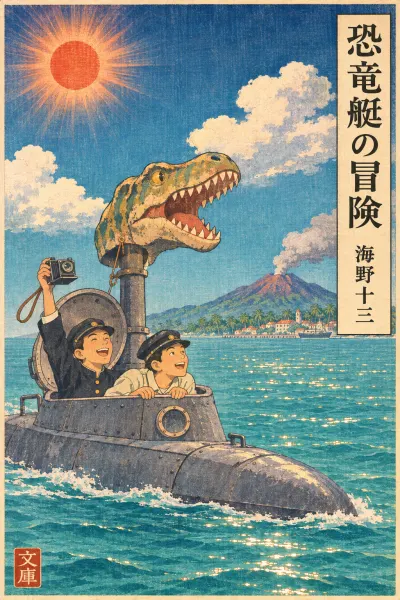
それは小型の潜水艇であった。They were small submarines.
二人で操縦のできる豆潜なのであった。Midget subs that two people could pilot.
売り主の話によると、これらの小さい潜水艇も、前にはずいぶんこの方面で活躍したそうである。According to the seller, these little submarines had once seen a great deal of action in these parts.
ところがこれらの船を活躍させた国は戦争に負けてしまい、これらの船をたくさん置き放しにして逃げてしまったという。But the country that had put them to work lost the war, and ran off leaving a great many of the boats abandoned, so he said.
そこで豆潜は競売に出たが買い手がないために売れなかった。So the midget subs were put up for auction, but they didn't sell, because there were no buyers.
そして、なんども競売をくりかえし、なんでも、十何回目かに、今の売り主が一たばにして買ったんだそうであるが、それはとほうもなくやすい値段だったそうである。They were auctioned again and again, and apparently at the tenth-something attempt the present seller bought the whole lot in one bundle, and the price, he said, was ridiculously low.
売り主が、そういうんだから、うそではあるまい。Since the seller himself said so, it can hardly be a lie.
それに、じっさいその豆潜についている値段札を見ると、ほんとにやすいのである。Besides, when you actually looked at the price tags on those midget subs, they really were cheap.
ぼくたちは、模型の電気機関車とレールと信号機などの一組を買うだけのお金で、その豆潜一隻を買うことができるのだった。For just the money it would take to buy a model electric locomotive set with rails, signals and so on, we could buy one of those midget subs.
ただみたいなものだ。It was practically free!
Vocabulary
| Word | Meaning | JLPT |
|---|---|---|
| 離水りすい | taking off from the water (of a seaplane)Literally 'leaving the water'; the counterpart of 離陸 (take-off from land). | — |
| 本筋ほんすじ | the main thread (of a story)話を本筋へもどす is a set phrase for 'to get back to the point'. | — |
| 多島海たとうかい | archipelago; a sea dotted with many islands | — |
| 総督府そうとくふ | Government House; colonial government office総督 is the Governor(-General) of a colony; 府 means 'government office'. | — |
| 噴火ふんか | eruption; to eruptUsed with する: 噴火している 'is erupting'. | N2 |
| やすぶしんやすぶしん | cheap, flimsy constructiondictionary form: 安普請普請 is an older word for building work; here written in kana. | — |
| 縁の下えんのした | the space under a raised floorAlso in the idiom 縁の下の力持ち, 'an unsung helper working behind the scenes'. | — |
| 剥製はくせい | stuffed (taxidermy) specimen | — |
| しぶしぶしぶしぶ | reluctantly, grudginglydictionary form: 渋々 | — |
| 掟おきて | rule, law (one that must be obeyed)Slightly solemn word; used humorously here for a boys' shopping rule. | — |
| 熱をあげたねつをあげる | to get enthusiastic about, become crazy aboutdictionary form: 熱を上げる | — |
| 豆潜まめせん | midget submarineShort for 豆潜水艇; 豆 'bean' as a prefix means 'tiny, miniature'. | — |
| 競売きょうばい | auction競売に出る 'to be put up for auction'. | — |
| とほうもなくとほうもない | absurdly, outrageously (low, high, etc.)dictionary form: 途方もない | — |
Grammar
〜そうな N1 so they say; I hear that (old-fashioned hearsay)
An older, slightly folksy form of the hearsay ending 〜そうだ, cutting off with な. The narrator uses it to report what he has been told about the town's history.
以前は、このギネタに、多島海総督府があり、総督がいたそうな。
In the old days, so they say, the archipelago's Government House was here in Gineta, and the Governor lived here too.
〜だの〜だの N2 things like A and B and…
Lists examples in a chatty, slightly breathless way, often suggesting there are too many to name. Here it conveys the boys' delight at the jumble of souvenirs.
貝がらだの、珊瑚だの、極楽鳥の標本だの
seashells and coral and stuffed birds of paradise
もう少しで〜ところだった N3 very nearly did ~ (but didn't)
ところだった after a plain verb describes something that almost happened. もう少しで ('a little more and') strengthens the near miss.
サムなんか、もう少しで、一軒の土産もの店を全部買いとってしまうところだった。
Sam, for one, very nearly bought up an entire souvenir shop.
〜を承諾させる (causative) N3 to make / get someone to do
The causative させる shows that the narrator got Sam to agree: 承諾させた means 'made/got him agree'. Sam is marked with を as the object of 説いて ('persuaded Sam'), and the plan he agreed to comes before ことを as the object of 承諾.
一番ほしいものから順番に買ってゆくことを承諾させた。
…got him to agree that we would buy things in order, beginning with what we wanted most.
〜ておかないと N4 unless you do ~ in advance
〜ておく means doing something in preparation; with the negative conditional ないと it means 'if you don't set things up this way, (something bad happens)'.
こうしておかないと床の下からむんむんと熱気があがってきて
unless you do it that way, stifling heat comes rising up from beneath the floor
〜まい N2 probably not; surely not
A written, somewhat literary negative guess, equivalent to 〜ないだろう. ではあるまい means 'it is surely not'.
売り主が、そういうんだから、うそではあるまい。
Since the seller himself said so, it can hardly be a lie.