Part 8 of 8 · JLPT N2
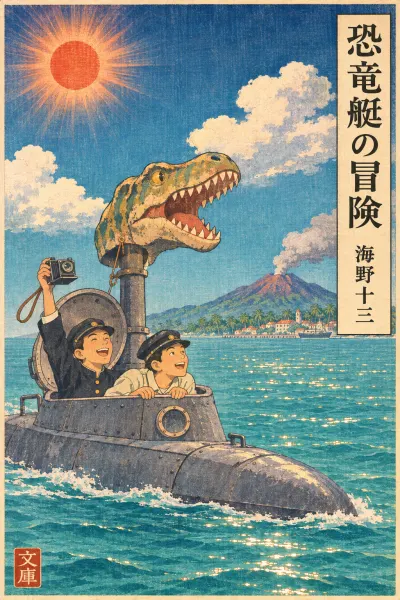
恐竜艇の冒険 Kyōryūtei no Bōken, part 8: A Narrow Escape and a Fortune
In this part
Jimmy and Sam worry that the real dinosaur, getting no answer from their model dinosaur, will grow angry and wreck their craft, so they creep back to the bay. The beast is gone, and they flee at full speed, run aground at the head of Gineta Bay and collapse on the beach while onlookers watch in shock. Back home, they make a fortune from broadcasts and books about the adventure, and Jimmy would like to visit Japan next holiday, after talking it over with Sam.
AI translation · independently checked
「恐龍は爬虫類だろう。爬虫類といえばヘビやトカゲがそうだ。ヘビは人間をのむからね。従って恐龍は人間を食うと思う」"A dinosaur's a reptile, isn't it? When you say reptiles, you mean things like snakes and lizards. And snakes swallow people, you know. So it follows that dinosaurs eat people, I reckon."
「なにが『従って』だ。食われちゃ、おしまいだ。ああ、困ったなあ」"Never mind your 'it follows'! If we get eaten, that's the end of us. Oh, what a mess!"
「ぼくはそんなことよりも、あのけだものが、ぼくらの恐龍号の恐龍に話しかけても返事をしないものだから、腹を立ててしまってね、ぼくらの艇をぽんと海の中へけとばして沈めてしまやしないかと心配しているんだ」"What worries me more than that is that the beast might talk to the dinosaur on our Dinosaur, get no answer, lose its temper, and kick our boat out into the sea and sink it."
「あっ、そうだ。昇降口をしめてくるのを忘れたよ。困った。本物の恐龍は相手が口をきかないものだから、きっと腹を立てるだろう」"Oh no, that's right! I forgot to shut the hatch when we left. That's bad. When the other fellow won't say a word, the real dinosaur is sure to get angry."
「そうなれば、ぼくらは、乗って帰る船がなくなるよ。そしてこの島に本物の恐龍といっしょに住むことになるだろう」"If that happens, we won't have a boat to ride home in. And then we'll end up living on this island with a real dinosaur."
「わーっ。本物の恐龍と同居するなんて、考えただけで、ぶるぶるぶるぶるだ」"Ugh! Sharing a home with a real dinosaur! Just thinking about it makes me shiver and shake and shiver and shake!"
サムは全身をこまかくふるえて見せた。Sam made a show of trembling all over in little shivers.
「ねえ、サム。恐龍は、鼻がきくだろうか。つまりにおいをかぎつけるのが鋭敏かな」"Say, Sam. Do you think a dinosaur has a good nose? I mean, is it sharp at sniffing things out?"
「なぜ、そんなことを聞くんだい」"Why do you ask a thing like that?"
「だって、ぼくはこれからそっと湾の方へ行って、本物の恐龍がどうしているか見てこようと思うんだ。しかし、もし恐龍の鼻がよくきくんだったら、ぼくが近づけば、恐龍に見つかって食べられてしまうからね」"Well, I'm thinking of creeping over towards the bay now to see what the real dinosaur is up to. But if a dinosaur has a really good nose, then as soon as I got near, it would find me and gobble me up."
「恐龍の臭覚は鈍感だと思う。なぜといって、ぼくらの作り物の恐龍のそばまで行っても、まだ本物かどうか分かりかねていたからね」"I think a dinosaur's sense of smell is pretty dull. Because, you see, even when it came right up next to our make-believe dinosaur, it still couldn't quite tell whether it was a real one or not."
「じゃあ行ってみよう」"Then let's go and see."
「ぼくも行く」"I'm coming too."
ぼくたちは、足音を忍びつつおそるおそる湾の見えるところまで行った。Muffling our footsteps, we crept fearfully along to a spot where we could see the bay.
「おや恐龍はいないぞ」"Hey, the dinosaur's not there!"
「ほんとだ。今のうちに、恐龍号に乗って逃げようよ」"You're right. Let's get aboard the Dinosaur and escape while we've got the chance!"
「よし、急げ、早く」"Right, hurry, quick!"
今から考えると、そのときどうして恐龍号にとびこんだか、どうして出帆したか、昇降口は誰がしめたのか、そんなことはすこしも記憶していない。Thinking back on it now, I have no memory at all of how we leapt into the Dinosaur, how we set sail, or who shut the hatch.
とにかく生命を的にして、早いところ片づけて、沖合いめがけて逃げ出したのだ。At any rate, with our lives at stake, we got it all done in a flash and fled, heading for the open sea.
もちろん潜航なんかしない。Of course, we didn't dive or anything like that.
浮上したままの全速力で白浪をたてて走った。We raced along on the surface at full speed, throwing up white foam.
気が気ではなかった。We were beside ourselves with worry.
今にも恐龍が追いかけて来るかと……。Wondering whether the dinosaur might come chasing after us at any moment...
ギネタ湾頭の浅瀬に艇をのしあげて、ぼくたちは「やれやれ助かった」と思った。When we ran the boat aground on the shallows at the head of Gineta Bay, we thought, "Phew, we're saved!"
ぼくたちは艇をとび出して、水を渡って海岸の砂の上に馳けあがり、気のゆるみで二人とも、人事不省に陥った。We jumped out of the boat, splashed through the water and dashed up onto the sand of the beach, and then, as the tension left us, both of us fell down senseless.
ぼくたちは知らなかったが、近くにいた人々は胆をつぶしたそうな。We didn't know it, but the people nearby were scared out of their wits, so they say.
そうでもあろう。And no wonder.
全速力で恐龍が海岸めがけて押し寄せて来たと思ったら、浅瀬にのしあげ、中から二人の少年がとび出してきて、砂の上でひっくりかえってしまったんだから。Just when they thought a dinosaur was charging at full speed towards the beach, it ran up onto the shallows, two boys jumped out of it, and then they keeled over flat on the sand!
ホテルでも、ぼくたちが三日三晩も、もどらないものだから、恐龍にさらわれたにちがいないと、手わけして探していたそうである。At the hotel, too, since we hadn't come back for three whole days and nights, they had decided we must have been carried off by the dinosaur, and had split up to search for us, so I'm told.
ぼくたちは運よく生命を拾って、本国へもどることが出来た。By good luck we escaped with our lives and were able to return to our home country.
いろいろ大損害もしたけれど、その後「恐龍艇の冒険」だの「恐龍を見た話」などを放送したり、本にして出版したりしたので、たいへん儲って金もちになった。We had suffered all sorts of heavy losses, but afterwards we did broadcasts such as "The Adventure of the Dinosaur Boat" and "The Time I Saw a Dinosaur," and published them as books, so we made a pile of money and became rich.
このつぎの休暇には、日本へ行ってみたい。Next holiday, I'd like to go to Japan.
こんどサムに相談してみよう。I think I'll talk it over with Sam soon.
Vocabulary
| Word | Meaning | JLPT |
|---|---|---|
| 爬虫類はちゅうるい | reptiles類 means "kind, class", as in 哺乳類 (mammals). | — |
| 同居どうきょ | living together under one roofUsed as a する verb: 〜と同居する. | N1 |
| 鋭敏えいびん | keen, sharp (of the senses)A formal word. It is the opposite of 鈍感. | — |
| 鈍感どんかん | dull, insensitiveAlso used of people who don't notice others' feelings. | N1 |
| 臭覚しゅうかく | sense of smellThe modern standard spelling is 嗅覚 (きゅうかく). | — |
| 忍びしのぶ | to do stealthily; 足音を忍ぶ = to muffle one's footstepsdictionary form: 忍ぶIt also means "to endure"; compare 忍者. | — |
| 出帆しゅっぱん | setting sail, departure of a shipLiterally "putting out the sail". The everyday word is 出航. | — |
| 潜航せんこう | travelling underwater, submerging (of a submarine)It is the opposite of 浮上 (surfacing). | — |
| 気が気ではなかったきがきでない | to be beside oneself with worry, on tenterhooksdictionary form: 気が気でない | — |
| 浅瀬あさせ | shallows, shoal | — |
| のしあげてのしあげる | to run (a ship) agrounddictionary form: のし上げるWhen used of people, のし上がる means "to rise in the world". | — |
| 人事不省じんじふせい | unconsciousness, a dead faintA four-character compound, usually used as 人事不省に陥る. | — |
| 胆をつぶしたきもをつぶす | to be frightened out of one's witsdictionary form: 胆をつぶすLiterally "to crush one's liver". It is also written 肝をつぶす. | — |
| 儲ってもうかる | to make a profit, to earn moneydictionary form: 儲かるThe modern spelling is 儲かって. | N2 |
Grammar
〜ちゃ(〜ては) N3 if (something bad happens)
〜ちゃ is the casual contraction of 〜ては. It sets up a condition that leads to a bad result, often followed by おしまいだ or だめだ.
食われちゃ、おしまいだ。
If we get eaten, that's the end of us.
〜やしないか N2 won't it (happen)? (fearful worry)
しまやしないか is a colloquial contraction of しまいはしないか. Combined with 心配する, it expresses the fear that something bad might happen.
沈めてしまやしないかと心配しているんだ
I'm worried it might go and sink it.
〜ものだから N3 because, since (giving a reason)
This pattern gives a reason in a slightly explanatory or excusing tone. Here the other side's silence is given as the reason the dinosaur gets angry.
本物の恐龍は相手が口をきかないものだから、きっと腹を立てるだろう
When the other fellow won't say a word, the real dinosaur is sure to get angry.
〜かねる N2 to be unable to, to find it hard to
The verb stem + かねる means that something cannot be done even though one may try. 分かりかねていた means the dinosaur couldn't quite make out the truth.
まだ本物かどうか分かりかねていたからね
it still couldn't quite tell whether it was a real one or not.
〜つつ N2 while (doing)
The verb stem + つつ is a written equivalent of 〜ながら. It shows two actions happening at the same time.
足音を忍びつつおそるおそる湾の見えるところまで行った
Muffling our footsteps, we crept fearfully to a spot where we could see the bay.
〜そうである/〜そうな N4 I hear that, so they say
The plain form + そうだ reports information heard from others. そうである is a written version, and そうな (in an earlier sentence) is an old-fashioned storytelling variant.
手わけして探していたそうである。
they had split up to search for us, so I'm told.