Part 3 of 8 · JLPT N2
恐竜艇の冒険 Kyōryūtei no Bōken, part 3: Piloting Lessons and a Grand Scheme
In this part
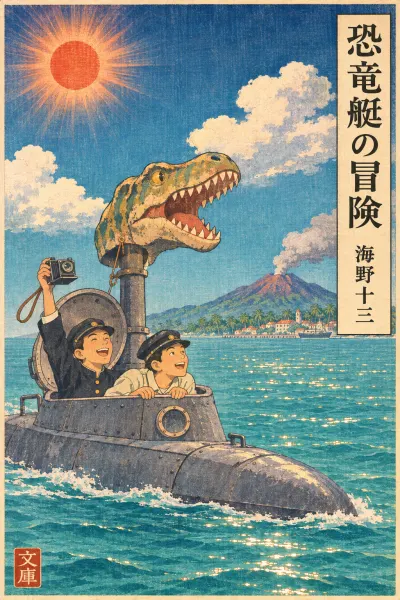
Jimmy and Sam buy the midget submarine and name it the Dinosaur. They learn to pilot it under Amir, a former navy petty officer, who warns them to check the hatch and clear the deck before diving. The boys practise hard because they have a secret plan: to use the sub to make a dinosaur appear in the sea.
AI translation · independently checked
「ジミー、これを買おうや」"Jimmy, let's buy this one!"
「うん、買おうな」"Yeah, let's buy it!"
サムもぼくも、このとき、皿のように目をむいて、目をくるくる動かしていたそうだ。Apparently, at that moment Sam and I both had our eyes popping out like saucers and rolling round and round.
ほしいものにぶつかって、うれしさに身体がふるえていたんだろう。I suppose we had run into the very thing we wanted, and we were trembling all over with joy.
買っちゃった!We bought it!
豆潜水艇を一隻。One midget submarine.
とうとう買ってしまったのだ。We had gone and bought it at last.
すばらしい計画A Splendid Plan
ぼくたち二人は、しばらくその豆潜水艇恐龍号(どうです、すばらしい名前ではないか)の運転を習うために、ギネタ船渠会社へ通った。For a while the two of us went regularly to the Gineta Dock Company to learn how to run our midget submarine, the Dinosaur (how about that, isn't it a splendid name?).
技士のアミール氏は、元海軍下士官で潜水艦のり八年の経歴がある人だそうで、ぼくたちに潜水艦の操縦を教えるのは上手であった。The engineer, Mr Amir, was said to be a former navy petty officer with eight years' service on submarines, and he was good at teaching us to pilot one.
「なあに、こんなものの操縦なんか、わけはない。自分が人間であることを忘れて、魚になったつもりで泳ぎまくればいいんだ。ほら、このとおり……」"Oh, there's nothing to handling a thing like this. Just forget you're a human being, pretend you've turned into a fish, and swim about all you like. Look, like this..."
アミール技士は、潜水艦を海面からさっと沈めたり、また急ぎ海面へ浮きあがらせたり、まるで自分が泳いでいるようにやってみせるのであった。Engineer Amir would sink the submarine swiftly from the surface, then bring it bobbing quickly back up again, showing us how it was done as if he himself were swimming.
「ただ、忘れてならないことは、潜るときに、上甲板への昇降口が閉まっているかどうか、それは必ずたしかめてからにすること。いいかね」"The one thing you mustn't forget, though, is this: when you dive, always make sure first that the hatch to the upper deck is shut. Got it?"
「はいはい。聞いています」"Yes, yes. We're listening."
「それから、潜るときの注意としてもう一つ。それは上甲板に水につかっては困るものが残ってやしないか、それに気をつけること」"And one more warning for when you dive. Watch out that nothing is left on the upper deck that shouldn't get wet."
「なんですか、水につかっては困るものというと……」"What do you mean, things that shouldn't get wet...?"
「実例をあげると、すぐ分る。たとえば、上甲板に人間が残っている。それを忘れて、そのまま艇が海の中に潜ってしまえば、その人間は、たいへん困るだろう。困るどころか、溺死してしまうからね」"An example will make it clear at once. Say a man is left on the upper deck. If you forget him and the boat just dives under the sea, that man will be in big trouble. Worse than trouble, in fact, because he'll drown."
「ははーん、なるほど」"Aha, I see."
「第二の例。上甲板に、虫のついた小麦粉を陽に乾してある。それを中へ入れるのを忘れて、その潜水艦が海の中へ潜ってしまえば、小麦粉はもう、永久にサヨナラだ」"Second example. Some weevily flour has been spread on the upper deck to dry in the sun. If you forget to bring it inside and the submarine dives into the sea, then it's goodbye to that flour for ever."
「ああ、分かりました」"Ah, we understand."
ぼくたちは操縦を一生けんめいに練習した。We practised piloting with all our might.
アミール技士は、ぼくたちの熱心さに対し、第一等のことばでほめた。Engineer Amir praised our keenness in the very highest terms.
ぼくたちが、たいへん熱心なのには、別にわけがあった。There was a particular reason why we were so very keen.
それはこの豆潜水艇を手に入れてからあとで、サムとぼくとが、すばらしい計画を思いついたからだ。It was because, after we got hold of the midget submarine, Sam and I had hit upon a splendid plan.
その計画を思う存分行うためには、豆潜の操縦がうんと上手になっていた方がよいのであった。To carry out that plan to our hearts' content, we had better become really good at handling the midget sub.
みなさん、ぼくの大計画が何であるかお分かりですかな。Now, everyone, can you guess what my grand plan is?
もうここでお話してしまいましょう。I'll go ahead and tell you right here.
それはね、ぼくたちは豆潜水艇を使って、海の中に恐龍を出すのである。It's this: we are going to use the midget submarine to make a dinosaur appear in the sea.
恐龍!A dinosaur!
知らない人はないでしょうね。I'm sure there's nobody who doesn't know what that is.
数千万年前に、地球の上にすんでいたという巨大な爬虫類である恐龍。The dinosaur, that gigantic reptile which is said to have lived on the earth tens of millions of years ago.
頭の先から尻尾まで三十何メートルもあるというすごい恐龍。The tremendous dinosaur, said to measure thirty-odd metres from the tip of its head to the end of its tail.
いつだったか、ヒマラヤ山脈のふもとの村にあらわれて、人々をおどろかしたというあの恐龍。That dinosaur which, some time or other, is said to have appeared in a village at the foot of the Himalayas and given the people a fright.
トカゲのくびを長くして、胴中をふくらませたような形をして、列車の上をひょいとまたいで行ったという恐龍。The dinosaur shaped like a lizard with its neck stretched long and its body puffed out, which is said to have stepped lightly right over a train.
それから今から二十何年前、スコットランドのネス湖のまん中あたりで、長いくびをひょっくり出していて、土地の人に見つけられたというあの太古の怪獣である恐龍!And then that monster of ancient times, the dinosaur, which twenty-odd years ago is said to have been spotted by the local people somewhere in the middle of Loch Ness in Scotland, suddenly poking out its long neck!
この恐龍を、ぼくたちは豆潜を使って海中に出す計画なのだ。Our plan is to use the midget sub to bring this dinosaur out into the sea.
いったいどうして、そんなことができるか、えへん、えへん。How on earth can such a thing be done? Ahem, ahem.
それがちゃんとできるのである。Well, it can be done, all right.
サムとぼくとで、とうとう考え出したことなのだ。It's something Sam and I finally worked out together.
Vocabulary
| Word | Meaning | JLPT |
|---|---|---|
| 目をむいてめをむく | to open one's eyes wide, goggledictionary form: 目をむくShows surprise or excitement. 皿のように (like saucers) adds the comic picture. | — |
| 潜水艇せんすいてい | small submarine, submersible艇 is used for small boats; 潜水艦 is a full-size submarine. 豆 (bean) in front means 'miniature'. | — |
| 隻せき | counter for ships and boats一隻 is read いっせき. | — |
| 通ったかよう | to go regularly, commutedictionary form: 通うUsed for attending a place again and again, such as a school or a workplace. | N4 |
| 経歴けいれき | career, record of experience | N1 |
| 操縦そうじゅう | piloting, handling (a vehicle or machine)Used for planes, ships and submarines. | N1 |
| わけはないわけはない | it's easy, nothing to itAn idiom: 'there is no difficulty'. Here わけ means 'trouble' or 'difficulty'. | — |
| 溺死できし | drowning (death by drowning)A formal word. The everyday verb is 溺れる (おぼれる). | — |
| 永久えいきゅう | forever, permanently | N3 |
| 熱心さねっしん | keenness, enthusiasmdictionary form: 熱心The suffix さ turns the na-adjective 熱心 into a noun. | N4 |
| 思う存分おもうぞんぶん | to one's heart's content, as much as one likes | — |
| 爬虫類はちゅうるい | reptiles類 means 'kind' or 'class', as in 魚類 (fish) and 鳥類 (birds). | — |
| またいでまたぐ | to step over, straddledictionary form: 跨ぐ | N2 |
| 太古たいこ | ancient times, remote antiquity | — |
Grammar
〜ちゃった N4 casual form of 〜てしまった (did completely / went and did)
〜ちゃった is the spoken contraction of 〜てしまった. It adds a feeling that the action is final and cannot be undone, here with excited glee. The next sentence repeats the idea in the full form 買ってしまったのだ.
買っちゃった!
We bought it!
〜つもりで N3 acting as if, imagining that
After a past-tense verb, 〜たつもりで means doing something while imagining a situation is true. Amir tells the boys to swim as though they had become fish.
魚になったつもりで泳ぎまくればいいんだ
just pretend you've turned into a fish and swim about all you like
〜かどうか N4 whether or not
This pattern embeds a yes/no question inside a sentence. The clause ending in かどうか becomes the thing that must be checked with たしかめる.
上甲板への昇降口が閉まっているかどうか、それは必ずたしかめてからにすること
always make sure first that the hatch to the upper deck is shut
〜てやしないか N2 whether something might perhaps be (a worry)
〜てやしない is a colloquial, emphatic form of 〜てはいない. Adding か turns it into a worried question: 'isn't something perhaps still there?'
上甲板に水につかっては困るものが残ってやしないか、それに気をつけること
watch out that nothing is left on the upper deck that shouldn't get wet
〜どころか N2 far from…, not just… but even
XどころかY means that X is an understatement and the reality is the more extreme Y. Being 'in trouble' is too mild, because the man will actually drown.
困るどころか、溺死してしまうからね
Worse than trouble, in fact, because he'll drown.
〜た方がよい N5 it is better to…, had better
A past-tense verb followed by 方がよい (or 方がいい) gives advice or states what is preferable. Here it explains why the boys need to become skilful pilots.
豆潜の操縦がうんと上手になっていた方がよいのであった
we had better become really good at handling the midget sub