Part 5 of 8 · JLPT N2
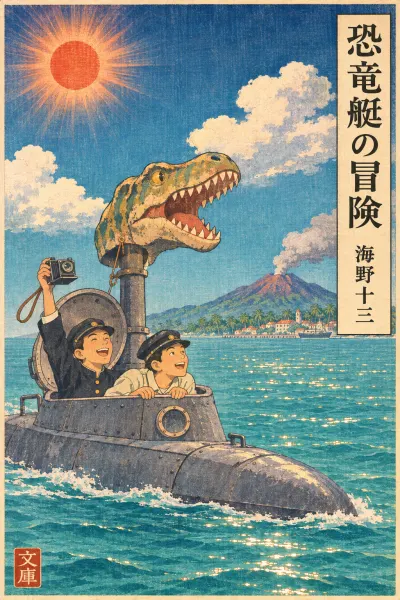
恐竜艇の冒険 Kyōryūtei no Bōken, part 5: Lying in Wait for a Victim
In this part
Jimmy and Sam move their gear into the midget submarine and set out before dawn with the dinosaur head fixed to the mast. They take turns as captain and lookout, but two days pass without a single ship worth frightening. Losing patience on the way home, they agree to scare anything at all, and Jimmy spots a little flotilla of fishing canoes.
AI translation · independently checked
しかし、こうなると、この荷物をあまり永くホテルへはおいておけない。But with things as they now stood, we couldn't leave all that stuff at the hotel for very long.
そこでその夜、ぼくたちはこの荷物を海岸のギネタ船渠の構内にあるぼくたちの潜水艇の中へはこびいれた。So that same night we carried the whole lot into our submarine, which lay within the grounds of the Gineta dock down on the shore.
あいにく月はない。As luck would have it, there was no moon.
月は夜中にならないと出ない。The moon wouldn't rise until the middle of the night.
ぼくたちは、その夜、この豆潜の中で眠った。That night we slept inside our pocket sub.
夜明けの二時間前である午前三時に、ぼくたちは起き出た。At three in the morning, two hours before dawn, we got up.
片われ月が空にかかっている。A half moon hung in the sky.
その光をたよりにぼくたちは、恐龍の首をマストにとりつけた。By its light we fixed the dinosaur's head to the mast.
夜明けをあと三十分にひかえて、ぼくたちは恐龍号の昇降口をぴったりと閉め、そしていよいよ出港するとすぐ潜航にはいった。With only thirty minutes left until daybreak, we shut the Dinosaur's hatch good and tight, and the moment we finally put out to sea we dived.
ずっと沖合へ出てから浮上した。We didn't surface until we were well out to sea.
艇長と見張番とを、二人で、かわるがわるすることにした。We decided the two of us would take turns being captain and lookout.
はじめはサムが艇長で、ぼくが見張番をやった。To begin with, Sam was captain and I was lookout.
見張番は双眼鏡で、水平線三百六十度をぐるっと見まわして、近づく船があるかと気をつけるのだ。The lookout sweeps the binoculars all the way round the horizon, the full three hundred and sixty degrees, keeping an eye out for any ship coming near.
そのほかに、ときどき空へも目を向けて、飛行機に気をつける。On top of that, he looks up at the sky now and then to watch out for aeroplanes.
飛行機はおどかすことができまいと思った。We reckoned there was no chance of frightening an aeroplane.
おどかせるのは船だけだ。Ships were the only things we could frighten.
船は見えたら、急いで潜航するのだ。As soon as a ship came in sight, we would dive in a hurry.
そして船がいよいよこっちへ近づいたら、そのときにこっちはぬっと海面へ浮上する手筈にしてあった。Then, when the ship had come really close, we would suddenly loom up to the surface of the sea. That was the plan we had worked out.
第一日は、大した相手にぶつからなかった。On the first day we didn't run into anything worth mentioning.
なにしろこのギネタの町は、そんなに繁盛している町ではないから、一日のうちに、入港船も出港船も一隻もないことがめずらしくないのである。You see, this town of Gineta isn't exactly a thriving place, so it's nothing unusual for a whole day to go by without a single ship coming into port or leaving it.
だから、港外の沖合に待っていたが、その日はついに獲物がこなかったのだ。So although we lay in wait out at sea beyond the harbour, that day our prey never showed up.
「今日はだめだったね」"No luck today, eh?"
帰って来てから、ぼくはサムにいった。I said this to Sam after we got back.
するとサムは、鞄の中から海図を出してきて、卓上にひろげながら、Sam pulled a chart out of his bag and spread it out on the table, saying,
「今日のところでは、毎日あぶれるかもしれない。もう三十マイル沖合いに出ると、主要航路にぶつかるんだ。つまり、このへんだ。この主要航路に待ってりゃ、かなり大きい汽船が通ると思うよ。三十マイル往復はちょっと骨が折れるけれど、明日はやってみないか」"If we stay where we were today, we might come up empty-handed every single day. Go another thirty miles out and we hit the main shipping lane. Round about here, see. If we wait on this main lane, I bet some pretty big steamers will come by. Thirty miles there and back is a bit of a slog, but why don't we give it a go tomorrow?"
「ふーん。やってみよう」というわけで、翌日はエンジンを全速にはたらかせて遠出をした。"Hmm. Let's do it." And so the next day we ran the engine at full speed and made the long trip.
ぼくもサムも、昨日と今日の見張で、すっかり陽に焼けて、黒くなってしまった。What with yesterday's lookout duty and today's, Sam and I were both thoroughly sunburnt and as brown as berries.
「ここもだめじゃないか」ぼくがいった。"This place is no good either, is it?" I said.
「いや、気永に待たなくちゃだめだよ。世界中の汽船がここに集まってくるわけのものじゃあるまいし、もっとがまんすることだ」"No, we've got to be patient and wait. It's not as if every steamer in the world is going to come crowding over here, so we'll just have to hang on a bit longer."
と、サムは大人のような口をきいた。Sam talked just like a grown-up.
しかし、彼もやっぱりつまらんと見え、その日帰航の途についたとき、Still, it seemed he was fed up too, because that day, as we set off on the voyage home, he said,
「まだ、店開きをやっていないんだから、これから小さな船でもなんでも見つけ次第、一度おどかしてみようじゃないか」と、いった。"We haven't even opened for business yet, so from now on, as soon as we spot a ship, even if it's just a little boat or whatever, let's try giving it a scare once."
「うん、それがいい。よし、第一の犠牲船を見つけてやるぞ」"Yes, that's the idea. Right, I'll find us our first victim!"
ぼくは見張りについた。I took up my post as lookout.
港まで、あと海上三マイルというところで、ぼくは五、六艘のカヌーが帆を張って走っているのを認めた。When we were only three miles out from the harbour, I made out five or six canoes skimming along under sail.
一日の漁をおえてギネタの港へもどっていく現地人の舟であった。They were the boats of local people heading back into Gineta harbour after a day's fishing.
「見つけた。六隻よりなる船団!」"Spotted! A convoy of six vessels!"
「えっ、六隻よりなる船団だって。おい、よく見ろよ。それは艦隊じゃないのか。艦隊をおどかしたら、大砲やロケット弾でうたれて、こっちはこっぱみじんだぞ」"What? A convoy of six vessels, you say? Hey, look properly. Isn't it a fleet of warships? If we frighten a fleet, they'll blast us with cannons and rockets and we'll be blown to smithereens!"
サムはおそれをなしている。Sam was scared out of his wits.
「よく見た。六隻よりなる船団なれども……」"I have looked well. A convoy of six vessels it is, and yet..."
「なれども――どうした」"And yet—what?"
Vocabulary
| Word | Meaning | JLPT |
|---|---|---|
| 構内こうない | premises, grounds (of a facility)Used for stations, factories, campuses and similar sites. | — |
| 片われ月かたわれづき | half moon, partial moondictionary form: 片割れ月Literary. 片割れ means 'broken piece' or 'one half'. 月 becomes づき by rendaku. | — |
| 潜航せんこう | running submerged, diving (of a submarine)潜航にはいる means 'to go under'. The opposite is 浮上. | — |
| 浮上ふじょう | surfacing, rising to the surface | — |
| 手筈てはず | plan, arrangements〜手筈にしてある means 'it is arranged that…'. | N1 |
| 繁盛はんじょう | prosperity, thriving (of a business or town) | N1 |
| 獲物えもの | prey, quarry, catchHere used humorously for the ships they hope to scare. | N1 |
| あぶれるあぶれる | to come away empty-handed, to miss outColloquial. Originally used of fishermen or day labourers who get no catch or no work. | — |
| 骨が折れるほねがおれる | to be hard work, to be a strainIdiom. Literally 'bones break'. | — |
| 気永きなが | patient, unhurrieddictionary form: 気長Usually written 気長. 気永に待つ means 'to wait patiently'. | — |
| 口をきいたくちをきく | to speak, to talk (in a certain manner)dictionary form: 口をきく大人のような口をきく means 'to talk like a grown-up'. | — |
| 店開きみせびらき | opening for businessUsed jokingly here for their first scare. | — |
| 船団せんだん | flotilla, convoy, group of ships | — |
| こっぱみじんこっぱみじん | smithereens, tiny fragmentsdictionary form: 木っ端微塵Literally 'wood chips and fine dust'. | — |
| おそれをなしているおそれをなす | to become frightened, to lose one's nervedictionary form: 恐れをなす | — |
Grammar
〜ないと〜ない N4 not … until …; unless …
A negative condition with と followed by a negative result means 'nothing happens until the condition is met'. Here the moon will not rise until midnight comes.
月は夜中にならないと出ない。
The moon wouldn't rise until the middle of the night.
〜まい N2 probably not; surely not
まい is a literary negative of conjecture, roughly equal to ないだろう. Attached to できる it gives できまい: 'it probably can't be done'.
飛行機はおどかすことができまいと思った。
We reckoned there was no chance of frightening an aeroplane.
〜てりゃ (〜ていれば) N3 if (one keeps) doing …
てりゃ is a casual contraction of ていれば, the conditional of 〜ている. 待ってりゃ means 'if we keep waiting'.
この主要航路に待ってりゃ、かなり大きい汽船が通ると思うよ。
If we wait on this main lane, I bet some pretty big steamers will come by.
〜わけのものじゃあるまいし N1 it's not as if …, so …
じゃあるまい is a literary 'surely isn't'. Adding し turns it into a reason clause: 'since it isn't as though X, you should do Y'. It sets up Sam's advice to be patient.
世界中の汽船がここに集まってくるわけのものじゃあるまいし、もっとがまんすることだ
It's not as if every steamer in the world is going to come crowding over here, so we'll just have to hang on a bit longer.
〜次第 N2 as soon as …
The verb stem plus 次第 means 'immediately upon doing'. 見つけ次第 means 'the moment we find one'.
これから小さな船でもなんでも見つけ次第、一度おどかしてみようじゃないか
From now on let's have a go at frightening whatever we find first, even if it's just some little boat.
〜なれども N1 it is …, and yet …
なれども is classical: the realis form なれ of the copula なり plus ども means 'although it is'. Here it is used in a mock-solemn tone and the sentence breaks off, leaving a hint of a 'but...'.
六隻よりなる船団なれども……
A convoy of six vessels it is, and yet...