Part 7 of 8 · JLPT N2
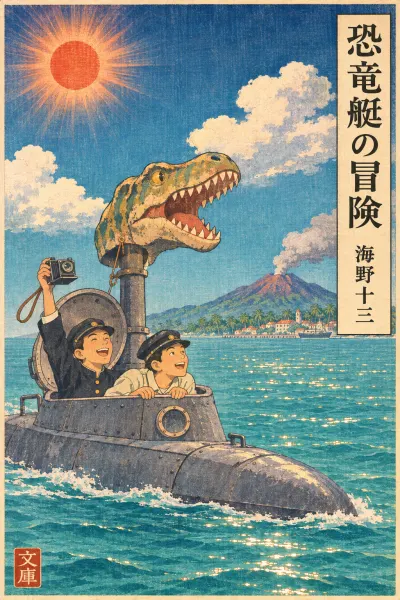
恐竜艇の冒険 Kyōryūtei no Bōken, part 7: Stranded, Then a Real Dinosaur
In this part
Search planes keep circling, so Jimmy and Sam have to hide beside the uninhabited island for three nights, drinking coconut water once their own water runs out. On the fourth morning the sky is quiet, and they go ashore to gather coconuts before setting off. Back at the bay they find a second dinosaur next to their boat, and this one is real, so they run deep into the jungle.
AI translation · independently checked
次から次へと、新しい飛行機がのぞきにやってきた。One after another, new planes came to take a look.
だんだん大型機へかわっていった。Little by little they changed to bigger and bigger machines.
「しょうがないね。まだ飛行機のやつ、下界をのぞいているぜ」"It's hopeless. Those blessed planes are still peering down at the world below."
「困ったねえ。もうすぐ日が暮れる。ぼくたちは夜間航海を習っていないから、明日の朝まで、ここを動くことはできやしないよ」"What a fix. It'll be dark soon. We haven't learned to navigate at night, so there's no way we can move from here until tomorrow morning."
「そんなら、今夜はここに泊まろう」"In that case, let's stay here tonight."
ぼくたちは無人島のかげで一泊することになった。So we ended up spending the night in the shelter of the uninhabited island.
夜になっても飛行機はまだ捜索をつづけていた。Even after nightfall the planes kept up the search.
中にはごていねいに照明弾を落としてゆく飛行機もあった。Some of them were even obliging enough to drop flares as they went.
「いやに大がかりになって来たね」"This is turning into an awfully big operation, isn't it?"
「きっと恐龍事件は世界中の大ニュースになって、さわがれているんだぜ」"I'll bet the dinosaur affair has become big news all over the world, and everyone's in an uproar about it."
「痛快だなあ。しかしカが多くていけないや」"What a lark! But these mosquitoes are a real nuisance."
夜は白みかかった。The night began to pale toward dawn.
さあ、早いところ帰航しようと思って、あたりの物音に耳をすました。Now, we thought, let's head home double-quick, and we listened hard to the sounds around us.
すると、小さいながらぶーんと飛行機の音が聞こえるではないか。And what do you know, there was the drone of a plane, faint but unmistakable!
「だめだ。まだ飛行機が、空にがんばっているよ」"No good. There's still a plane hanging on up in the sky."
「夜がすっかり明けちまうと、ちょっと出にくいんだ。困ったね」"Once it's broad daylight, it'll be pretty hard to slip out. What a fix."
夜が明けた。Day broke.
飛行機の数はふえた。The number of planes grew.
これではいよいよ動けない。Now we really couldn't budge.
その日も一泊、次の日も、やむを得ず一泊した。We stayed another night that day, and the day after that, having no choice, we stayed yet another night.
困ったのは食糧だ。The real trouble was food.
もっと持ってくればよかった。We should have brought more.
水は完全になくなった。Our water ran out completely.
上陸してヤシの実のくさい水をのんで、ようようのどのかわきをとめて生きていた。We went ashore and drank the smelly water from coconuts, and just about managed to quench our thirst and keep alive.
恐龍出現The Dinosaur Appears
四日目の朝のこと、起きて船の外へ出てみると、うれしや飛行機の音がしない。It was on the morning of the fourth day: I got up and went outside the boat, and joy of joys, there was no sound of planes.
そこでサムを起こした。So I woke Sam.
「よし、今のうちに出航だ。しかしその前にヤシの実を十個ばかり拾って、艇内にはこんでおく必要がある。これからまだどういう目にあうかもしれないから、水の用意はしておかないといけないんだ」"Right, we set off while we've got the chance. But first we need to gather about ten coconuts and take them on board. We don't know what we'll run into yet, so we've got to have water ready."
「なるほど。では二人で、五個ずつ拾ってくればいいんだね。ゆこう」"I see. Then if the two of us collect five each, that'll do it. Let's go."
サムとぼくとは急いで上陸した。Sam and I hurried ashore.
それから近くのヤシの林へはいって、なるべく色の青いヤシの実を拾いあつめた。Then we went into a nearby palm grove and gathered coconuts, picking the greenest ones we could.
五個のヤシの実は、やっと両手に抱えて持ちはこびができる。Five coconuts are just about all you can carry, hugged in both arms.
ぼくとサムとは、うんうんいいながら林を出て、艇のつないである湾の方へよたよた歩いていった。Grunting and groaning, Sam and I came out of the grove and tottered off toward the bay where the boat was moored.
そのときである。It was just then.
サムが、「あっ」といって立ちどまった。Sam cried "Oh!" and stopped dead.
「どうした、サム」と、ぼくはたずねた。"What's up, Sam?" I asked.
「うむ。ぼくの目はどうかしているらしい。恐龍の首が二つ見えるんだ」"Hmm. Something seems to be wrong with my eyes. I can see two dinosaur necks."
「あははは、何をいっているか」"Ha ha ha! What are you talking about?"
と、ぼくはばかばかしくなって、湾の方を見た。I said, thinking it was all nonsense, and looked toward the bay.
「あっ!」"Oh!"
ぼくの腕からヤシの実がころがり落ちた。The coconuts tumbled out of my arms.
ぼくの膝は急にがくがくになった。My knees suddenly went all wobbly.
のどがからからになって、声がでなくなった。My throat went bone-dry, and my voice wouldn't come out.
なぜ?Why?
なぜといって、ぼくは見たのだ。Why, because I had seen it.
ぼくらの恐龍のそばに、もう一頭の恐龍が長い首をのばし、口を開いたり閉じたりして、のそのそしているのであった。Right beside our Dinosaur, another dinosaur was stretching out its long neck, opening and shutting its mouth, and lumbering about.
それに、作り物の恐龍でないことは、一目で分かった。What's more, one look was enough to tell that it was no man-made dinosaur.
大きな胴が、マングロープをめりめりと押し倒している。Its huge body was crushing the mangroves flat with a splintering crack.
長い尻尾が、ぱちゃんと大きくヤシの梢を叩く。Its long tail gave the top of a palm a great slap.
ころころとヤシの実がころがるのが見える。We could see the coconuts tumbling down.
ほんものの恐龍だ。It was a real dinosaur.
「逃げよう、本物の恐龍だ」"Let's run! It's a real dinosaur!"
サムもこのとき悟ったと見え、ぼくの腕をとった。Sam seemed to have realised it at the same moment, for he grabbed my arm.
ぼくは無言で廻れ右をして走り出した。Without a word I turned on my heel and broke into a run.
密林の奥深くへ……。Deep, deep into the jungle...
「おどろいたね。この島には本物の恐龍がすんでいるんだよ」"What a shock! There are real dinosaurs living on this island!"
「恐龍島って、ほんとうにあるんだな。あいつは人間を食うだろうか」"So there really is such a thing as a Dinosaur Island. Do you think that brute eats people?"
Vocabulary
| Word | Meaning | JLPT |
|---|---|---|
| 下界げかい | the world below (seen from the sky)Originally a Buddhist word for the human world beneath the heavens. | — |
| 捜索そうさく | search, search operationUsed for organised searches for missing people or objects; 捜索する. | N1 |
| 照明弾しょうめいだん | flare, illumination shell照明 (lighting) + 弾 (bullet, shell). | — |
| 大がかりおおがかり | large-scale, elaborateNa-adjective; also written 大掛かり. | — |
| 痛快つうかい | thrilling, delightfulDescribes the satisfying excitement of something going splendidly. | — |
| 白みしらむ | to grow light (at dawn)dictionary form: 白むUsually in 夜が白む or 空が白む; 〜かかる adds 'beginning to'. | — |
| 耳をすましたみみをすます | to listen carefully, strain one's earsdictionary form: 耳を澄ます澄ます means 'to make clear'. | — |
| やむを得ずやむをえない | unavoidably, having no choicedictionary form: やむを得ないThe 〜ず form works as an adverb: 'unavoidably'. | N2 |
| 食糧しょくりょう | food supplies, provisionsCompare 食料, which means foodstuffs in general. | N3 |
| ようようようよう | barely, just aboutOld-fashioned form of ようやく. | — |
| 上陸じょうりく | going ashore, landing上陸する: to land from the sea. | N1 |
| 梢こずえ | treetop, top branches | N1 |
| 悟ったさとる | to realise, graspdictionary form: 悟るSuggests a sudden understanding of the real situation. | N1 |
| 密林みつりん | jungle, dense forest密 means 'dense', 林 means 'woods'. | — |
Grammar
〜やしない N2 emphatic negative: certainly cannot / will not
This is a colloquial contraction of 〜はしない that strongly stresses the negative. Here できやしない means 'there's just no way we can'.
明日の朝まで、ここを動くことはできやしないよ
there's no way we can move from here until tomorrow morning
〜ではないか N2 and what do you know / why, if it isn't…
In narration, this pattern presents a surprising discovery with exclamatory force. It is not a real question.
小さいながらぶーんと飛行機の音が聞こえるではないか。
And what do you know, there was the drone of a plane, faint but unmistakable!
〜ちまう N3 casual form of 〜てしまう (completely / unfortunately)
〜てしまう contracts to 〜ちまう (or 〜ちゃう) in rough, casual speech. Here 明けちまう means 'gets completely light', with a sense of regret.
夜がすっかり明けちまうと、ちょっと出にくいんだ。
Once it's broad daylight, it'll be pretty hard to slip out.
〜ばよかった N4 should have (done)
The conditional ば followed by よかった ('it would have been good') expresses regret about something that was not done.
もっと持ってくればよかった。
We should have brought more.
〜たり〜たりする N4 doing things like A and B / alternating A and B
Here the pattern describes repeated alternating actions: the mouth opening and closing again and again.
口を開いたり閉じたりして、のそのそしているのであった。
opening and shutting its mouth, and lumbering about.
〜と見え(る) N1 it seems that…, apparently
This is a literary way to infer something from outward signs. Sam grabbing Jimmy's arm shows that he too had realised the danger.
サムもこのとき悟ったと見え、ぼくの腕をとった。
Sam seemed to have realised it at the same moment, for he grabbed my arm.