Upper intermediate · JLPT N2
トカトントンTokatonton — The Distant Hammer
- JLPT N2
- 12,737 characters
- 8 parts
- about 106 minutes
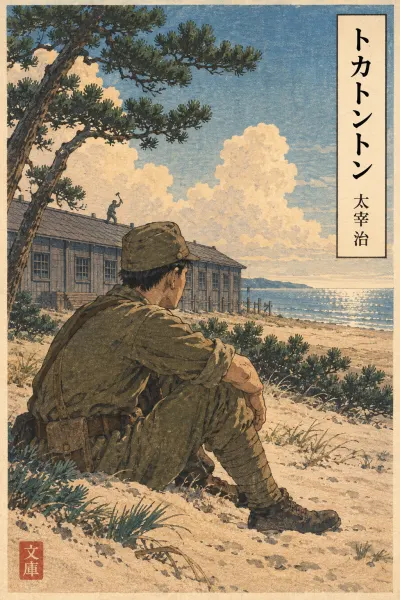
"Tokatonton" is a short story by Dazai Osamu set in the first year after Japan's defeat. Most of it is a long, confessional letter from a twenty-six-year-old post-office clerk in a coastal village near Aomori to a novelist he admires. A brief note and the writer's reply close the story. The young man describes a strange affliction. Ever since the surrender broadcast, whenever he feels moved, inspired or proud, he hears the faint sound of a hammer driving nails, *tokatonton*, and all feeling drains out of him. He describes how the sound has struck his writing, his work, his politics and even his love for a young inn maid, when real hammering echoes from a nearby shed. The tone is earnest, rambling and self-mocking. The comedy keeps turning into something bleaker, and the reader is left asking how far to trust the letter-writer. For learners, the polite desu/masu letter style is regular and approachable. The challenges are long, looping sentences, a little rural dialect, period vocabulary and references to Western and Japanese art and literature.
Contents
Before you read
- Learn the letter conventions first. 拝啓 opens and 敬具 closes the young man's letter. 拝復 opens the writer's reply and 不尽 closes it. The shift from long polite rambling to a terse reply is part of the meaning.
- Watch for the narrator's verbal tic そうしてそれから ("and then, and after that"). It strings episodes together in long, loosely joined sentences. Read each one by finding where each clause ends with て or し, and don't expect tight logic.
- Expect a shift in register in the dialogue. The uncle speaks in older rural-male speech (俺, のう, わからん for わからない). Hanae speaks softly with わ and のよ. The lieutenant gives short military commands.
- Many of the grammar points express the narrator's doubt and inner struggle: 〜のではなかろうか ("might it not be that…"), 〜か知れない, 〜ような気がする, 〜て仕方が無い ("can't help…"), 〜まい and 〜をさえ. Spotting them shows how much he hedges, which matters when he later admits the letter may contain lies.
- Learn some post-office vocabulary before Parts 3 to 5, such as 郵便局, 窓口 (counter), 貯金 (savings) and 通帳 (passbook). Hanae's weekly deposits and the currency-switch rush both happen at the narrator's counter.
Words to know
The most useful words from the notes across the story.
| Word | Meaning | JLPT |
|---|---|---|
| 幻聴げんちょう | auditory hallucination幻 'illusion' + 聴 'hearing'. | — |
| 部落ぶらく | hamlet, small villageOlder word; today it can carry discriminatory associations, so 集落 is preferred. | — |
| 凄腕すごうで | great skill; a shrewd operatorHere it hints that she is good at getting money from men. | — |
| 先輩せんぱい | senior (someone who went before you at the same school or workplace) | N4 |
| さかんにさかん | vigorously; frequently; a great dealdictionary form: 盛んHere it describes the sound coming again and again. | N4 |
| 気の毒きのどく | a shame; unfair on someone; pitiableHere it means he would feel bad imposing on them. | N3 |
| 覚悟かくご | resolve, being prepared (for something grave)覚悟をする / 覚悟して: to brace oneself for death, hardship and the like. | N3 |
| 貯金ちょきん | savings; (making) a depositThe narrator works at a post office, which also handled savings accounts. | N3 |
| かれこれかれこれ | about, roughly, going on for (a period of time) | N2 |
| くだらないくだらない | worthless, trivial, good-for-nothing | N2 |
| 釘くぎ | nail釘を打つ: to drive in a nail. | N2 |
| 感激かんげき | being deeply moved or stirred | N2 |
| 呆れあきれる | to be appalled, to be dumbfoundeddictionary form: 呆れるUsed for disgust or disbelief at something absurd. | N2 |
| ねらってねらう | to have one's eye on; to targetdictionary form: 狙うAlso used for aiming a weapon. | N2 |
| 通帳つうちょう | bankbook; passbook | N2 |
Plot summary
Show the full summary (contains spoilers)
A young man from Aomori writes to a novelist. He was a soldier on the Chiba coast in August 1945. After the surrender broadcast, as he felt ready to die, the distant sound of a hammer emptied him of all feeling. Since then this *tokatonton* has kept returning. It struck as he neared the end of a long account of his army days, and soon afterwards, finding the manuscript ridiculous, he gave up writing. It cut off his pride in hard work during the currency switch and his elation at a workers' demonstration. Real hammering from a shed chilled his love for the maid Hanae just after she confided that her savings belong to her employer. He begs for an explanation and admits that much of the letter may be lies. The writer replies curtly that his suffering is affected and that true thought needs courage. If the young man could feel Jesus's words in Matthew 10:28 like a thunderclap, the writer says, the sound would stop.
About the author
Dazai Osamu (太宰治) was the pen name of Tsushima Shūji, born into a wealthy landowning family in Aomori Prefecture in northern Japan. He studied French literature at Tokyo Imperial University but did not graduate, devoting himself instead to writing. He is best known for the novels The Setting Sun (斜陽) and No Longer Human (人間失格), which draw heavily on his own troubled life. Much of his work is dark and confessional. Keep Running, Melos shows a brighter, more straightforwardly heroic side of his writing. He died by suicide in 1948.