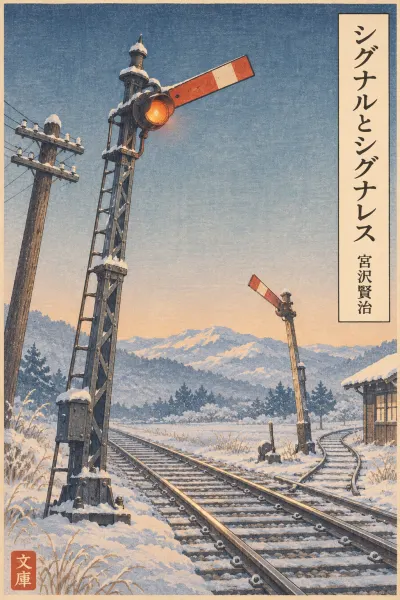
Part 4 of 8 · JLPT N2
シグナルとシグナレス Shigunaru to Shigunaresu, part 4: A Starry Promise and a Windy Day
In this part
Signaless worries that she is too plain for Signal, but he says that is exactly why he loves her, and the two promise to marry; he offers her the Ring Nebula as an engagement ring. A warehouse roars with laughter and promises to keep their secret. Later, in a strong wind, Signal takes advantage of the noise to talk to Signaless unheard by his fat telegraph-pole guardian, asking her just to nod, or shake her head sideways, in reply, and telling her he hopes they can marry when spring comes.
AI translation · independently checked
「だってあたしはこんなつまらないんですわ」"But I'm so plain and dull, you know."
「わかってますよ。僕にはそのつまらないところが尊いんです」"I know that. To me, that very plainness is precious."
すると、さあ、シグナレスはあらんかぎりの勇気を出して言い出しました。And then, oh my, Signaless gathered every scrap of courage she had and spoke up.
「でもあなたは金でできてるでしょう。新式でしょう。赤青眼鏡を二組みも持っていらっしゃるわ、夜も電燈でしょう。あたしは夜だってランプですわ、眼鏡もただ一つきり、それに木ですわ」"But you're made of metal, aren't you? And you're the new kind. You have two whole pairs of red-and-blue spectacles, and at night you have electric light, don't you? Even at night I have only a lamp, and just one single pair of spectacles, and on top of that I'm made of wood."
「わかってますよ。だから僕はすきなんです」"I know that. That's exactly why I love you."
「あら、ほんとう。うれしいわ。あたしお約束するわ」"Oh, really? I'm so glad. I promise you."
「え、ありがとう、うれしいなあ、僕もお約束しますよ。あなたはきっと、私の未来の妻だ」"Oh, thank you! How happy I am! I promise too. You will surely be my future wife."
「ええ、そうよ、あたし決して変わらないわ」"Yes, that's right. I'll never change."
「結婚指環をあげますよ、そら、ね、あすこの四つならんだ青い星ね」"I'll give you an engagement ring. Look, there, see? Those four blue stars in a row over there."
「ええ」"Yes."
「あのいちばん下の脚もとに小さな環が見えるでしょう、環状星雲ですよ。あの光の環ね、あれを受け取ってください。僕のまごころです」"Right at the foot of the lowest one you can see a little ring, can't you? That's the Ring Nebula. That ring of light, please accept it. It is my true heart."
「ええ。ありがとう、いただきますわ」"Yes. Thank you, I accept it gladly."
「ワッハッハ。大笑いだ。うまくやってやがるぜ」"Wa-ha-ha! What a laugh! Well, ain't you two doing nicely for yourselves!"
突然向こうのまっ黒な倉庫が、空にもはばかるような声でどなりました。Suddenly the pitch-black warehouse over the way bellowed in a voice so loud it seemed to make even the sky wince.
二人はまるでしんとなってしまいました。The two of them went perfectly silent.
ところが倉庫がまた言いました。But the warehouse spoke again.
「いや心配しなさんな。この事は決してほかへはもらしませんぞ。わしがしっかりのみ込みました」"Nah, don't you fret. I won't breathe a word of this to nobody, no sir. I've swallowed it down good and tight."
その時です、お月さまがカブンと山へおはいりになって、あたりがポカッと、うすぐらくなったのは。It was just then that the moon went plop! behind the mountain, and all around, pop!, everything grew dim.
今は風があんまり強いので電信柱どもは、本線の方も、軽便鉄道の方もまるで気が気でなく、ぐうん ぐうん ひゅうひゅう と独楽のようにうなっておりました。Now the wind was so fierce that the telegraph poles, those of the main line and those of the light railway alike, were quite beside themselves, humming like spinning tops: gwoon, gwoon, hyoo-hyoo.
それでも空はまっ青に晴れていました。Even so, the sky was clear and deep blue.
本線シグナルつきの太っちょの電信柱も、もうでたらめの歌をやるどころの話ではありません。Even the fat telegraph pole that went with the main-line Signal was in no state for singing his nonsense songs any more.
できるだけからだをちぢめて眼を細くして、ひとなみに、ブウウ、ブウウとうなってごまかしておりました。He shrank himself as small as he could, narrowed his eyes, and hummed booo, booo like everyone else to cover it up.
シグナレスはこの時、東のぐらぐらするくらい強い青びかりの中を、びっこをひくようにして走って行く雲を見ておりましたが、それからチラッとシグナルの方を見ました。At that moment Signaless was watching the clouds that went racing along, as if limping, through the blue glare in the east, so strong it made everything reel; then she stole a quick glance toward Signal.
シグナルは、今日は巡査のようにしゃんと立っていましたが、風が強くて太っちょの電柱に聞こえないのをいいことにして、シグナレスに話しかけました。Today Signal was standing up straight like a policeman, but, taking advantage of the wind being too strong for the fat pole to hear, he began speaking to Signaless.
「どうもひどい風ですね。あなた頭がほてって痛みはしませんか。どうも僕は少しくらくらしますね。"What a dreadful wind, isn't it? Doesn't your head feel hot and ache? I must say I feel a little dizzy.
いろいろお話ししますから、あなたただ頭をふってうなずいてだけいてください。どうせお返事をしたって僕のところへ届きはしませんから、それから僕の話でおもしろくないことがあったら横の方に頭を振ってください。I'll tell you all sorts of things, so please just nod your head. Even if you answered, it wouldn't reach me anyway. And if I say anything you don't like, please shake your head sideways.
これは、本当は、ヨーロッパの方のやり方なんですよ。向こうでは、僕たちのように仲のいいものがほかの人に知れないようにお話をする時は、みんなこうするんですよ。This, you know, is really the way they do it in Europe. Over there, when close friends like us want to talk without other people finding out, they all do it like this.
僕それを向こうの雑誌で見たんです。ね、あの倉庫のやつめ、おかしなやつですね、いきなり僕たちの話してるところへ口を出して、引き受けたのなんのって言うんですもの、あいつはずいぶん太ってますね、今日も眼をパチパチやらかしてますよ、僕のあなたに物を言ってるのはわかっていても、何を言ってるのか風でいっこう聞こえないんですよ、けれども全体、あなたに聞こえてるんですか、聞こえてるなら頭を振ってください、ええそう、聞こえるでしょうね。I saw it in a magazine from over there. Say, that warehouse fellow is a funny one, isn't he? Butting right into our conversation like that and going on about leaving it to him and whatnot. He's awfully fat, isn't he? He's blinking his eyes away again today. Even though he knows I'm talking to you, he can't hear a thing of what I'm saying because of the wind. But tell me, can you hear me at all? If you can, please nod your head. Ah yes, you can, can't you.
僕たち早く結婚したいもんですね、早く春になれぁいいんですね、僕のところのぶっきりこに少しも知らせないでおきましょう。How I wish we could marry soon. If only spring would come quickly. Let's not let my Bukkiriko know a single thing about it.
そしておいて、いきなり、ウヘン! ああ風でのどがぜいぜいする。ああひどい。ちょっとお話をやめますよ。And then, all of a sudden: Ahem! Ah, the wind's making my throat wheeze. Oh, it's awful. I'll stop talking for a little while.
僕のどが痛くなったんです。わかりましたか、じゃちょっとさようなら」My throat has started to hurt. Do you understand? Well then, goodbye for a little while."
Vocabulary
| Word | Meaning | JLPT |
|---|---|---|
| 尊いとうとい | precious, valuable, worthy of respectAlso read たっとい. Stronger and more formal than 大切. | N1 |
| あらんかぎりあらんかぎり | all there is, every last bit ofdictionary form: あらん限りLiterary: old verb あり + volitional ん + 限り, meaning 'as much as there is'. | — |
| 新式しんしき | new type, latest modelOpposite: 旧式 (きゅうしき), old-fashioned. | — |
| まごころまごころ | sincere heart, true feelingsdictionary form: 真心 | N1 |
| はばかるはばかる | to hold back out of awe or deference; here, a voice so loud that even the sky might shrink from itdictionary form: 憚る空にもはばかる: so loud that even the sky would be embarrassed by it. | — |
| もらしませんもらす | to let slip, to leak (a secret)dictionary form: 漏らす | N1 |
| のみ込みのみこむ | to swallow; to take in, understand and keepdictionary form: 飲み込むHere a joke: he has 'swallowed' the secret, so it stays inside him. | N1 |
| 気が気でなくきがきでない | to be worried sick, on edgedictionary form: 気が気でない | — |
| 独楽こま | spinning topSpecial reading (jukujikun): the kanji mean 'alone' and 'enjoy'. | — |
| でたらめでたらめ | random, made-up nonsensedictionary form: 出鱈目 | N2 |
| ごまかしてごまかす | to cover up, to fudge, to bluff one's way throughdictionary form: 誤魔化す | N1 |
| びっこをひくびっこをひく | to limpdictionary form: びっこを引くOld word now considered offensive; today use 足を引きずる. | — |
| しゃんとしゃんと | upright, straight and trim | — |
| ほてってほてる | to feel hot, to burn (face, body)dictionary form: 火照る | — |
Grammar
〜てやがる N2 rude/contemptuous 'is doing'
やがる attaches to the te-form in place of いる and adds scorn or mockery. It fits the warehouse's blunt, coarse speech.
うまくやってやがるぜ
Ain't you two doing nicely for yourselves!
〜なさんな N1 don't (do)
A colloquial contraction of 〜なさるな, the negative imperative of なさる: a softened prohibition ('don't ~'). It sounds folksy, familiar and somewhat old-fashioned, like 'don't you fret'.
いや心配しなさんな。
Nah, don't you fret.
〜どころの話ではない N2 far from being able to; in no state for
Says that the situation is so serious that the thing mentioned is out of the question. The gale leaves the pole no room for singing.
もうでたらめの歌をやるどころの話ではありません。
He was in no state for singing his nonsense songs any more.
〜のをいいことにして N1 taking advantage of the fact that
Uses a circumstance as a convenient excuse or opportunity, often slyly. Signal uses the noisy wind to talk without being overheard.
風が強くて太っちょの電柱に聞こえないのをいいことにして、シグナレスに話しかけました。
Taking advantage of the wind being too strong for the fat pole to hear, he began speaking to Signaless.
〜ないでおく N4 to leave (something) not done on purpose
The negative of 〜ておく: deliberately keep from doing something. Signal suggests keeping the pole in the dark.
僕のところのぶっきりこに少しも知らせないでおきましょう。
Let's not let my Bukkiriko know a single thing about it.
〜ばいい (なれぁいい) N4 if only ~; I wish ~
〜ばいい expresses a wish. なれぁ is a slurred, casual pronunciation of なれば.
早く春になれぁいいんですね
If only spring would come quickly.