Part 8 of 8 · JLPT N2
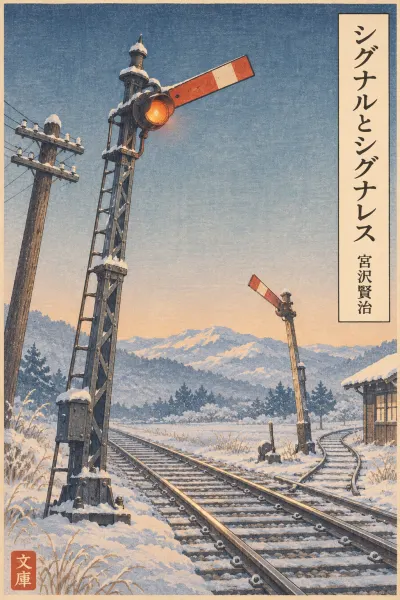
シグナルとシグナレス Shigunaru to Shigunaresu, part 8: A Shared Dream Among the Stars
In this part
On a warm, foggy night, the warehouse roof apologises for making things worse and leads Signal and Signaless in a strange chant of Greek letters. Suddenly the two signals find themselves side by side on a starry seashore and then among burning star-mist, happy together at last. A deep voice breaks in, and they wake to find they had been sharing a dream, while the roof stands laughing under a clear, starry sky.
AI translation · independently checked
今夜は暖かです。Tonight is warm.
霧がふかくふかくこめました。A fog settled in, thick, thick and deep.
その霧を徹して、月のあかりが水色にしずかに降り、電信柱も枕木も、みんな寝しずまりました。Through that fog the moonlight fell quietly, pale blue as water, and the telegraph poles and the sleepers all sank into sleep.
シグナルが待っていたようにほっと息をしました。Signal let out a sigh of relief, as if he had been waiting for this.
シグナレスも胸いっぱいのおもいをこめて、小さくほっといきしました。Signaless, too, gave a small sigh, with all the feeling her heart could hold.
その時シグナルとシグナレスとは、霧の中から倉庫の屋根の落ちついた親切らしい声の響いて来るのを聞きました。Just then, Signal and Signaless heard the calm, kindly voice of the warehouse roof come ringing out of the fog.
「お前たちは、全くきのどくだね、わたしたちは、今朝うまくやってやろうと思ったんだが、かえっていけなくしてしまった。ほんとにきのどくなことになったよ。しかしわたしには、また考えがあるから、そんなに心配しないでもいいよ。お前たちは霧でお互いに顔も見えずさびしいだろう」"You two are truly to be pitied. This morning we meant to set things right for you, but instead we only made them worse. It's turned out a sorry business indeed. Still, I have another idea, so you needn't worry so. With this fog you can't even see each other's faces, and you must be lonely."
「ええ」"Yes."
「ええ」"Yes."
「そうか、ではおれが見えるようにしてやろう。いいか、おれのあとについて二人いっしょにまねをするんだぜ」"I see. Well then, I'll fix it so you can see each other. Listen up—follow after me, the pair of you together, and copy what I say, got it?"
「ええ」"Yes."
「そうか。ではアルファー」"Right. Then—Alpha."
「アルファー」"Alpha."
「ビーター」「ビーター」"Beta." "Beta."
「ガムマー」「ガムマーアー」"Gamma." "Gammaaa."
「デルター」「デールータァーアアア」"Delta." "Deeel-taaa-aaah."
実に不思議です。It was truly a wonder.
いつかシグナルとシグナレスとの二人は、まっ黒な夜の中に肩をならべて立っていました。Before they knew it, Signal and Signaless were standing shoulder to shoulder in a pitch-black night.
「おや、どうしたんだろう。あたり一面まっ黒びろうどの夜だ」"Why, what has happened? All around us is a night of jet-black velvet."
「まあ、不思議ですわね。まっくらだわ」"Oh, how strange. It's so dark."
「いいや、頭の上が星でいっぱいです。おや、なんという大きな強い星なんだろう。それに見たこともない空の模様ではありませんか、いったいあの十三連なる青い星はどこにあったのでしょう、こんな星は見たことも聞いたこともありませんね、僕たちぜんたいどこに来たんでしょうね」"No—above our heads it's full of stars. Oh, what huge, fierce stars they are! And isn't that a pattern in the sky we've never seen before? Wherever were those thirteen blue stars in a row? I've never seen or heard of stars like these. Wherever in the world have we come to?"
「あら、空があんまり速くめぐりますわ」"Oh, the sky is turning round so fast!"
「ええ、ああ、あの大きな橙の星は地平線から今上ります。おや、地平線じゃない。水平線かしら。そうです。ここは夜の海の渚ですよ」"Yes—ah, that great orange star is rising from the horizon just now. Oh, but it's not the land's horizon. Is it the sea's? Yes, it is. This is the shore of a sea at night."
「まあ奇麗だわね、あの波の青びかり」"Oh, how beautiful—that blue glow on the waves."
「ええ、あれは磯波の波がしらです、立派ですねえ、行ってみましょう」"Yes, those are the crests of the breakers on the rocky shore. Aren't they splendid? Let's go and see."
「まあ、ほんとうにお月さまのあかりのような水よ」"Oh, the water really is like moonlight."
「ね、水の底に赤いひとでがいますよ。銀水のなまこがいますよ。ゆっくりゆっくり、這ってますねえ、それからあのユラユラ青びかりの棘を動かしているのは、雲丹ですね。波が寄せて来ます。少し遠のきましょう」"Look, there's a red starfish on the bottom. And a silver-water sea cucumber. They're crawling ever so slowly, aren't they? And that one waving its swaying, blue-glowing spines—that's a sea urchin. Here come the waves. Let's step back a little."
「ええ」"Yes."
「もう、何べん空がめぐったでしょう。たいへん寒くなりました。海がなんだか凍ったようですね。波はもう、うたなくなりました」"How many times has the sky turned round by now? It's grown very cold. The sea seems somehow to have frozen. The waves have stopped singing."
「波がやんだせいでしょうかしら。何か音がしていますわ」"Could it be because the waves have stopped? I can hear some kind of sound."
「どんな音」"What sort of sound?"
「そら、夢の水車のきしりのような音」"Listen—a sound like the creaking of a water wheel in a dream."
「ああそうだ。あの音だ。ピタゴラス派の天球運動の諧音です」"Ah, yes. That's it. That's the harmony of the heavenly spheres in motion, as the school of Pythagoras taught."
「あら、なんだかまわりがぼんやり青白くなってきましたわ」"Oh, everything around us is growing a dim, pale blue."
「夜が明けるのでしょうか。いやはてな。おお立派だ。あなたの顔がはっきり見える」"Is the dawn coming? No, wait—how odd. Oh, how splendid! I can see your face clearly."
「あなたもよ」"And I can see yours."
「ええ、とうとう、僕たち二人きりですね」"Yes. At long last, it's just the two of us."
「まあ、青白い火が燃えてますわ。まあ地面と海も。けど熱くないわ」"Oh, pale blue fire is burning! Oh, on the ground and the sea too. But it isn't hot."
「ここは空ですよ。これは星の中の霧の火ですよ。僕たちのねがいがかなったんです。ああ、さんたまりや」"This is the sky. This is the fire of the mist among the stars. Our wish has come true. Ah, Santa Maria."
「ああ」"Ah."
「地球は遠いですね」"The Earth is far away, isn't it?"
「ええ」"Yes."
「地球はどっちの方でしょう。あたりいちめんの星、どこがどこかもうわからない。あの僕のブッキリコはどうしたろう。あいつは本当はかあいそうですね」"Which way is the Earth, I wonder? Stars all around us—I can't tell anymore where anything is. What has become of that Bukkiriko of mine? Really, the poor fellow is to be pitied."
「ええ、まあ、火が少し白くなったわ、せわしく燃えますわ」"Yes. Oh, the fire has turned a little whiter. It's burning so restlessly."
「きっと今秋ですね。そしてあの倉庫の屋根も親切でしたね」"It must be autumn now, surely. And the warehouse roof was kind to us, wasn't it?"
「それは親切とも」いきなり太い声がしました。"Kind indeed, and no mistake!" a deep voice suddenly said.
気がついてみると、ああ、二人ともいっしょに夢を見ていたのでした。When they came to their senses—ah, the two of them had been dreaming the same dream together.
いつか霧がはれてそら一めんの星が、青や橙やせわしくせわしくまたたき、向こうにはまっ黒な倉庫の屋根が笑いながら立っておりました。At some point the fog had lifted, and the stars filled the whole sky, twinkling blue and orange, busily, busily, and over there stood the jet-black warehouse roof, laughing.
二人はまたほっと小さな息をしました。The two of them once more gave a small sigh of relief.
Vocabulary
| Word | Meaning | JLPT |
|---|---|---|
| こめましたこめる | (of fog, smoke) to hang thickly, fill the airdictionary form: 込める・籠めるIn 5 the same verb means 'to put (feeling) into': 胸いっぱいのおもいをこめて. | — |
| 枕木まくらぎ | railway sleeper, crosstieLiterally 'pillow wood': the beams the rails rest on. | — |
| 寝しずまりましたねしずまる | to fall asleep and become quiet (of everyone)dictionary form: 寝静まるUsed for a whole household or place going silent at night. | — |
| 倉庫そうこ | warehouse, storehouse | N2 |
| きのどくきのどく | pitiable, unfortunate; I feel sorry for youdictionary form: 気の毒Expresses sympathy for someone else's bad luck. | N3 |
| かえってかえって | on the contrary, instead (with the opposite result)dictionary form: 却ってMarks an outcome opposite to what was intended. | N2 |
| 渚なぎさ | water's edge, beachPoetic word for the shoreline. | — |
| 波がしらなみがしら | crest of a wavedictionary form: 波頭頭 (かしら) 'head' with rendaku → がしら. | — |
| なまこなまこ | sea cucumberdictionary form: 海鼠 | — |
| 雲丹うに | sea urchinKanji used for sound; often written in kana. | — |
| 遠のきましょうとおのく | to move away, draw backdictionary form: 遠のく | — |
| きしりきしり | creak, grinding squeakdictionary form: 軋りNoun from 軋る (to creak), as of wheels or hinges. | — |
| かあいそうかわいそう | poor thing, pitiabledictionary form: 可哀想かあいそう is an old-fashioned spelling/pronunciation of かわいそう. | N3 |
| またたきまたたく | to twinkle (of stars); to blinkdictionary form: 瞬く | — |
Grammar
〜ないでもいい N4 you don't have to ~
The negative て-form plus もいい gives permission not to do something. The roof tells the signals there is no need to worry. It is a softer variant of 〜なくてもいい.
そんなに心配しないでもいいよ
you needn't worry so
〜ようにしてやる N3 to make it so that ~ (as a favour)
〜ようにする means 'to bring about a state where ~', and てやる adds that the speaker does it for someone below or close to him. The roof offers to make the two able to see each other.
ではおれが見えるようにしてやろう
Well then, I'll fix it so you can see each other.
〜せいでしょうかしら N3 could it be because of ~?
せい names a cause, often of something unwelcome or odd. でしょうか with feminine かしら makes a gentle, wondering guess.
波がやんだせいでしょうかしら。
Could it be because the waves have stopped?
〜とも N2 of course ~, certainly ~
Sentence-final とも strongly affirms what the other person has just said. The roof agrees emphatically that it was kind.
「それは親切とも」
"Kind indeed, and no mistake!"
〜ていたのでした N3 it turned out that ~ had been happening
ていた describes an ongoing state, and のでした presents it as an explanation revealed afterwards. The narrator discloses that the whole journey had been a dream.
二人ともいっしょに夢を見ていたのでした。
the two of them had been dreaming the same dream together.