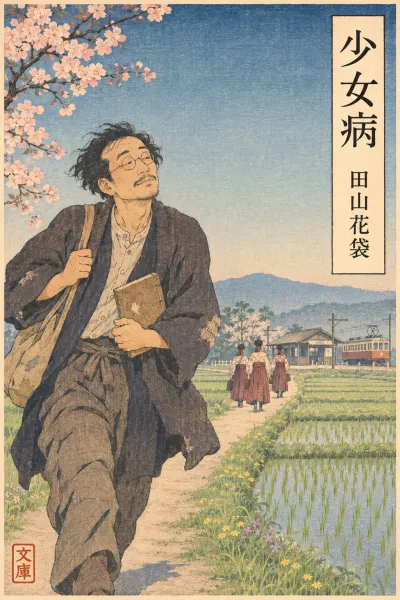
Part 2 of 8 · JLPT N2
少女病(一(つづき)) Shōjobyō, part 2: Two Familiar Girls at Yoyogi
In this part
On his way to the station, Sugita catches sight of an elegant young woman from a wealthy local family whom he has secretly followed before, and he drifts between fantasy and guilty self-correction about his age and family. At the Yoyogi stop he spots a plump schoolgirl he also knows by sight, convinces himself she recognises him, and stares at both girls, quite forgetting the approaching train.
AI translation · independently checked
今日もそこに来て耳を敧てたが、電車の来たような気勢もないので、同じ歩調ですたすたと歩いていったが、高い線路に突き当たって曲がる角で、ふと栗梅の縮緬の羽織をぞろりと着た恰好の好い庇髪の女の後ろ姿を見た。Today, too, he came to that spot and pricked up his ears, but there was no sign of a train approaching, so he strode briskly on at the same pace. At the corner where the road met the high railway embankment and turned, he suddenly caught sight of a woman from behind: a well-made figure with her hair in a pompadour, a chestnut-maroon crêpe haori hanging loosely from her shoulders.
鶯色のリボン、繻珍の鼻緒、おろし立ての白足袋、それを見ると、もうその胸はなんとなくときめいて、そのくせどうのこうのと言うのでもないが、ただ嬉しく、そわそわして、その先へ追い越すのがなんだか惜しいような気がする様子である。A nightingale-green ribbon, sandal thongs of figured satin, brand-new white split-toed socks: at the sight of them his heart was already fluttering somehow, and though there was nothing in particular to it, he was simply glad and restless, and it seemed he felt it would somehow be a pity to overtake her and go on ahead.
男はこの女を既に見知っているので、少なくとも五、六度はその女と同じ電車に乗ったことがある。He already knew this woman by sight; he had ridden in the same train with her at least five or six times.
それどころか、冬の寒い夕暮れ、わざわざ廻り路をしてその女の家を突き留めたことがある。More than that, one cold winter evening he had gone out of his way to follow her and find out where she lived.
千駄谷の田畝の西の隅で、樫の木で取り囲んだ奥の大きな家、その総領娘であることをよく知っている。He knew very well that she was the eldest daughter of the big house standing back at the western edge of the Sendagaya rice fields, enclosed by oak trees.
眉の美しい、色の白い頬の豊かな、笑う時言うに言われぬ表情をその眉と眼との間にあらわす娘だ。She was a girl with lovely eyebrows, a fair complexion and full cheeks, who, when she laughed, showed between her brows and her eyes an expression beyond all description.
「もうどうしても二十二、三、学校に通っているのではなし……それは毎朝逢わぬのでもわかるが、それにしてもどこへ行くのだろう」と思ったが、その思ったのが既に愉快なので、眼の前にちらつく美しい着物の色彩が言い知らず胸をそそる。"She must be twenty-two or twenty-three by now, and she isn't going to school… that much is clear from my not meeting her every morning, but where can she be going, then?" he thought. Yet the mere thinking of it was already a pleasure, and the colours of the lovely kimono flickering before his eyes stirred his heart in a way he could not express.
「もう嫁に行くんだろう?」と続いて思ったが、今度はそれがなんだか侘しいような惜しいような気がして、「己も今少し若ければ……」と二の矢を継いでたが、「なんだばかばかしい、己は幾歳だ、女房もあれば子供もある」と思い返した。"She'll be getting married soon, I suppose?" he went on to think; but this time it left him feeling somehow forlorn, somehow regretful, and he loosed a second arrow: "If only I were a little younger…" Then he caught himself: "What nonsense! How old am I? I have a wife, and children too."
思い返したが、なんとなく悲しい、なんとなく嬉しい。He caught himself, and yet he felt somehow sad, and somehow glad.
代々木の停留場に上る階段のところで、それでも追い越して、衣ずれの音、白粉の香いに胸を躍らしたが、今度は振り返りもせず、大足に、しかも駆けるようにして、階段を上った。At the stairs leading up to the Yoyogi stop he overtook her after all, and his heart leapt at the rustle of her silks and the scent of her face powder; but this time he did not even look back, and went up the stairs with long strides, almost at a run.
停留場の駅長が赤い回数切符を切って返した。The stationmaster at the stop punched his red coupon ticket and handed it back.
この駅長もその他の駅夫も皆この大男に熟している。This stationmaster, and the porters too, all knew this big man well.
せっかちで、あわて者で、早口であるということをも知っている。They knew, moreover, that he was impatient, easily flustered and quick of speech.
板囲いの待合所に入ろうとして、男はまたその前に兼ねて見知り越しの女学生の立っているのをめざとくも見た。As he was about to enter the board-fenced waiting shelter, the man's quick eyes once again caught sight of a schoolgirl he had long known by sight, standing in front of it.
肉づきのいい、頬の桃色の、輪郭の丸い、それはかわいい娘だ。She was a plump girl with rosy cheeks and a round face, a truly sweet thing.
はでな縞物に、海老茶の袴をはいて、右手に女持ちの細い蝙蝠傘、左の手に、紫の風呂敷包みを抱えているが、今日はリボンがいつものと違って白いと男はすぐ思った。She wore a gaily striped kimono with a maroon hakama, carried a slender lady's umbrella in her right hand, and held a bundle wrapped in a purple cloth under her left arm; today her ribbon was white, not the usual one, the man noticed at once.
この娘は自分を忘れはすまい、むろん知ってる!This girl would not have forgotten him; of course she knew him!
と続いて思った。So he went on to think.
そして娘の方を見たが、娘は知らぬ顔をして、あっちを向いている。Then he looked towards the girl, but she wore an air of not knowing him and was facing the other way.
あのくらいのうちは恥ずかしいんだろう、と思うとたまらなくかわいくなったらしい。At that age they must feel shy, he thought, and at the thought she seemed to grow unbearably sweet to him.
見ぬようなふりをして幾度となく見る、しきりに見る。Pretending not to look, he looked again and again, looked and kept on looking.
――そしてまた眼をそらして、今度は階段のところで追い越した女の後ろ姿に見入った。Then he turned his eyes away once more, and this time gazed raptly at the back of the woman he had overtaken on the stairs,
電車の来るのも知らぬというように――。as if he did not even know that the train was coming.
Vocabulary
| Word | Meaning | JLPT |
|---|---|---|
| 敧てたそばだてる | to prick up (one's ears), to strain to listendictionary form: 敧てるAlmost always in the set phrase 耳を敧てる; today usually written 欹てる or in kana. | — |
| 気勢けはい | sign, indication (of something present or approaching); here written 気勢 but read けはい (= 気配)Literary writing for 気配. Read きせい, it means 'spirit, ardour'. | — |
| 庇髪ひさしがみ | pompadour-style hair, swept forward over the browA Meiji fashion strongly associated with schoolgirls and young women; 庇 means 'eaves'. | — |
| 羽織はおり | haori, a loose half-length jacket worn over a kimonoNo English equivalent, so the word is kept in translation. | — |
| ときめいてときめく | (of the heart) to flutter, to throb with excitementdictionary form: ときめくUsually with 胸 as subject: 胸がときめく. | — |
| 突き留めたつきとめる | to track down, to find out (where something is)dictionary form: 突き留めるNow usually written 突き止める. | — |
| 総領そうりょう | eldest child, heir総領娘 is the eldest daughter of a family; an old-fashioned word. | — |
| 女房にょうぼう | wifeCasual, somewhat old-fashioned word a man uses for his own wife. | N2 |
| 二の矢を継いでにのやをつぐ | to follow up with a second shot (here, a second thought)dictionary form: 二の矢を継ぐLiterally 'to nock a second arrow'. | — |
| 回数切符かいすうきっぷ | coupon ticket (from a book of multi-ride tickets)Modern 回数券. | — |
| めざとくめざとい | quick to notice, sharp-eyeddictionary form: めざといKanji: 目敏い. Here めざとくも adds 'with keen eyes, as usual'. | — |
| 袴はかま | hakama, pleated divided skirt worn over a kimonoA maroon (海老茶) hakama was the emblem of Meiji schoolgirls, who were nicknamed 海老茶式部. | — |
| 蝙蝠傘こうもりがさ | Western-style umbrella or parasolNamed after the bat (蝙蝠) because of its black ribbed shape. | — |
| 見入ったみいる | to gaze intently at, to be absorbed in lookingdictionary form: 見入るTakes に for its object: 後ろ姿に見入る. | — |
Grammar
〜ような気がする N3 to feel as if ~, to have a feeling that ~
Marks a vague, subjective impression rather than a firm judgement. Here it is softened further with なんだか, and 様子である adds the narrator's ironic distance, as in 'it seemed he felt…'.
その先へ追い越すのがなんだか惜しいような気がする様子である
it seemed he felt it would somehow be a pity to overtake her and go on ahead
〜たことがある N4 have (once) done ~
Past form plus ことがある states a past experience. In this passage it piles up the man's earlier encounters with the woman.
少なくとも五、六度はその女と同じ電車に乗ったことがある
he had ridden in the same train with her at least five or six times
〜のではなし N1 it's not as if ~; since ~ isn't the case
A literary or colloquial way of giving a negative reason, leaving the conclusion implied. The man reasons that she is not a student, so where could she be going?
学校に通っているのではなし
she isn't going to school
〜もあれば〜もある N2 there is ~ and there is also ~
Conditional あれば links two items to stress that both exist. Here it emphasises his responsibilities as he scolds himself.
女房もあれば子供もある
I have a wife, and children too
〜はすまい N1 surely will not ~
まい is a literary negative of conjecture or intention attached to する (here す). With は inserted, 忘れはすまい means 'surely won't have forgotten', expressing the man's self-flattering certainty.
この娘は自分を忘れはすまい
This girl would not have forgotten him
〜ぬ (classical negative) N2 not ~ (= 〜ない)
ぬ attaches to the ない-stem and works like ない in modifying or adverbial phrases. It appears throughout this passage: 見ぬ, 逢わぬ, 知らぬ.
見ぬようなふりをして幾度となく見る
Pretending not to look, he looked again and again