Part 8 of 8 · JLPT N2
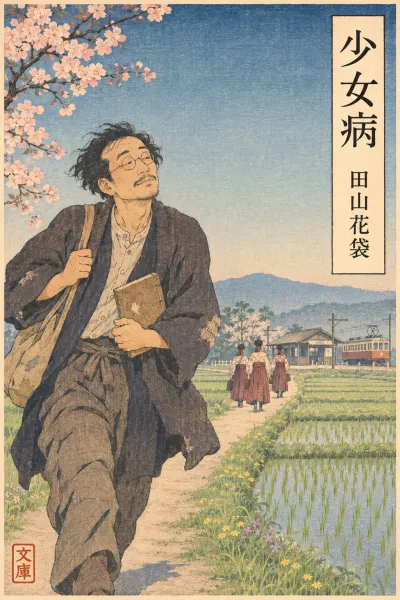
少女病(五(つづき)) Shōjobyō, part 8: A Last Glimpse, a Fatal Fall
In this part
Leaving the office in the afternoon, Sugita sinks into despair over his lost youth and thinks he would be better off dead. On the crowded train home he again sees the beautiful young lady from Shinanomachi and gazes at her, entranced. At Ichigaya the train lurches, he loses his grip on the brass rail, falls onto the tracks and is dragged to his death by an oncoming train.
AI translation · independently checked
午後三時過ぎ、退出時刻が近くなると、家のことを思う。A little past three in the afternoon, as the hour for leaving drew near, he would think of home.
妻のことを思う。He would think of his wife.
つまらんな、年を老ってしまったとつくづく慨嘆する。What a dreary business, he would lament from the bottom of his heart; I have grown old.
若い青年時代をくだらなく過ごして、今になって後悔したとてなんの役にたつ、ほんとうにつまらんなアと繰り返す。I frittered away the years of my youth, and what good does it do to regret it now? It really is dreary, he would repeat to himself.
若い時に、なぜはげしい恋をしなかった?Why, when he was young, had he not loved with passion?
なぜ充分に肉のかおりをも嗅がなかった?Why had he not breathed his fill of the scent of the flesh as well?
今時分思ったとて、なんの反響がある?What echo could come of thinking about it at this late hour?
もう三十七だ。He was thirty-seven already.
こう思うと、気がいらいらして、髪の毛をむしりたくなる。When he thought this way he grew irritable and wanted to tear out his hair.
社のガラス戸を開けて戸外に出る。He opened the glass door of the office and went outside.
終日の労働で頭脳はすっかり労れて、なんだか脳天が痛いような気がする。His brain was utterly worn out by the whole day's labour, and the crown of his head seemed somehow to ache.
西風に舞い上がる黄いろい塵埃、侘しい、侘しい。Yellow dust whirling up on the west wind; how bleak, how bleak.
なぜか今日はことさらに侘しくつらい。For some reason, today was especially bleak and painful.
いくら美しい少女の髪の香に憧れたからって、もう自分らが恋をする時代ではない。However much he might yearn for the fragrance of a pretty girl's hair, he and his kind were past the age for falling in love.
また恋をしたいたッて、美しい鳥を誘う羽翼をもう持っておらない。Even if he wished to love again, he no longer had the wings with which to lure a beautiful bird.
と思うと、もう生きている価値がない、死んだ方が好い、死んだ方が好い、死んだ方が好い、とかれは大きな体格を運びながら考えた。And with that thought: there is no worth in living any longer; I would be better off dead, better off dead, better off dead, he reflected as he carried his large frame along.
顔色が悪い。His colour was bad.
眼の濁っているのはその心の暗いことを示している。The cloudiness of his eyes betrayed the darkness of his heart.
妻や子供や平和な家庭のことを念頭に置かぬではないが、そんなことはもう非常に縁故が遠いように思われる。It was not that he never gave a thought to his wife and children and his peaceful home, but such things now seemed to have only the remotest connection with him.
死んだ方が好い?Better off dead?
死んだら、妻や子はどうする?If he died, what would become of his wife and children?
この念はもうかすかになって、反響を与えぬほどその心は神経的に陥落してしまった。This thought had already grown faint; his heart had sunk so far into nervous ruin that it no longer called forth any response.
寂しさ、寂しさ、寂しさ、この寂しさを救ってくれるものはないか、美しい姿の唯一つでいいから、白い腕にこの身を巻いてくれるものはないか。Loneliness, loneliness, loneliness; was there nothing that would rescue him from this loneliness? Was there no one, even a single lovely figure would do, who would wrap him in her white arms?
そうしたら、きっと復活する。Then he would surely come back to life.
希望、奮闘、勉励、必ずそこに生命を発見する。Hope, struggle, diligence: he would surely discover life in them.
この濁った血が新しくなれると思う。He believed this clouded blood of his could be made new.
けれどこの男は実際それによって、新しい勇気を恢復することができるかどうかはもちろん疑問だ。Whether this man could in fact recover fresh courage by such means is, of course, doubtful.
外濠の電車が来たのでかれは乗った。A Sotobori streetcar came, and he got on.
敏捷な眼はすぐ美しい着物の色を求めたが、あいにくそれにはかれの願いを満足させるようなものは乗っておらなかった。His quick eyes at once sought out the colour of a pretty kimono, but unfortunately there was no one aboard to satisfy his wishes.
けれど電車に乗ったということだけで心が落ちついて、これからが――家に帰るまでが、自分の極楽境のように、気がゆったりとなる。Yet the mere fact of being on the tram calmed his heart, and from now on, all the way until he reached home, he felt at ease, as though this were his own Paradise.
路側のさまざまの商店やら招牌やらが走馬燈のように眼の前を通るが、それがさまざまの美しい記憶を思い起こさせるので好い心地がするのであった。The various shops and signboards along the roadside passed before his eyes like the figures of a revolving lantern, and because they called up all sorts of lovely memories he felt pleasantly content.
お茶の水から甲武線に乗り換えると、おりからの博覧会で電車はほとんど満員、それを無理に車掌のいる所に割り込んで、とにかく右の扉の外に立って、しっかりと真鍮の丸棒を攫んだ。When he changed to the Kōbu Line at Ochanomizu, the train was almost full because of the exposition then being held; he forced his way into the spot where the conductor stood, managed somehow to stand outside the right-hand door, and gripped the brass rail tightly.
ふと車中を見たかれははッとして驚いた。Happening to glance into the carriage, he gave a start of surprise.
そのガラス窓を隔ててすぐそこに、信濃町で同乗した、今一度ぜひ逢いたい、見たいと願っていた美しい令嬢が、中折れ帽や角帽やインバネスにほとんど圧しつけられるようになって、ちょうど烏の群れに取り巻かれた鳩といったようなふうになって乗っている。Right there, just on the other side of the glass window, was the beautiful young lady who had boarded with him at Shinanomachi, the one he had longed to meet and to look upon once more; she was riding almost crushed among felt hats, square student caps and Inverness capes, for all the world like a dove surrounded by a flock of crows.
美しい眼、美しい手、美しい髪、どうして俗悪なこの世の中に、こんなきれいな娘がいるかとすぐ思った。Beautiful eyes, beautiful hands, beautiful hair; how, he thought at once, could so lovely a girl exist in this vulgar world?
誰の細君になるのだろう、誰の腕に巻かれるのであろうと思うと、たまらなく口惜しく情けなくなってその結婚の日はいつだか知らぬが、その日は呪うべき日だと思った。Whose wife would she become, he wondered, in whose arms would she be held? At that thought he felt unbearably bitter and wretched, and though he did not know when her wedding would be, he thought that day would be a day to curse.
白い襟首、黒い髪、鶯茶のリボン、白魚のようなきれいな指、宝石入りの金の指輪――乗客が混合っているのとガラス越しになっているのとを都合のよいことにして、かれは心ゆくまでその美しい姿に魂を打ち込んでしまった。A white nape, black hair, a greenish-brown ribbon, lovely fingers like whitebait, a gold ring set with a jewel: taking advantage of the press of passengers and of the glass between them, he poured his whole soul to his heart's content into that beautiful figure.
水道橋、飯田町、乗客はいよいよ多い。Suidōbashi, Iidamachi; the passengers grew ever more numerous.
牛込に来ると、ほとんど車台の外に押し出されそうになった。By Ushigome he was almost being pushed off the carriage altogether.
かれは真鍮の棒につかまって、しかも眼を令嬢の姿から離さず、うっとりとしてみずからわれを忘れるというふうであったが、市谷に来た時、また五、六の乗客があったので、押しつけて押しかえしてはいるけれど、ややともすると、身が車外に突き出されそうになる。He clung to the brass rail without taking his eyes from the young lady, as if lost in rapture and quite forgetting himself; but when they reached Ichigaya five or six more passengers got on, and though he pushed back against those pushing on him, he kept being on the point of being thrust out of the car.
電線のうなりが遠くから聞こえてきて、なんとなくあたりが騒々しい。The hum of the electric wires came from far off, and everything around seemed somehow clamorous.
ピイと発車の笛が鳴って、車台が一、二間ほど出て、急にまたその速力が早められた時、どうした機会か少なくとも横にいた乗客の二、三が中心を失って倒れかかってきたためでもあろうが、令嬢の美にうっとりとしていたかれの手が真鍮の棒から離れたと同時に、その大きな体はみごとにとんぼがえりを打って、なんのことはない大きな毬のように、ころころと線路の上に転がり落ちた。The whistle shrilled for departure, the car moved forward a yard or two, and when it suddenly gathered speed again, then whether by some chance jolt, or at least because two or three passengers beside him had lost their balance and fallen against him, his hand, while he was rapt in the young lady's beauty, slipped from the brass rail, and at that same moment his great body turned a splendid somersault and, for all the world like a big ball, went rolling down onto the tracks.
危ないと車掌が絶叫したのも遅し早し、上りの電車が運悪く地を撼かしてやってきたので、たちまちその黒い大きい一塊物は、あなやという間に、三、四間ずるずると引き摺られて、紅い血が一線長くレールを染めた。No sooner had the conductor shrieked a warning than, by ill luck, an inbound train came shaking the ground, and in an instant that large black mass was dragged scraping along for six or seven yards, and a long line of red blood stained the rail.
非常警笛が空気を劈いてけたたましく鳴った。The emergency whistle shrieked, splitting the air.
Vocabulary
| Word | Meaning | JLPT |
|---|---|---|
| 慨嘆がいたんする | to lament, deploredictionary form: 慨嘆するA literary word for grieving over a sad state of affairs. | — |
| 後悔こうかいする | to regretdictionary form: 後悔する | — |
| 侘しいわびしい | bleak, dreary, forlornSuggests lonely, comfortless poverty of feeling or surroundings. | — |
| 憧れたあこがれる | to long for, yearn fordictionary form: 憧れる | N2 |
| 価値ねうち | worth, valueNormally read かち; ねうち (usually written 値打ち) is the native word given here as a reading. | N3 |
| 陥落かんらく | collapse, fallHere glossed with the English word "lost" (ロスト), a fashionable Meiji touch meaning his nerves were ruined. | — |
| 奮闘ふんとう | hard struggle, strenuous effort | N1 |
| 走馬燈そうまとう | revolving lanternA lantern whose cut-out figures spin round; used for scenes or memories flashing past one after another. | — |
| 満員まんいん | full to capacity, packed | N2 |
| 車掌しゃしょう | conductor (on a train or tram) | N2 |
| 令嬢れいじょう | young lady (of good family)A respectful word for someone else's daughter. | — |
| 細君さいくん | wifeOld-fashioned, slightly familiar word for a wife. | — |
| 呪うのろう | to curse | — |
| とんぼがえりとんぼがえり | somersaultdictionary form: とんぼ返りとんぼがえりを打つ = to turn a somersault; today it also means a quick there-and-back trip. | — |
Grammar
〜たとて N1 even if; even though
A literary form of 〜ても. Followed by a rhetorical question like なんの役にたつ, it stresses that the action is pointless.
今になって後悔したとてなんの役にたつ
what good does it do to regret it now?
いくら〜からって / 〜たッて N3 no matter how much; even if
からって and たって are casual forms of からといって and ても. With いくら they mean that however much something is true, the expected result does not follow.
いくら美しい少女の髪の香に憧れたからって、もう自分らが恋をする時代ではない。
However much he might yearn for the fragrance of a pretty girl's hair, he and his kind were past the age for falling in love.
〜ぬではないが N2 it is not that one doesn't…, but
ぬ is the literary negative (= ない). The double negative partly admits something before the main point that follows が.
妻や子供や平和な家庭のことを念頭に置かぬではないが
It was not that he never gave a thought to his wife and children and his peaceful home, but
〜べき N2 should; deserving to be
Attached to the dictionary form of a verb and placed before a noun, it marks something that ought to be done to it. 呪うべき日 is a day that deserves to be cursed.
その日は呪うべき日だと思った。
he thought that day would be a day to curse.
〜そうになる N3 to come close to; to be on the verge of
Verb stem + そうになる describes something that almost happens. Here it is used with a passive verb: he kept almost being pushed out of the car.
ややともすると、身が車外に突き出されそうになる。
he kept being on the point of being thrust out of the car.
〜と同時に N3 at the same time as; the moment that
It links two events that happen at once: his hand leaving the rail and his body somersaulting.
かれの手が真鍮の棒から離れたと同時に、その大きな体はみごとにとんぼがえりを打って
the moment his hand slipped from the brass rail, his great body turned a splendid somersault