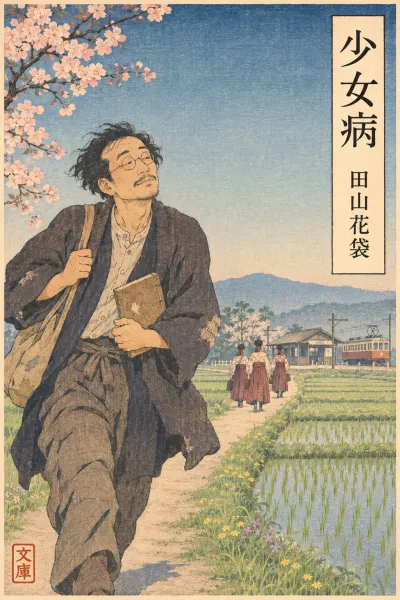
Part 3 of 8 · JLPT N2
少女病(二) Shōjobyō, part 3: A Dropped Hairpin in the Fields
In this part
A middle-aged man has long admired a plump schoolgirl who rides the same train as him at the same hour. One day he passes her on a country path, notices the aluminium hairpin she has dropped, and calls her back to return it, delighted that she will now remember his face. His happiness soon turns into gloomy thoughts about his wasted youth, his ageing wife and his dreary life, until the thought of his stern editor sends him hurrying on his way.
AI translation · independently checked
この娘は自分を忘れはすまいとこの男が思ったのは、理由のあることで、それにはおもしろいエピソードがあるのだ。The man had good reason to believe that this girl would not forget him, and behind that belief lay an amusing episode.
この娘とはいつでも同時刻に代々木から電車に乗って、牛込まで行くので、以前からよくその姿を見知っていたが、それといってあえて口をきいたというのではない。Since she always boarded the tram at Yoyogi at the same hour as he did and rode as far as Ushigome, he had long known her well by sight, though that did not mean he had ever ventured to speak to her.
ただ相対して乗っている、よく肥った娘だなアと思う。He merely sat opposite her and thought, What a well-fleshed girl she is!
あの頬の肉の豊かなこと、乳の大きなこと、りっぱな娘だなどと続いて思う。How full her cheeks were, how large her breasts, what a splendid girl, and so his thoughts ran on.
それがたび重なると、笑顔の美しいことも、耳の下に小さい黒子のあることも、こみ合った電車の吊皮にすらりとのべた腕の白いことも、信濃町から同じ学校の女学生とおりおり邂逅してはすっぱに会話を交じゆることも、なにもかもよく知るようになって、どこの娘かしらん?As this happened time after time, he came to know everything about her: the loveliness of her smile, the small mole beneath her ear, the whiteness of the arm she stretched out gracefully to the strap in the crowded tram, the way she would chatter flippantly with girls from her school whom she now and then met from Shinanomachi on, until he began to wonder whose daughter she might be.
などとその家、その家庭が知りたくなる。And he found himself wanting to know her home and her family.
でもあとをつけるほど気にも入らなかったとみえて、あえてそれを知ろうともしなかったが、ある日のこと、男は例の帽子、例のインバネス、例の背広、例の靴で、例の道を例のごとく千駄谷の田畝にかかってくると、ふと前からその肥った娘が、羽織りの上に白い前懸けをだらしなくしめて、半ば解きかけた髪を右の手で押さえながら、友達らしい娘と何ごとかを語り合いながら歩いてきた。Yet it seemed she did not attract him enough to follow her, and he made no effort to find out; but one day, as the man came along his usual road in the usual way, in his usual hat, his usual Inverness cape, his usual suit and his usual shoes, and reached the rice fields of Sendagaya, that plump girl suddenly appeared ahead of him, walking his way, a white apron tied carelessly over her haori, holding her half-undone hair in place with her right hand as she talked about something with a girl who appeared to be her friend.
いつも逢う顔に違ったところで逢うと、なんだか他人でないような気がするものだが、男もそう思ったとみえて、もう少しで会釈をするような態度をして、急いだ歩調をはたと留めた。When one meets a familiar face in an unfamiliar place, one somehow feels that the person is no stranger, and the man evidently felt so too, for he almost made as if to bow and abruptly checked his hurried stride.
娘もちらとこっちを見て、これも、「あああの人だナ、いつも電車に乗る人だナ」と思ったらしかったが、会釈をするわけもないので、黙ってすれ違ってしまった。The girl, too, glanced his way and seemed to think, "Ah, it's that man, the one who's always on the tram," but as there was no reason for her to bow, they passed each other in silence.
男はすれ違いざまに、「今日は学校に行かぬのかしらん? そうか、試験休みか春休みか」と我知らず口に出して言って、五、六間無意識にてくてくと歩いていくと、ふと黒い柔かい美しい春の土に、ちょうど金屏風に銀で画いた松の葉のようにそっと落ちているアルミニウムの留針。As they passed, the man said aloud without knowing it, "Isn't she going to school today, I wonder? Ah, of course, it must be the examination holiday, or the spring holiday," and when he had trudged on unthinkingly for five or six ken, there, suddenly, on the dark, soft, lovely spring earth, lying quietly like a pine needle painted in silver on a gold folding screen, was an aluminium hairpin.
娘のだ!The girl's!
いきなり、振り返って、大きな声で、He turned around at once and, in a loud voice,
「もし、もし、もし」"Excuse me! Excuse me! Excuse me!"
と連呼した。he called out again and again.
娘はまだ十間ほど行ったばかりだから、むろんこの声は耳に入ったのであるが、今すれ違った大男に声をかけられるとは思わぬので、振り返りもせずに、友達の娘と肩を並べて静かに語りながら歩いていく。The girl had gone no more than ten ken, so of course the voice reached her ears, but as it never occurred to her that the big man she had just passed might be calling to her, she walked on without even turning round, side by side with her friend, talking quietly.
朝日が美しく野の農夫の鋤の刃に光る。The morning sun glittered beautifully on the blade of a farmer's spade in the field.
「もし、もし、もし」"Excuse me! Excuse me! Excuse me!"
と男は韻を押んだように再び叫んだ。the man cried again, as though keeping to a rhyme.
で、娘も振り返る。And so the girl turned round.
見るとその男は両手を高く挙げて、こっちを向いておもしろい恰好をしている。She saw the man facing her with both hands raised high, cutting a comical figure.
ふと、気がついて、頭に手をやると、留針がない。Suddenly it dawned on her, and when she put her hand to her head, the hairpin was gone.
はっと思って、「あら、私、嫌よ、留針を落としてよ」と友達に言うでもなく言って、そのまま、ばたばたとかけ出した。With a start she said, half to her friend and half to no one, "Oh, how dreadful, I've dropped my hairpin!" and at once went running off, pattering along.
男は手を挙げたまま、そのアルミニウムの留針を持って待っている。The man stood waiting, his hand still raised, holding the aluminium hairpin.
娘はいきせき駆けてくる。The girl came running up, out of breath.
やがてそばに近寄った。Soon she drew near.
「どうもありがとう……」"Thank you so much…"
と、娘は恥ずかしそうに顔を赧くして、礼を言った。said the girl, blushing with embarrassment.
四角の輪廓をした大きな顔は、さも嬉しそうににこにこと笑って、娘の白い美しい手にその留針を渡した。The large, square-framed face beamed with every sign of delight as he handed the hairpin into the girl's lovely white hand.
「どうもありがとうございました」"Thank you very much indeed."
と、再びていねいに娘は礼を述べて、そして踵をめぐらした。The girl thanked him once more, politely, and then turned on her heel.
男は嬉しくてしかたがない。The man could not contain his happiness.
愉快でたまらない。He was beside himself with pleasure.
これであの娘、己の顔を見覚えたナ……と思う。Now that girl has come to know my face, he thought.
これから電車で邂逅しても、あの人が私の留針を拾ってくれた人だと思うに相違ない。From now on, when they met on the tram, she would surely think, That is the man who picked up my hairpin.
もし己が年が若くって、娘が今少し別嬪で、それでこういう幕を演ずると、おもしろい小説ができるんだなどと、とりとめもないことを種々に考える。If I were young, and the girl a little prettier, and we played out a scene like this, it would make an amusing novel; he turned over all manner of idle thoughts of this sort.
聯想は聯想を生んで、その身のいたずらに青年時代を浪費してしまったことや、恋人で娶った細君の老いてしまったことや、子供の多いことや、自分の生活の荒涼としていることや、時勢におくれて将来に発達の見込みのないことや、いろいろなことが乱れた糸のように縺れ合って、こんがらがって、ほとんど際限がない。One association bred another: how he had squandered his youth in vain, how the wife he had married for love had grown old, how many children they had, how desolate his own life was, how he had fallen behind the times and had no prospect of advancement, all these things twisted together like tangled thread, snarled up, almost without end.
ふと、その勤めている某雑誌社のむずかしい編集長の顔が空想の中にありありと浮かんだ。Suddenly the face of the difficult chief editor at the magazine where he worked rose vividly in his imaginings.
と、急に空想を捨てて路を急ぎ出した。At that he abruptly cast his daydreams aside and hurried on his way.
Vocabulary
| Word | Meaning | JLPT |
|---|---|---|
| 見知ってみしる | to know by sightdictionary form: 見知るRecognising someone's face without being acquainted with them. | — |
| 邂逅かいこう | chance meeting, encounterLiterary word; 邂逅する means to run into someone. | — |
| はすっぱはすっぱ | flippant, frivolous (of a woman's manner)Often written 蓮っ葉; slightly disapproving. | — |
| 例のれいの | the usual, that sameRepeated here for ironic effect, stressing his unchanging routine. | — |
| 田畝たんぼ | rice fieldsOld spelling of たんぼ (normally 田んぼ). | N2 |
| インバネスいんばねす | Inverness cape (a sleeveless caped overcoat)Fashionable men's overcoat in Meiji Japan, worn over Western or Japanese dress. | — |
| 会釈えしゃく | a slight bow, nod of greetingA light bow to acquaintances, not a deep formal one. | — |
| 連呼れんこ | calling out repeatedly | — |
| いきせきいきせききる | panting, out of breath (from hurrying)dictionary form: 息せき切るHere shortened to いきせき used as an adverb. | — |
| 踵をめぐらしたきびすをめぐらす | to turn on one's heel, turn backdictionary form: 踵をめぐらすLiterary idiom; 踵 (きびす) is an old word for heel. | — |
| 別嬪べっぴん | a beauty, a pretty womanColloquial, somewhat old-fashioned. | — |
| 細君さいくん | wifeOld-fashioned word, used of one's own or another man's wife. | — |
| 荒涼こうりょう | desolate, bleak荒涼としている describes a barren scene or, here, a dreary life. | — |
| 見込みみこみ | prospect, hope見込みがない: there is no chance or prospect. | N1 |
Grammar
〜はすまい N2 will surely not; probably won't
まい attaches to a verb to express negative conjecture or negative intention. 忘れはすまい (from 忘れはしない) means she is not likely to forget, with は adding emphasis.
この娘は自分を忘れはすまいとこの男が思ったのは
That the man believed this girl would not forget him
〜とみえて N2 it seems that…, apparently…
The narrator infers someone's feelings from outward signs and then states what followed. Here it explains why he never followed her home.
でもあとをつけるほど気にも入らなかったとみえて
Yet it seemed she did not attract him enough to follow her
〜ものだ N3 it is natural that…; one tends to…
ものだ after a plain form states a general truth about human nature. The narrator first gives the general rule, then applies it to the man.
いつも逢う顔に違ったところで逢うと、なんだか他人でないような気がするものだが
When one meets a familiar face in an unfamiliar place, one somehow feels that the person is no stranger
〜ざま(に) N1 just as…, at the moment of…
ざま attached to a verb stem marks the very moment an action happens. すれ違いざまに means right as they passed each other.
男はすれ違いざまに、「今日は学校に行かぬのかしらん?
As they passed, the man said, "Isn't she going to school today, I wonder?
〜てしかたがない/〜てたまらない N3 unbearably…, can't help feeling…
Attaches to the te-form of i-adjectives (嬉しくて) and to the で form of na-adjectives or nouns (愉快で) to express a feeling so strong it cannot be contained. The two lines repeat the idea for comic emphasis.
男は嬉しくてしかたがない。
The man could not contain his happiness.
〜に相違ない N2 must surely…; there is no doubt that…
A formal, written equivalent of 〜に違いない, expressing strong certainty. Here it conveys the man's confident fantasy about what the girl will think.
あの人が私の留針を拾ってくれた人だと思うに相違ない。
She would surely think, That is the man who picked up my hairpin.