Part 2 of 8 · JLPT N1
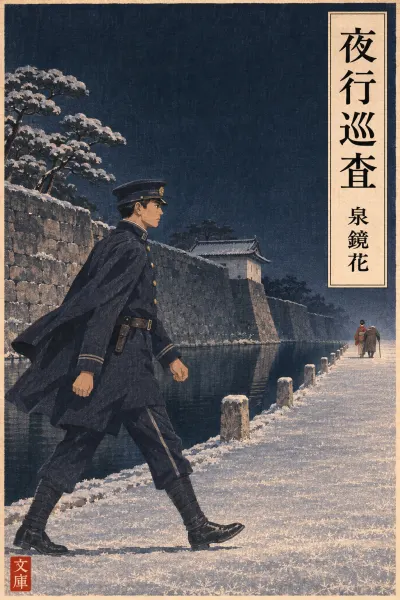
夜行巡査 Yakōjunsa, part 2: The Constable's Unswerving Night Patrol
In this part
Angered by the old rickshaw man's story, the young workman curses the strict policeman and offers to treat the old man to a drink. The narrative then turns to that policeman, Hatta Yoshinobu, and describes his perfectly regular stride, his piercing eyes that miss no detail ahead of him, and his total confidence that he never needs to look behind him.
AI translation · independently checked
いと長々しき繰り言をまだるしとも思わで聞きたる壮佼は一方ならず心を動かし、The young fellow, who had listened to this very long-winded grievance without finding it the least bit tedious, was moved beyond all measure,
「爺さん、いやたあ謂われねえ、むむ、もっともだ。聞きゃ一人息子が兵隊になってるというじゃねえか、おおかた戦争にも出るんだろう、そんなことなら黙っていないで、どしどし言い籠めて隙あ潰さした埋め合わせに、酒代でもふんだくってやればいいに」"Grandpa, I can't say no to that. Hmm, you've every right. And from what I hear, your only son's gone for a soldier, ain't he? Likely he'll be off to the war, too. If that's how things stand, you oughtn't to have kept quiet. You should've argued him down good and proper and squeezed some drink money out of him to make up for the time he made you waste."
「ええ、めっそうな、しかし申しわけのためばかりに、そのことも申しましたなれど、いっこうお肯き入れがござりませんので」"Oh, heavens, I'd never dare! Still, just to excuse myself, I did mention that too, sir, but he wouldn't listen to a word of it."
壮佼はますます憤りひとしお憐れみて、The young fellow grew ever more indignant and pitied the old man all the more,
「なんという木念人だろう、因業な寒鴉め、といったところで仕方もないかい。ときに爺さん、手間は取らさねえからそこいらまでいっしょに歩びねえ。"What a blockhead! A heartless winter crow, that one. Though there's no use saying so, I suppose. Say, Grandpa, I won't keep you long, so walk along with me a little way.
股火鉢で五合とやらかそう。ナニ遠慮しなさんな、ちと相談もあるんだからよ。はて、いいわな。We'll straddle a brazier and put away a good five gō of sake. Now, don't you be shy. I've got a little something to talk over with you, see. Come on, it's fine.
おめえ稼業にも似合わねえ。ばかめ、こんな爺さんを掴めえて、剣突もすさまじいや、なんだと思っていやがんでえ、こう指一本でも指してみろ、今じゃおいらが後見だ」It ain't fitting for a man in your line of work. The fool! Grabbing hold of an old man like this and giving him such a savage tongue-lashing. Who does he think he is? Just let him try pointing so much as one finger at you. From now on, I'm your protector."
憤慨と、軽侮と、怨恨とを満たしたる、視線の赴くところ、麹町一番町英国公使館の土塀のあたりを、柳の木立ちに隠見して、角燈あり、南をさして行く。His gaze was full of indignation, contempt and resentment, and where it fell, along the earthen wall of the British Legation in Kōjimachi Ichibanchō, now glimpsed and now hidden among a stand of willows, there was a square lantern moving southward.
その光は暗夜に怪獣の眼のごとし。Its light was like the eye of a monstrous beast in the dark of night.
二Two
公使館のあたりを行くその怪獣は八田義延という巡査なり。That beast passing along by the Legation was a constable named Hatta Yoshinobu.
渠は明治二十七年十二月十日の午後零時をもって某町の交番を発し、一時間交替の巡回の途に就けるなりき。At twelve o'clock midnight on the tenth of December in the twenty-seventh year of Meiji, he had set out from the police box of a certain district and taken to the road on his patrol, one of the hourly shifts.
その歩行や、この巡査には一定の法則ありて存するがごとく、晩からず、早からず、着々歩を進めて路を行くに、身体はきっとして立ちて左右に寸毫も傾かず、決然自若たる態度には一種犯すべからざる威厳を備えつ。As for his gait, it was as though this constable followed some fixed law: neither slow nor fast, he advanced along the road step by steady step, his body held stiffly upright and leaning not a hair's breadth to left or right, and his resolute, unshakeable bearing was invested with a kind of dignity that none might violate.
制帽の庇の下にものすごく潜める眼光は、機敏と、鋭利と厳酷とを混じたる、異様の光に輝けり。The gaze that lurked so fearsomely beneath the peak of his uniform cap shone with a strange light, a mingling of alertness, sharpness and severity.
渠は左右のものを見、上下のものを視むるとき、さらにその顔を動かし、首を掉ることをせざれども、瞳は自在に回転して、随意にその用を弁ずるなり。When he looked at things to left and right, or surveyed things above and below, he never moved his face or turned his head; yet his pupils rolled freely and served his purpose at will.
されば路すがらの事々物々、たとえばお堀端の芝生の一面に白くほの見ゆるに、幾条の蛇の這えるがごとき人の踏みしだきたる痕を印せること、英国公使館の二階なるガラス窓の一面に赤黒き燈火の影の射せること、その門前なる二柱のガス燈の昨夜よりも少しく暗きこと、往来のまん中に脱ぎ捨てたる草鞋の片足の、霜に凍て附きて堅くなりたること、路傍にすくすくと立ち併べる枯れ柳の、一陣の北風に颯と音していっせいに南に靡くこと、はるかあなたにぬっくと立てる電燈局の煙筒より一縷の煙の立ち騰ること等、およそ這般のささいなる事がらといえども一つとしてくだんの巡査の視線以外に免るることを得ざりしなり。And so, of all the things and happenings along his way, not one escaped the gaze of this constable, however trifling such matters might be: that across the whole of the lawn by the moat, glimmering faintly white, were printed the tracks people had trampled, like so many crawling snakes; that a dull red lamplight shone across the glass windows on the upper floor of the British Legation; that the two gas lamps before its gate were a little dimmer than the night before; that a single straw sandal, cast off in the middle of the street, had frozen fast in the frost and gone hard; that the withered willows standing tall in a row by the roadside rustled at a gust of north wind and bowed all together to the south; and that from the chimney of the power station, looming far off in the distance, a thin thread of smoke was rising.
しかも渠は交番を出でて、路に一個の老車夫を叱責し、しかしてのちこのところに来たれるまで、ただに一回も背後を振り返りしことあらず。What is more, from the time he left the police box, rebuked an old rickshaw man on the road, and then came to this spot, he had not looked back even once.
渠は前途に向かいて着眼の鋭く、細かに、きびしきほど、背後には全く放心せるもののごとし。The keener, the more minute and the stricter his watch on the way ahead, the more he seemed wholly heedless of what lay behind him.
いかんとなれば背後はすでにいったんわが眼に検察して、異状なしと認めてこれを放免したるものなればなり。For what lay behind him he had already inspected once with his own eyes, found nothing amiss, and released.
兇徒あり、白刃を揮いて背後より渠を刺さんか、巡査はその呼吸の根の留まらんまでは、背後に人あるということに、思いいたることはなかるべし。Should some ruffian swing a naked blade and stab him from behind, the constable would surely never realise that anyone stood behind him until the very root of his breath had ceased.
他なし、渠はおのが眼の観察の一度達したるところには、たとい藕糸の孔中といえども一点の懸念をだに遺しおかざるを信ずるによれり。The reason was simply this: he believed that wherever the observation of his eyes had once reached, he left behind not one speck of doubt, not even in the hollow of a lotus-root fibre.
Vocabulary
| Word | Meaning | JLPT |
|---|---|---|
| 繰り言くりごと | repetitive complaint; grumbling told over and overFrom 繰る (to reel in), as in going over the same thing again and again. | — |
| 一方ならずひとかたならず | extraordinarily; beyond measureLiterary; literally 'not of just one kind'. | — |
| 酒代さかて | drink money; a tipOld word for a gratuity given to workers or rickshaw men, as if 'for sake'. | — |
| めっそうなめっそう | heavens, no! (I would never)dictionary form: 滅相Humble, horrified refusal; still heard today as めっそうもない. | — |
| 木念人ぼくねんじん | blockhead; unfeeling, wooden persondictionary form: 朴念仁Usually written 朴念仁; here the kanji 木 ('wood') stresses the stiffness. | — |
| 因業いんごう | heartless; cruel and stubbornOriginally a Buddhist word for karma; colloquially used for a hard-hearted person. | — |
| 剣突けんつく | harsh scolding; a sharp rebuffColloquial; 剣突を食わせる means 'to snap at someone'. | — |
| 後見こうけん | protector; backer; guardianToday mostly a legal term for a guardian. | — |
| 角燈かくとう | square hand lanternThe lantern carried by Meiji police on night patrol. | — |
| 巡回じゅんかい | patrol; roundRelated to 巡査 (patrol constable): both use 巡 'go around'. | — |
| 威厳いげん | dignity; commanding presence | — |
| 自若じじゃく | calm and unshakenOften in the set phrase 泰然自若 (perfectly composed). | — |
| 放心ほうしん | inattention; leaving the mind off somethingToday usually 'absent-mindedness' or 'being dazed'. | — |
| 白刃はくじん | naked blade; drawn sword | — |
Grammar
〜で (classical negative) N1 without doing ~
In classical Japanese, で after the negative stem means 'without ~ing', like modern 〜ないで. 思わで is the same as 思わないで.
まだるしとも思わで聞きたる
who had listened without finding it tedious
〜のごとし / 〜がごとく N1 like ~; as if ~
ごとし is the literary form of 〜のようだ. It attaches to nouns with の and to verbs with が, and it takes the adverbial form ごとく before a following clause.
その光は暗夜に怪獣の眼のごとし。
Its light was like the eye of a monstrous beast in the dark of night.
〜べからざる N1 must not be ~; cannot be ~
べからず is the negative of the classical べし, and the form べからざる modifies a noun. 犯すべからざる威厳 is a dignity that cannot or must not be violated.
一種犯すべからざる威厳を備えつ
was invested with a kind of dignity that none might violate
〜といえども N1 even though ~; even if ~
This is a formal concessive like 〜でも or 〜けれども. Here it stresses that even the smallest matters did not escape his eyes.
およそ這般のささいなる事がらといえども
however trifling such matters might be
〜んか (hypothetical) N1 suppose ~ were to happen
ん is the classical volitional or conjectural auxiliary (む), and with か it sets up an imagined situation, 'what if ~'. The result follows with the conjectural べし: なかるべし means 'surely there would be none'.
白刃を揮いて背後より渠を刺さんか
Should he swing a naked blade and stab him from behind
Edo dialect 〜ねえ / 〜たあ N2 rough Tokyo speech: 〜ない, 〜とは
Rough Tokyo (Edo) speech: 〜ない becomes 〜ねえ, and particles fuse with the preceding word (とは→たあ, 暇を→ひまあ). いやたあ謂われねえ means いやとは言われない, 'I can't say no (to that)', so the speaker is agreeing with the old man.
爺さん、いやたあ謂われねえ、むむ、もっともだ
Grandpa, I can't say you're wrong. Hmm, you've every right.