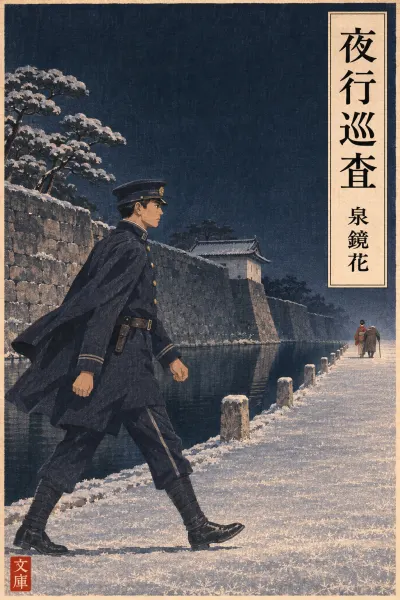
Part 3 of 8 · JLPT N1
夜行巡査 Yakōjunsa, part 3: No Mercy for a Freezing Mother
In this part
On his patrol, Constable Hatta finds a ragged beggar woman sheltering under a gateway with her baby, trying to keep the child warm. Although she begs to stay just a little while because of the cold, he coldly orders her to move on, saying the rules make no exception. The scene then shifts to a young beauty who is leading her drunken old uncle along the moat late at night and notices a constable approaching.
AI translation · independently checked
ゆえに渠は泰然と威厳を存して、他意なく、懸念なく、悠々としてただ前途のみを志すを得るなりけり。Therefore he could keep his calm and his dignity and, with no other thought and no misgiving, set his mind serenely upon the road ahead and nothing else.
その靴は霜のいと夜深きに、空谷を鳴らして遠く跫音を送りつつ、行く行く一番町の曲がり角のややこなたまで進みけるとき、右側のとある冠木門の下に踞まれる物体ありて、わが跫音に蠢けるを、例の眼にてきっと見たり。His boots set the empty hollows ringing in that deep and frosty night and sent their echoing footfalls far ahead. As he went steadily on to a point a little short of the corner of Ichibanchō, he noticed something crouched beneath a crossbeam gate on the right, stirring at the sound of his steps, and he fixed a sharp look on it with those eyes of his.
八田巡査はきっと見るに、こはいと窶々しき婦人なりき。When Constable Hatta looked sharply, he saw that it was a most wretchedly shabby woman.
一個の幼児を抱きたるが、夜深けの人目なきに心を許しけん、帯を解きてその幼児を膚に引き緊め、着たる襤褸の綿入れを衾となして、少しにても多量の暖を与えんとせる、母の心はいかなるべき。She held a small child in her arms. Perhaps, with no eyes upon her in the dead of night, she had let down her guard: she had undone her sash, pressed the child close against her bare skin, and made a coverlet of the ragged padded robe she wore, so as to give it even a little more warmth. What must a mother's heart have been then?
よしやその母子に一銭の恵みを垂れずとも、たれか憐れと思わざらん。Even if one bestowed not a single sen of charity upon that mother and child, who would not feel pity for them?
しかるに巡査は二つ三つ婦人の枕頭に足踏みして、Yet the constable stamped his feet two or three times by the woman's head,
「おいこら、起きんか、起きんか」"Hey, you there! Get up, won't you? Get up!"
と沈みたる、しかも力を籠めたる声にて謂えり。he said, in a voice that was low and yet full of force.
婦人はあわただしく蹶ね起きて、急に居住まいを繕いながら、The woman sprang up in a fluster and, hastily putting herself in a proper posture,
「はい」と答うる歯の音も合わず、そのまま土に頭を埋めぬ。"Yes, sir," she answered, her teeth chattering, and then, just as she was, she bowed her head down to the very earth.
巡査は重々しき語気をもて、In a weighty tone, the constable said,
「はいではない、こんな処に寝ていちゃあいかん、疾く行け、なんという醜態だ」"Never mind 'yes, sir.' You can't go sleeping in a place like this. Move along at once. What a disgraceful sight!"
と鋭き音調。His tone was sharp.
婦人は恥じて呼吸の下にて、The woman, ashamed, said under her breath,
「はい、恐れ入りましてございます」"Yes, sir. I am most dreadfully sorry, sir."
かく打ち謝罪るときしも、幼児は夢を破りて、睡眠のうちに忘れたる、饑えと寒さとを思い出し、あと泣き出だす声も疲労のために裏涸れたり。Just as she was apologising thus, the child woke from its dreams, remembered the hunger and cold it had forgotten in sleep, and burst out crying, its voice hoarse and thin from exhaustion.
母は見るより人目も恥じず、慌てて乳房を含ませながら、The moment the mother saw this, heedless of anyone's eyes, she hurriedly gave it her breast and said,
「夜分のことでございますから、なにとぞ旦那様お慈悲でございます。大眼に御覧あそばして」"It is so late at night, sir, so I beg you, master, have mercy on us. Please be so kind as to overlook it."
巡査は冷然として、The constable answered coldly,
「規則に夜昼はない。寝ちゃあいかん、軒下で」"The rules make no difference between night and day. You can't sleep here, under the eaves."
おりからひとしきり荒ぶ風は冷を極めて、手足も露わなる婦人の膚を裂きて寸断せんとせり。Just then a gust of wind raged for a while, bitter beyond measure, as if to rend the bare-limbed woman's skin and cut it into shreds.
渠はぶるぶると身を震わせ、鞠のごとくに竦みつつ、She shook all over and huddled up like a ball,
「たまりません、もし旦那、どうぞ、後生でございます。しばらくここにお置きあそばしてくださいまし。この寒さにお堀端の吹き曝しへ出ましては、こ、この子がかわいそうでございます。いろいろ災難に逢いまして、にわかの物貰いで勝手は分りませず……」といいかけて婦人は咽びぬ。"I can't bear it. Oh, master, please, I beg you, for pity's sake. Let me stay here just a little while, I pray you. If I go out on the windswept moat-side in this cold, m-my poor child will suffer so. I have met with all sorts of misfortune, and I've only just been forced to beg, so I don't know how things are done..." She began to say this and then choked with sobs.
これをこの軒の主人に請わば、その諾否いまだ計りがたし。Had she asked this of the master of the house whose eaves these were, whether he would have consented or refused could not be told.
しかるに巡査は肯き入れざりき。But the constable would not give ear to her.
「いかん、おれがいったんいかんといったらなんといってもいかんのだ。たといきさまが、観音様の化身でも、寝ちゃならない、こら、行けというに」"No. Once I've said no, it's no, whatever you say. Even if you were Kannon herself in human form, you couldn't sleep here. Come on, I told you to move!"
三Three
「伯父さんおあぶのうございますよ」"Uncle, do be careful, it's dangerous."
半蔵門の方より来たりて、いまや堀端に曲がらんとするとき、一個の年紀少き美人はその同伴なる老人の蹣跚たる酔歩に向かいて注意せり。Coming from the direction of Hanzōmon and just about to turn onto the moat-side road, a young beauty was warning the old man with her about his tottering, drunken steps.
渠は編み物の手袋を嵌めたる左の手にぶら提灯を携えたり。In her left hand, gloved in knitted wool, she carried a hand lantern.
片手は老人を導きつつ。With her other hand she guided the old man.
伯父さんと謂われたる老人は、ぐらつく足を蹈み占めながら、The old man called Uncle, planting his unsteady feet firmly, said,
「なに、だいじょうぶだ。あれんばかしの酒にたべ酔ってたまるものかい。ときにもう何時だろう」"Bah, I'm fine. As if I'd get drunk on a drop like that! By the way, what time would it be now?"
夜は更けたり。The night had grown late.
天色沈々として風騒がず。The sky lay deep and still, and no wind stirred.
見渡すお堀端の往来は、三宅坂にて一度尽き、さらに一帯の樹立ちと相連なる煉瓦屋にて東京のその局部を限れる、この小天地寂として、星のみひややかに冴え渡れり。The road along the moat, as far as the eye could see, came to an end once at Miyakezaka; beyond, a belt of trees and the brick buildings joined to them marked off that corner of Tokyo, and this little world lay hushed, with only the stars shining cold and clear.
美人は人ほしげに振り返りぬ。The beauty looked back, as if longing for some human company.
百歩を隔てて黒影あり、靴を鳴らしておもむろに来たる。A hundred paces off there was a dark figure, approaching slowly with ringing boots.
「あら、巡査さんが来ましたよ」"Oh, look, here comes a policeman."
Vocabulary
| Word | Meaning | JLPT |
|---|---|---|
| 威厳いげん | dignity, authorityOften used of officials and people in power. | — |
| 霜しも | frost | N3 |
| 冠木門かぶきもん | gateway with a crossbeam over two postsA traditional gate style of samurai residences. | — |
| 窶々しきやつやつしい | shabby, wretched-lookingdictionary form: 窶々しいLiterary; related to やつれる 'to become haggard'. | — |
| 襤褸らんる | rags, tattered clothesAlso read ぼろ in everyday Japanese. | — |
| 憐れあわれ | pitiful; pitydictionary form: 哀れ・憐れ憐れと思う = to feel pity for. | — |
| 醜態しゅうたい | disgraceful sight, shameful behaviour | — |
| 慈悲じひ | mercy, compassionOriginally a Buddhist term; お慈悲 is used when pleading. | — |
| 大眼に御覧あそばしておおめにみる | to overlook, to let something pass (written here with the variant 大眼 for 大目; 御覧あそばす is an honorific form, so the phrase means 'please be so kind as to overlook it')dictionary form: 大目に見るUsually written 大目に見る; here in very humble-polite form. | — |
| 規則きそく | rule, regulation | N4 |
| 軒下のきした | the space under the eaves | — |
| 後生ごしょう | for pity's sake, I beg youLiterally 'the next life'; 後生だから is a desperate plea. | — |
| 物貰いものもらい | beggar; beggingIn modern Japanese it can also mean a sty on the eye. | — |
| 化身けしん | incarnation, a deity in human form観音様 is Kannon, the bodhisattva of mercy. | — |
Grammar
〜を得る(うる) N1 to be able to do
Attached to a verb in the plain non-past form plus を, 得る (literary reading うる) expresses possibility. Here it says he 'was able to' aim at the road ahead without worry.
ただ前途のみを志すを得るなりけり
he could set his mind on the road ahead and nothing else
〜ずとも / 〜ざらん N1 even if not ~ / would surely not ~
ず is the classical negative; ずとも means 'even without doing'. ざらん is negative plus the conjecture ん, and with たれか it makes a rhetorical question: 'who would not...?'
よしやその母子に一銭の恵みを垂れずとも、たれか憐れと思わざらん
Even if one gave not a single sen, who would not feel pity?
〜んか N2 won't you ~? (rough command)
ん is a colloquial negative (= ない), and 起きんか literally asks 'won't you get up?', which works as a gruff order. It suits the constable's curt, official tone.
おいこら、起きんか、起きんか
Hey, you there! Get up, won't you? Get up!
〜ちゃあいかん / 〜ちゃならない N4 you must not ~
ちゃ is the spoken contraction of ては; with いかん (= いけない) or ならない it forbids an action. The stretched ちゃあ adds emphasis.
こんな処に寝ていちゃあいかん
You can't go sleeping in a place like this
たとい〜でも N2 even if ~
たとい (modern たとえ) introduces an extreme supposition, and でも completes it. The constable means that no exception could ever be made.
たといきさまが、観音様の化身でも、寝ちゃならない
Even if you were Kannon herself in human form, you couldn't sleep here
〜てたまるものか N1 as if I would ~! / I'd never ~
This emphatic rhetorical form flatly denies that something could happen ('as if I would...!'). The uncle insists that so little sake could never make him drunk.
あれんばかしの酒にたべ酔ってたまるものかい
As if I'd get drunk on a drop like that!