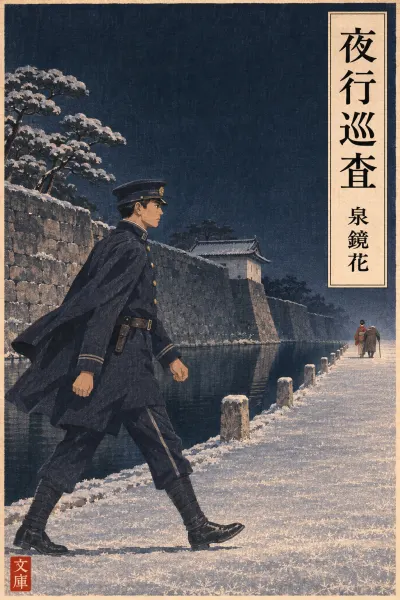
Part 5 of 8 · JLPT N1
夜行巡査 Yakōjunsa, part 5: The Uncle's Cruel Reason Revealed
In this part
On the street, the uncle tells his niece Okō why he refused the constable's suit. He says it was not about money or rank: he knows she truly loves the man, and he wants to keep her longing for him and enjoy her suffering. When Okō protests at his cruelty and asks what displeases him, he claims he is very fond of her and that this is exactly why he stands in her way. She then asks whether the constable has wronged him.
AI translation · independently checked
真顔になりて謂う風情、酒の業とも思われざりき。So earnest was his face as he spoke that it could scarcely be thought the work of drink.
女はようよう口を開き、At length the girl opened her mouth:
「伯父さん、あなたまあ往来で、何をおっしゃるのでございます。早く帰ろうじゃございませんか」"Uncle, really, what are you saying, out here in the public street? Do let us hurry home."
と老人の袂を曳き動かし急ぎ巡査を避けんとするは、聞くに堪えざる伯父の言を渠の耳に入れじとなるを、伯父は少しも頓着せで、平気に、むしろ聞こえよがしに、So saying, she tugged at the old man's sleeve and made haste to get away from the constable, for she wished to keep her uncle's unbearable words from reaching his ears. Yet the uncle paid not the slightest heed, and calmly, indeed as though he meant to be overheard, went on:
「あれもさ、巡査だから、おれが承知しなかったと思われると、何か身分のいい官員か、金満でも択んでいて、月給八円におぞ毛をふるったようだが、そんな賤しい了簡じゃない。"Now, about that fellow. Since he's a constable, people might think I refused him because I was holding out for some official of good standing or a man of money, that I turned up my nose at eight yen a month. But my notions aren't as low as that.
おまえのきらいな、いっしょになると生き血を吸われるような人間でな、たとえばかったい坊だとか、高利貸しだとか、再犯の盗人とでもいうような者だったら、おれは喜んで、くれてやるのだ。Had he been a man you loathed, the sort who'd suck the very lifeblood out of you once you were married, say a leper, or a moneylender, or a thief caught for the second time, I'd have handed you over to him gladly.
乞食ででもあってみろ、それこそおれが乞食をしておれの財産をみなそいつに譲って、夫婦にしてやる。Suppose he were a beggar. Why, then I'd turn beggar myself, give my whole fortune to the fellow, and make the two of you man and wife.
え、お香、そうしておまえの苦しむのを見て楽しむさ。けれどもあの巡査はおまえが心からすいてた男だろう。Eh, Okō? And then I'd take my pleasure in watching you suffer. But that constable is the man you've loved with all your heart, isn't he?
あれと添われなけりゃ生きてる効がないとまでに執心の男だ。そこをおれがちゃんと心得てるから、きれいさっぱりと断わった。He's the man you're so set on that you'd say life isn't worth living unless you can marry him. And because I understand that perfectly well, I turned him down, clean and flat.
なんと慾のないもんじゃあるまいか。そこでいったんおれが断わった上はなんでもあきらめてくれなければならないと、普通の人間ならいうところだが、おれがのはそうじゃない。Now, isn't that free of greed on my part? An ordinary man would say that once I've refused, you must give him up whatever happens. But that's not my way.
伯父さんがいけないとおっしゃったから、まあ私も仕方がないと、おまえにわけもなく断念めてもらった日にゃあ、おれが志も水の泡さ、形なしになる。If you were to give him up without a struggle, saying, 'Uncle has said no, so I suppose there's nothing to be done,' then my whole purpose would come to nothing. It would be utterly spoiled.
ところで、恋というものは、そんなあさはかなもんじゃあない。なんでも剛胆なやつが危険な目に逢えば逢うほど、いっそう剛胆になるようで、何かしら邪魔がはいれば、なおさら恋しゅうなるものでな、とても思い切れないものだということを知っているから、ここでおもしろいのだ。But love is no such shallow thing as that. A bold fellow grows bolder the more danger he meets, and in the same way love only grows fonder whenever something gets in its way. I know you can never bring yourself to give him up, and that's where the fun of it lies.
どうだい、おまえは思い切れるかい、うむ、お香、今じゃもうあの男を忘れたか」Well? Can you give him up? Hm, Okō? Have you forgotten that man by now?"
女はややしばらく黙したるが、The girl was silent for some little while,
「い……い……え」ときれぎれに答えたり。and then answered, in broken fragments, "N... n... no."
老夫は心地よげに高く笑い、The old man laughed aloud with evident relish.
「むむ、もっともだ。そうやすっぽくあきらめられるようでは、わが因業も価値がねえわい。これ、後生だからあきらめてくれるな。まだまだ足りない、もっとその巡査を慕うてもらいたいものだ」"Mm, quite right. If you could give him up as cheaply as that, all my wickedness wouldn't be worth a thing. Here now, I beg you, don't you give him up. It's not nearly enough yet. I want you to pine for that constable more still."
女はこらえかねて顔を振り上げ、Unable to bear it any longer, the girl lifted her face.
「伯父さん、何がお気に入りませんで、そんな情けないことをおっしゃいます、私は、……」と声を飲む。"Uncle, what is it that displeases you so, that you say such cruel things? I..." Her voice caught in her throat.
老夫は空嘯き、The old man looked away, unconcerned.
「なんだ、何がお気に入りません? 謂うな、もったいない。なんだってまたおそらくおまえほどおれが気に入ったものはあるまい。"What's that? 'What displeases you?' Don't say such things. It's an ungrateful thing to say. Why, there's likely nothing in the world that pleases me as much as you do.
第一容色はよし、気立てはよし、優しくはある、することなすこと、おまえのことといったら飯のくいようまで気に入るて。To begin with, you're pretty, you're good-natured, you're gentle. Everything you do, everything about you pleases me, down to the way you eat your rice.
しかしそんなことで何、巡査をどうするの、こうするのという理窟はない。たといおまえが何かの折に、おれの生命を助けてくれてさ、生命の親と思えばとても、けっして巡査にゃあ遣らないのだ。But none of that is any reason for me to do this or that about the constable. Even if you were to save my life some day, and I looked on you as the one I owed my life to, I would still never give you to that constable.
おまえが憎い女ならおれもなに、邪魔をしやあしねえが、かわいいから、ああしたものさ。If you were a girl I hated, why, I wouldn't stand in your way. It's because I'm fond of you that I've done what I did.
気に入るの入らないのと、そんなこたあ言ってくれるな」So don't go talking to me about pleasing and displeasing."
女は少しきっとなり、The girl turned a little stern.
「それではあなた、あのおかたになんぞお悪いことでもございますの」"Then, Uncle, has that gentleman done you some wrong?"
Vocabulary
| Word | Meaning | JLPT |
|---|---|---|
| 風情ふぜい | air, manner, appearanceHere it means the way he looked as he spoke. It can also mean 'elegance' or 'charm'. | — |
| 袂たもと | the long, hanging sleeve of a kimonoTugging at someone's 袂 is a typical way of urging them along. | — |
| 頓着とんじゃく | concern, heedUsually used with a negative: 頓着しない means 'not to care at all'. Also read とんちゃく. | — |
| 了簡りょうけん | way of thinking, intention, attitudeAn old-fashioned word, often used in phrases like 了簡が狭い (narrow-minded). | — |
| 高利貸しこうりがし | moneylender, loan shark高利 means 'high interest'. A common villain in Meiji fiction. | — |
| 執心しゅうしん | attachment, strong devotion to someoneImplies an obsessive, clinging attachment. | — |
| 心得てるこころえる | to understand fully, to be well aware ofdictionary form: 心得る心得てる is the casual contraction of 心得ている. | N2 |
| 水の泡みずのあわ | coming to nothing (literally 'a bubble on the water')Used in the set phrase 水の泡になる, 'to be wasted'. | — |
| 危険けんのん | dangerous, riskydictionary form: 剣呑Old colloquial word. Here it is written with the kanji for 危険 but read けんのん. | — |
| 剛胆ごうたん | bold, fearlessAlso written 豪胆. 胆 means 'liver', which was thought of as the seat of courage. | — |
| 因業いんごう | cruelty, heartlessnessOriginally a Buddhist term for karma. Later it came to mean a hard-hearted, merciless person or deed. | — |
| 後生ごしょう | (in 後生だから) 'I beg you, for pity's sake'Literally 'the next life'. When read こうせい, it means 'younger generation'. | — |
| 空嘯きそらうそぶく | to look away as if unconcerned, to feign indifferencedictionary form: 空嘯くA literary verb. | — |
| 容色きりょう | good looks (of a woman)dictionary form: 器量Written 容色 (normally read ようしょく) but glossed as きりょう. 器量よし means 'a beauty'. | — |
Grammar
〜ざりき N1 did not ~ (classical negative + past)
ざり is the classical negative auxiliary ず, and き marks direct past. 思われざりき therefore equals modern 思われなかった.
酒の業とも思われざりき。
It could scarcely be thought the work of drink.
〜じ N1 will not ~, intend not to ~ (classical negative volition)
じ attaches to the 未然形 (irrealis form) and expresses a determination not to do something. 入れじ means 'I will not let it enter', which describes Okō's wish to keep the words from Hatta's ears.
聞くに堪えざる伯父の言を渠の耳に入れじとなるを
because she wished to keep her uncle's unbearable words from reaching his ears
〜よがしに N1 as if to make a show of ~, pointedly
Attached to an imperative form, it describes doing something openly so that others will notice. 聞こえよがしに means speaking deliberately so that someone will overhear.
平気に、むしろ聞こえよがしに
calmly, indeed as though he meant to be overheard
〜た日には(日にゃあ) N1 if it came to ~, should ~ happen (usually with a bad result)
This sets up a situation and then states the unwelcome consequence. 日にゃあ is the colloquial contraction of 日には.
おまえにわけもなく断念めてもらった日にゃあ、おれが志も水の泡さ
If you were to give him up without a struggle, my whole purpose would come to nothing.
〜ば〜ほど N3 the more ~, the more ~
The same verb is repeated, first in the ば form and then before ほど. Together they show that one thing increases along with another.
危険な目に逢えば逢うほど、いっそう剛胆になる
grows bolder the more danger he meets
〜てくれるな N3 please don't ~ (for my sake)
This is くれる followed by the prohibitive な. It is a blunt, masculine request not to do something. The uncle uses it ironically to beg Okō not to give up her love.
後生だからあきらめてくれるな
I beg you, don't you give him up.