Part 7 of 8 · JLPT N1
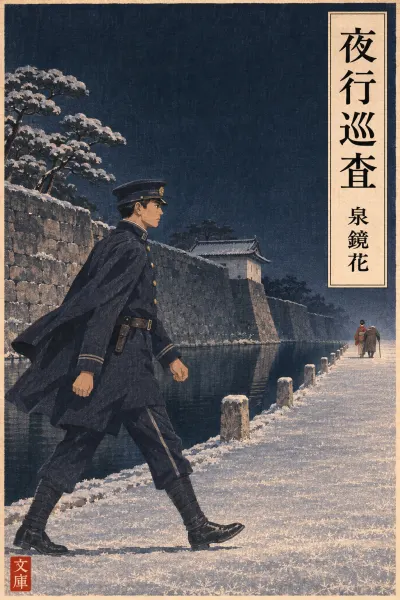
夜行巡査 Yakōjunsa, part 7: Okō's Despair at the Moat's Edge
In this part
The drunken uncle keeps tormenting Okō with threats, while Hatta, patrolling behind them, refuses to break his fixed pace and routine even though every word pains him. When the uncle swears that Okō will die with him, she breaks free and leaps onto the moat bank. Thinking she will drown herself, the old man lunges after her, slips on the frost and falls into the icy water. Okō clings to Hatta, who coldly climbs the embankment with his lantern to look for the old man.
AI translation · independently checked
眼にいっぱいの涙を湛えて、お香はわなわなふるえながら、両袖を耳にあてて、せめて死刑の宣告を聞くまじと勤めたるを、老夫は残酷にも引き放ちて、Her eyes brimming with tears and her whole body trembling, Okō pressed both sleeves to her ears, striving at least not to hear her sentence of death; but the old man cruelly pulled them away,
「あれ!」と背くる耳に口、and as she turned her ear aside with a cry of "Oh!", he put his mouth close to it:
「どうだ、解ったか。なんでも、少しでもおまえが失望の苦痛をよけいに思い知るようにする。そのうち巡査のことをちっとでも忘れると、それ今夜のように人の婚礼を見せびらかしたり、気の悪くなる談話をしたり、あらゆることをして苛めてやる」"Well, do you understand now? Whatever it takes, I'll make you feel the pain of disappointment all the more, even if only a little. And if you ever forget that policeman for a moment, why, I'll parade other folks' weddings before you as I did tonight, I'll tell you stories to turn your stomach, I'll torment you in every way there is."
「あれ、伯父さん、もう私は、もう、ど、どうぞ堪忍してくださいまし。お放しなすって、え、どうしょうねえ」"Oh, Uncle, I can't, not any more, p-please, I beg you, forgive me. Let me go, oh, what am I to do!"
とおぼえず、声を放ちたり。Without meaning to, she cried out aloud.
少し距離を隔てて巡行せる八田巡査は思わず一足前に進みぬ。Constable Hatta, patrolling a little distance behind, involuntarily took a step forward.
渠はそこを通り過ぎんと思いしならん。He had probably meant to pass that spot by.
さりながらえ進まざりき。Yet he could not go forward.
渠は立ち留まりて、しばらくして、たじたじとあとに退りぬ。He halted, and after a while fell back, faltering.
巡査はこのところを避けんとせしなり。The constable had meant to avoid this spot.
されども渠は退かざりき。And yet he did not withdraw.
造次の間八田巡査は、木像のごとく突っ立ちぬ。For one fleeting moment Constable Hatta stood rooted to the ground like a wooden statue.
さらに冷然として一定の足並みをもて粛々と歩み出だせり。Then, once more coldly composed, he set off solemnly at his fixed and measured pace.
ああ、恋は命なり。Ah, love is life itself!
間接にわれをして死せしめんとする老人の談話を聞くことの、いかに巡査には絶痛なりしよ。How exquisitely painful it must have been for the constable to hear the old man's words, which sought, however indirectly, to drive him to his death!
ひとたび歩を急にせんか、八田は疾に渠らを通り越し得たりしならん、あるいはことさらに歩をゆるうせんか、眼界の外に渠らを送遣し得たりしならん。Had he but quickened his step, Hatta could long since have passed them by; or, had he deliberately slowed it, he could have let them pass beyond his sight.
されども渠はその職掌を堅守するため、自家が確定せし平時における一式の法則あり。But in order to keep faithfully to his duties, he had a set of rules for ordinary times, fixed by his own hand.
交番を出でて幾曲がりの道を巡り、再び駐在所に帰るまで、歩数約三万八千九百六十二と。From leaving the police box, along the many turnings of his route, until returning once more to the post: some thirty-eight thousand, nine hundred and sixty-two paces.
情のために道を迂回し、あるいは疾走し、緩歩し、立停するは、職務に尽くすべき責任に対して、渠が屑しとせざりしところなり。To turn aside from his road for the sake of feeling, or to run, or to dawdle, or to stand still, was something he did not deem honourable, set against his responsibility to give himself wholly to his duty.
六VI
老人はなお女の耳を捉えて放たず、負われ懸くるがごとくにして歩行きながら、The old man, still holding the girl by the ear and never letting go, walked on as though he were hanging upon her back,
「お香、こうは謂うもののな、おれはおまえが憎かあない、死んだ母親にそっくりでかわいくってならないのだ。"Okō, for all I talk like this, see, I don't hate you. You're the very image of your dead mother, and I can't help but love you.
憎いやつなら何もおれが仕返しをする価値はないのよ。だからな、食うことも衣ることも、なんでもおまえの好きなとおり、おりゃ衣ないでもおまえには衣せる。If it was somebody I hated, there'd be no point in me taking revenge at all. So, you see, what you eat, what you wear, anything at all, just as you please. Even if I go without clothes myself, I'll see you dressed.
わがままいっぱいさしてやるが、ただあればかりはどんなにしても許さんのだからそう思え。I'll let you have your own way in everything, but that one thing I'll never allow, come what may, so get that into your head.
おれももう取る年だし、死んだあとでと思うであろうが、そううまくはさせやあしない、おれが死ぬときはきさまもいっしょだ」I'm getting on in years too, and you'll be thinking, 'once he's dead,' but I won't let things go so nicely for you. When I die, you're coming with me."
恐ろしき声をもて老人が語れるその最後の言を聞くと斉しく、お香はもはや忍びかねけん、力を極めて老人が押えたる肩を振り放し、ばたばたと駈け出だして、あわやと見る間に堀端の土手へひたりと飛び乗りたり。The instant she heard those last words, spoken by the old man in a dreadful voice, Okō, it seems, could bear it no longer. With all her might she shook off the shoulder he was holding down, broke away with hurried, pattering steps, and in the blink of an eye leapt lightly up onto the bank of the moat.
コハ身を投ぐる!She means to throw herself in!
と老人は狼狽えて、引き戻さんと飛び行きしが、酔眼に足場をあやまり、身を横ざまに霜を辷りて、水にざんぶと落ち込みたり。So thought the old man in alarm, and he sprang forward to pull her back; but his drunken eyes misjudged his footing, he slid sideways on the frost, and he plunged with a great splash into the water.
このとき疾く救護のために一躍して馳せ来たれる、八田巡査を見るよりも、At that moment, the instant she saw Constable Hatta, who had already come racing up in a single bound to give aid,
「義さん」と呼吸せわしく、お香は一声呼び懸けて、巡査の胸に額を埋めわれをも人をも忘れしごとく、ひしとばかりに縋り着きぬ。"Yoshi-san!" Okō called out once, breathless, and burying her forehead in the constable's chest, as though she had forgotten both herself and all the world, she clung to him tightly.
蔦をその身に絡めたるまま枯木は冷然として答えもなさず、堤防の上につと立ちて、角燈片手に振り翳し、水をきっと瞰下ろしたる、ときに寒冷謂うべからず、見渡す限り霜白く墨より黒き水面に烈しき泡の吹き出ずるは老夫の沈める処と覚しく、薄氷は亀裂しおれり。With the ivy still wound about it, the withered tree, cold and unmoved, gave no reply. He sprang up onto the embankment, raised his lantern high in one hand and glared down at the water. The cold at that hour was beyond all words. As far as the eye could reach the frost lay white, and where fierce bubbles welled up on the water, blacker than ink, seemed to be the place where the old man had sunk. The thin ice had cracked.
Vocabulary
| Word | Meaning | JLPT |
|---|---|---|
| 湛えてたたえる | to be filled with (tears, water); to brimdictionary form: 湛えるOften used with 涙 or 笑み: 笑みを湛える 'to wear a smile'. | — |
| 宣告せんこく | pronouncement; sentence (of a court)死刑の宣告 = a death sentence; used figuratively here. | — |
| 残酷ざんこく | cruel; brutal残酷にも = 'cruelly' (にも adds the narrator's disapproval). | N1 |
| 堪忍かんにん | forgiveness; patience堪忍してください is an emotional, old-fashioned way of begging 'forgive me / spare me'. | — |
| 渠かれ | he; himArchaic literary pronoun used by Meiji writers in place of 彼. | — |
| 冷然れいぜん | coldly; with icy composureLiterary; 冷然として = 'coldly, unmoved'. | — |
| 粛々しゅくしゅく | solemnly; in quiet, orderly fashionToday often heard in news: 粛々と進める 'to proceed steadily'. | — |
| 職掌しょくしょう | official duties; one's postFormal; the modern everyday word is 職務. | — |
| 迂回うかい | detour; going the long way roundStill common: 迂回路 'detour route'. | — |
| 屑しとせざりしいさぎよしとする | to consider honourable; to find acceptable to one's pridedictionary form: 屑しとするAlmost always negative: 〜を屑しとしない 'to be too proud to…'. Usually written 潔しとしない. | — |
| 仕返ししかえし | revenge; getting evenEveryday word; 仕返しをする = to pay someone back. | — |
| 狼狽えてうろたえる | to panic; to be flustereddictionary form: 狼狽えるThe kanji 狼狽 is also read ろうばい (狼狽する). | — |
| 縋り着きぬすがりつく | to cling todictionary form: 縋り付くぬ here is the classical completion ending: 'clung'. | — |
| 薄氷はくひょう | thin iceAlso read うすごおり; 薄氷を踏む 'to tread on thin ice'. | — |
Grammar
〜まじ N1 will not; must not (negative intention)
Classical negative of intention or prohibition, the ancestor of modern 〜まい. 聞くまじと means 'resolved not to hear'.
せめて死刑の宣告を聞くまじと勤めたる
striving at least not to hear her sentence of death
〜んとす N1 to be about to; to intend to
Classical volitional ん plus と思う/とす expresses intention or an action about to happen, like modern 〜ようとする. 通り過ぎんと思う = 'think to pass by'.
渠はそこを通り過ぎんと思いしならん。
He had probably meant to pass that spot by.
AをしてBせしむ N1 to make A do B (literary causative)
A kanbun-style causative: the person made to act is marked with をして, and the verb takes しむ. われをして死せしめん = 'to make me die'.
間接にわれをして死せしめんとする老人の談話
the old man's words, which sought, however indirectly, to drive him to his death
〜てならない N2 can't help feeling; extremely
Attached to a feeling word, it shows the emotion is too strong to hold back. かわいくってならない is the colloquial form of かわいくてならない.
死んだ母親にそっくりでかわいくってならないのだ。
You're the very image of your dead mother, and I can't help but love you.
〜と斉しく N1 at the same moment as; no sooner than
A literary equivalent of 〜と同時に or 〜とすぐ. 聞くと斉しく means 'the instant she heard'.
その最後の言を聞くと斉しく、お香はもはや忍びかねけん
The instant she heard those last words, Okō, it seems, could bear it no longer
〜かねる N2 unable to; cannot bring oneself to
Attached to a verb stem, it means the action is hard or impossible to carry out. 忍びかねる = 'cannot endure', and the classical ending けん adds the narrator's guess: 'it seems'.
お香はもはや忍びかねけん
Okō, it seems, could bear it no longer