Part 6 of 8 · JLPT N1
夜行巡査 Yakōjunsa, part 6: The Uncle's Old Love and Revenge
In this part
The uncle ironically praises the constable Hatta ('Mr Eight Yen') for his harshness and devotion to duty, while Okō turns back and silently makes a pleading gesture towards Hatta. The uncle then flatly refuses to let her marry him. He reveals that he once loved Okō's mother, who married his brother instead, and that he raised Okō so that he could make her suffer the pain of thwarted love in her parents' place, now that she has come to love Hatta.
AI translation · independently checked
かく言い懸けて振り返りぬ。Having spoken thus far, she looked back over her shoulder.
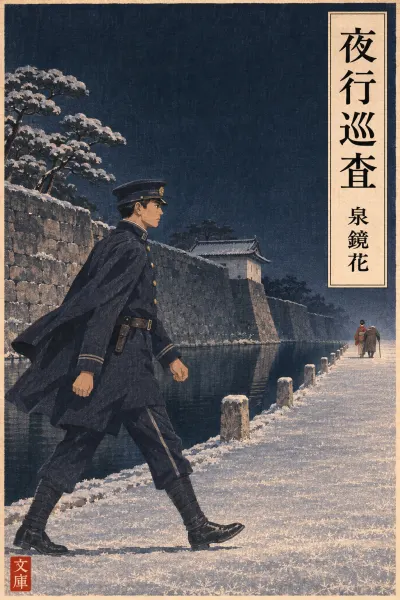
巡査はこのとき囁く声をも聞くべき距離に着々として歩しおれり。The constable was at that moment pacing steadily onward, close enough that he could have heard even a whisper.
老夫は頭を打ち掉りて、The old man shook his head.
「う、んや、吾ゃあいつも大好きさ。八円を大事にかけて、世の中に巡査ほどのものはないと澄ましているのが妙だ。"N-no, no, I like the fellow very much indeed. The way he treasures his eight yen and holds himself so smugly, as if there were nothing in the world to compare with a constable — it's quite delightful.
あまり職掌を重んじて、苛酷だ、思い遣りがなさすぎると、評判の悪いのに頓着なく、すべ一本でも見免さない、アノ邪慳非道なところが、ばかにおれは気に入ってる。He makes so much of his duty that people call him harsh and heartless, yet he doesn't care a jot for his bad name, and he won't let so much as a single straw go by. That cruel, pitiless streak of his — I'm uncommonly fond of it.
まず八円の価値はあるな。八円じゃ高くない、禄盗人とはいわれない、まことにりっぱな八円様だ」Well, he's worth his eight yen, I'll grant him that. At eight yen he's no dear bargain; no one could call him a thief of his wages. A truly splendid Mr Eight Yen, that one."
女はたまらず顧みて、小腰を屈め、片手をあげてソト巡査を拝みぬ。Unable to bear it, the woman looked back, bent slightly at the waist, raised one hand, and softly made a gesture of supplication towards the constable.
いかにお香はこの振舞を伯父に認められじとは勉めけん。How hard Okō must have striven that her uncle should not notice this!
瞬間にまた頭を返して、八田がなんらの挙動をもてわれに答えしやを知らざりき。In an instant she had turned her head forward again, and so she never knew whether Hatta had made any movement in answer to her.
五V
「ええと、八円様に不足はないが、どうしてもおまえを遣ることはできないのだ。それもあいつが浮気もので、ちょいと色に迷ったばかり、おいやならよしなさい、よそを聞いてみますという、お手軽なところだと、おれも承知をしたかもしれんが、どうしておれが探ってみると、義延(巡査の名)という男はそんな男と男が違う。"Well now, I've no complaint against Mr Eight Yen, but I simply cannot give you to him. If he were a fickle sort who'd merely lost his head over a pretty face for a while — the easy kind who'd say, 'If you don't care for it, never mind, I'll try elsewhere' — I might well have given my consent. But when I looked into the matter, I found that this man Yoshinobu (the constable's name) is another man altogether.
なんでも思い込んだらどうしても忘れることのできない質で、やっぱりおまえと同一ように、自殺でもしたいというふうだ。He's the kind who, once he has set his heart on something, can never forget it, whatever happens. Just like you, he looks as though he'd sooner kill himself.
ここでおもしろいて、はははははは」と冷笑えり。That's just what makes it so amusing — ha ha ha ha ha!" he sneered.
女は声をふるわして、The girl, her voice trembling,
「そんなら伯父さん、まあどうすりゃいいのでございます」と思い詰めたる体にて問いぬ。asked, in utter desperation, "Then, Uncle, whatever am I to do?"
伯父は事もなげに、Her uncle answered as if it were nothing at all:
「どうしてもいけないのだ。どんなにしてもいけないのだ。とてもだめだ、なんにもいうな、たといどうしても肯きゃあしないから、お香、まあ、そう思ってくれ」"It won't do, no matter what. It won't do, whatever you try. It's quite hopeless. Don't say a word — however you plead, I shan't listen. So, Okō, just get that into your head."
女はわっと泣きだしぬ。The woman burst into tears.
渠は途中なることをも忘れたるなり。She had forgotten even that she was out in the open street.
伯父は少しも意に介せず、Her uncle, not troubled in the least, went on:
「これ、一生のうちにただ一度いおうと思って、今までおまえにもだれにもほのめかしたこともないが、ついでだから謂って聞かす。いいか、亡くなったおまえのお母さんはな」"Listen. I meant to say this only once in my whole life, and until now I've never so much as hinted at it to you or to anyone else — but since we're on the subject, I'll tell you. Are you listening? Your late mother, you see—"
母という名を聞くやいなや女はにわかに聞き耳立てて、The moment she heard the word 'mother', the woman suddenly pricked up her ears.
「え、お母さんが」"What — my mother?"
「むむ、亡くなった、おまえのお母さんには、おれが、すっかり惚れていたのだ」"Mm. Your late mother — I was utterly in love with her."
「あら、まあ、伯父さん」"Oh! Why, Uncle!"
「うんや、驚くこたあない、また疑うにも及ばない。それを、そのお母さんを、おまえのお父さんに奪られたのだ。"No, no, there's nothing to be startled about, and no need to doubt it either. And she — that mother of yours — was taken from me by your father.
な、解ったか。もちろんおまえのお母さんは、おれがなんだということも知らず、弟もやっぱり知らない。There, do you understand? Of course your mother never knew what I felt for her, and my younger brother didn't know either.
おれもまた、口へ出したことはないが、心では、心では、実におりゃもう、お香、おまえはその思い遣りがあるだろう。Nor did I ever put it into words. But in my heart, in my heart, I truly — Okō, you can surely imagine what it was like.
巡査というものを知ってるから。婚礼の席に連なったときや、明け暮れそのなかのいいのを見ていたおれは、ええ、これ、どんな気がしたとおまえは思う」Because you know what it is to love a constable. When I sat among the guests at their wedding, and when I watched from morning to night how close they were — come now, how do you think I felt?"
という声濁りて、痘痕の充てる頬骨高き老顔の酒気を帯びたるに、一眼の盲いたるがいとものすごきものとなりて、拉ぐばかり力を籠めて、お香の肩を掴み動かし、As he spoke, his voice grew thick; his old face, high-cheekboned and covered with pockmarks, was flushed with drink, and with its one blind eye it took on a truly fearsome look. Gripping Okō's shoulder with force enough to crush it, he shook her.
「いまだに忘れない。どうしてもその残念さが消え失せない。そのためにおれはもうすべての事業を打ち棄てた。"I still haven't forgotten. Whatever I do, the bitterness of it won't go away. Because of it I threw away all my ambitions.
名誉も棄てた。家も棄てた。つまりおまえの母親が、おれの生涯の幸福と、希望とをみな奪ったものだ。I threw away my good name. I threw away my home. In short, your mother robbed me of all the happiness and all the hopes of my life.
おれはもう世の中に生きてる望みはなくなったが、ただ何とぞしてしかえしがしたかった、といって寝刃を合わせるじゃあない、恋に失望したもののその苦痛というものは、およそ、どのくらいであるということを、思い知らせたいばっかりに、要らざる生命をながらえたが、慕い合って望みが合うた、おまえの両親に対しては、どうしてもその味を知らせよう手段がなかった。I had nothing left to live for in this world, yet somehow or other I wanted my revenge. Not that I meant to sharpen a blade in secret — no. I dragged out a life I had no use for only because I wanted to make them feel what the anguish of a man disappointed in love is really like. But your parents, who loved each other and got their wish, were beyond my reach; I could find no way to make them taste it.
もうちっと長生きをしていりゃ、そのうちにはおれが仕方を考えて思い知らせてやろうものを、ふしあわせだか、しあわせだか、二人ともなくなって、残ったのはおまえばかり。Had they lived a little longer, I'd have thought of a way in time and made them feel it. But — whether by bad luck or good, I can't say — both of them died, and you alone were left.
親身といってほかにはないから、そこでおいらが引き取って、これだけの女にしたのも、三代祟る執念で、親のかわりに、なあ、お香、きさまに思い知らせたさ。You had no other kin, so I took you in and raised you into the woman you are now — and it was all out of a grudge that haunts three generations, so that in your parents' place, eh, Okō, I could make you feel it.
幸い八田という意中人が、おまえの胸にできたから、おれも望みが遂げられるんだ。さ、こういう因縁があるんだから、たとい世界の金満におれをしてくれるといったって、とても謂うこたあ肯かれない。Luckily, this Hatta has found a place in your heart, so now I can have my wish at last. There — since this is how things stand between us, even if someone offered to make me the richest man in the world, I could never grant what you ask.
覚悟しろ! 所詮だめだ。や、こいつ、耳に蓋をしているな」Resign yourself! It's no use, after all. What — the wretch is stopping her ears!"
Vocabulary
| Word | Meaning | JLPT |
|---|---|---|
| 囁くささやく | to whisperHere 囁く声 means 'a whispering voice', i.e. even a whisper. | N2 |
| 頓着とんじゃく | concern, caring about somethingUsually negative: 〜に頓着なく / 頓着しない, meaning 'paying no heed to'. Also read とんちゃく. | — |
| 邪慳じゃけん | cruel, harsh, unkindNow usually written 邪険. | — |
| 拝みおがむ | to put one's hands together in supplication; to begdictionary form: 拝むHere a silent gesture of apology and pleading towards Hatta. | N2 |
| 思い詰めたるおもいつめる | to brood desperately; to be driven to desperationdictionary form: 思い詰める〜たる is the classical form of 〜た used before a noun. | — |
| 意に介せずいにかいする | to mind, to care aboutdictionary form: 意に介するAlmost always negative: 意に介さない means 'not to care in the least'. | — |
| 惚れてほれる | to fall in love, to be smittendictionary form: 惚れるPlainer and more colloquial than 恋する. | — |
| 寝刃を合わせるねたばをあわせる | to sharpen a dull blade in secret; to plot violent revenge寝刃 is a blade gone dull; old idiom. | — |
| 祟るたたる | to haunt, to bring a curse onUsed of angry spirits or grudges that bring misfortune. | — |
| 執念しゅうねん | tenacious grudge, obsession執念深い means vindictive or persistent. | — |
| 意中人おもいもの | (here read おもいもの, the author's gloss for 意中の人) the person one loves, one's sweetheartdictionary form: 意中の人Kyōka glosses 意中人 (normally いちゅうのひと) with the native word おもいもの. | — |
| 因縁いんねん | fateful connection, karmic bondA Buddhist term for cause and effect binding people together. | — |
| 覚悟かくご | resignation; readiness for the worst覚悟しろ: 'Prepare yourself / Resign yourself!' | N3 |
| 所詮しょせん | after all, in the end (it's no use)Implies that resistance is pointless. | — |
Grammar
〜ぬ (classical perfective) N1 did ~, has done ~ (completed action)
In classical narration, ぬ attached to the 連用形 marks a completed action, much like modern 〜た. It ends many narrative sentences in this text.
かく言い懸けて振り返りぬ。
Having spoken thus far, she looked back over her shoulder.
〜べき N2 could / should ~; such that ~ is possible
べき, the attributive form of classical べし, here expresses possibility and modifies 距離: 'a distance at which one could hear'. In modern Japanese it mostly means 'should'.
囁く声をも聞くべき距離に着々として歩しおれり
he was pacing steadily onward, close enough to hear even a whisper
〜やいなや N1 the moment ~, as soon as ~
Attached to the dictionary form, it shows that the second action follows immediately on the first. It is formal and literary.
母という名を聞くやいなや女はにわかに聞き耳立てて
the moment she heard the word 'mother', the woman suddenly pricked up her ears
〜にも及ばない N1 there is no need to ~
Verb (dictionary form) + には及ばない / にも及ばない means 'there is no need to ~'. Here も is additive ('nor / also'), linking 疑う to the preceding 驚くこたあない: 'no need to be startled, nor any need to doubt'.
驚くこたあない、また疑うにも及ばない
there's nothing to be startled about, and no need to doubt it either
〜たいばかりに N2 solely because one wants to ~
〜ばかりに gives a single, often obsessive reason for an action, usually one that leads to something bad or extreme. ばっかり is the emphatic spoken form.
思い知らせたいばっかりに、要らざる生命をながらえたが
I dragged out a life I had no use for only because I wanted to make them feel it
〜じ / 〜けん (classical auxiliaries) N1 じ: 'not intend to / so as not to'; けん: 'must have ~'
じ is the classical negative of intention, so 認められじ means 'so as not to be noticed'. けん (けむ) guesses at a past event: 勉めけん means 'she must have striven'. With いかに, the narrator exclaims at how hard she must have tried.
いかにお香はこの振舞を伯父に認められじとは勉めけん。
How hard Okō must have striven that her uncle should not notice this!