Part 8 of 8 · JLPT N1
夜行巡査 Yakōjunsa, part 8: The Constable's Final Act of Duty
In this part
When Okō's uncle falls into the water on a freezing night, Hatta resolves to save him. He does this out of duty, even though he despises the old man and cannot swim. Okō clings to him and begs him not to go, but he shakes her off and leaps in, throwing away his life and his love. The narrator closes by asking why society praised Hatta's 'benevolence' in this death but never acknowledged his harsh, cruel treatment of an old rickshaw man and a mother and child on his rounds.
AI translation · independently checked
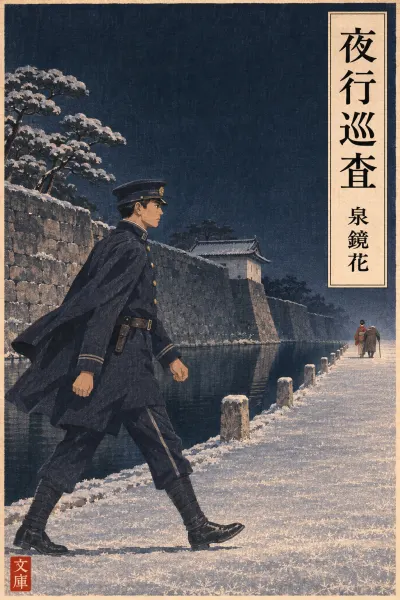
八田巡査はこれを見て、躊躇するもの一秒時、手なる角燈を差し置きつ、と見れば一枝の花簪の、徽章のごとくわが胸に懸かれるが、ゆらぐばかりに動悸烈しき、お香の胸とおのが胸とは、ひたと合いてぞ放れがたき。Constable Hatta, seeing this, hesitated for but a single second and set down the lantern in his hand. And behold: the sprig of a flowered hairpin hung against his breast like a badge, while Okō's breast, her heart pounding so fiercely that the hairpin seemed to tremble, pressed so closely to his own that the two could scarcely be parted.
両手を静かにふり払いて、Gently shaking off her two hands, he said,
「お退き」"Stand aside."
「え、どうするの」"What? What are you going to do?"
とお香は下より巡査の顔を見上げたり。Okō gazed up from below into the constable's face.
「助けてやる」"I'm going to save him."
「伯父さんを?」"My uncle?"
「伯父でなくってだれが落ちた」"If not your uncle, who else fell in?"
「でも、あなた」"But, dear—"
巡査は儼然として、The constable, with stern gravity, replied,
「職務だ」"It is my duty."
「だってあなた」"But dear, you—"
巡査はひややかに、「職掌だ」The constable said coldly, "It is my office."
お香はにわかに心着き、またさらに蒼くなりて、Okō suddenly realised something and turned paler still.
「おお、そしてまああなた、あなたはちっとも泳ぎを知らないじゃありませんか」"Oh, and besides, dear, you don't know how to swim at all, do you?"
「職掌だ」"It is my office."
「それだって」"Even so—"
「いかん、だめだもう、僕も殺したいほどの老爺だが、職務だ! 断念ろ」"No. It's no use now. He's an old man I'd gladly kill myself, but it is my duty! Give it up."
と突きやる手に喰い附くばかり、She all but sank her teeth into the hand that thrust her away,
「いけませんよう、いけませんよう。あれ、だれぞ来てくださいな。助けて、助けて」と呼び立つれど、土塀石垣寂として、前後十町に行人絶えたり。and cried out, "You mustn't, you mustn't! Oh, somebody, please come! Help, help!" But the earthen walls and stone embankments lay utterly silent, and for ten chō (about a kilometre) in either direction not a single passer-by was to be seen.
八田巡査は、声をはげまし、Constable Hatta raised his voice and cried,
「放さんか!」"Let go, will you!"
決然として振り払えば、力かなわで手を放てる、咄嵯に巡査は一躍して、棄つるがごとく身を投ぜり。When he shook her off with resolve, her strength failed and she loosed her hold; in that instant the constable sprang forward and flung himself in, as one who casts his own body away.
お香はハッと絶え入りぬ。Okō gasped and fell into a swoon.
あわれ八田は警官として、社会より荷える負債を消却せんがため、あくまでその死せんことを、むしろ殺さんことを欲しつつありし悪魔を救わんとして、氷点の冷、水凍る夜半に泳ぎを知らざる身の、生命とともに愛を棄てぬ。Alas! To discharge the debt he owed to society as an officer of the law, Hatta sought to save the very devil whose death he had desired to the last, nay, whom he had longed to kill. On a midnight of freezing cold, when the water itself turns to ice, he who could not swim cast away his love together with his life.
後日社会は一般に八田巡査を仁なりと称せり。In later days, society at large praised Constable Hatta as a man of benevolence.
ああはたして仁なりや、しかも一人の渠が残忍苛酷にして、恕すべき老車夫を懲罰し、憐むべき母と子を厳責したりし尽瘁を、讃歎するもの無きはいかん。Ah, but was he truly benevolent? And how is it that no one sang the praises of the tireless zeal with which this same man, cruel and harsh, punished an old rickshaw man who deserved forgiveness, and sternly rebuked a mother and child who deserved pity?
(明治二十八年四月「文芸倶楽部」)(Bungei Kurabu, April 1895)
Vocabulary
| Word | Meaning | JLPT |
|---|---|---|
| 躊躇ちゅうちょする | to hesitatedictionary form: 躊躇するA formal word; in everyday speech you would say ためらう. | — |
| 動悸どうき | a pounding heart, palpitations動悸がする means 'one's heart is pounding'. | — |
| 職務しょくむ | official duty, one's dutiesHatta keeps repeating it as a curt formula. | N1 |
| 職掌しょくしょう | one's office, official functionAn old-fashioned near-synonym of 職務. | — |
| 断念ろあきらめる | to give up, resign oneselfdictionary form: 諦めるThe kanji 断念 (だんねん, 'abandoning hope') is used with the reading あきらめ; ろ is the plain imperative ending. | N3 |
| 行人こうじん | passer-byA literary word; modern Japanese uses 通行人. | — |
| 決然けつぜん | resolutely, with determinationUsed in the form 決然として. | — |
| 咄嵯とっさ | in an instant, on the spur of the momentdictionary form: 咄嗟Usually written 咄嗟; 咄嵯 is a variant form found in old texts. | N1 |
| 負債ふさい | debtUsed figuratively here: what Hatta owes society as a policeman. | N1 |
| 消却しょうきゃく | to pay off, discharge (a debt)dictionary form: 消却する | — |
| 夜半よわ | the middle of the night, midnightA poetic reading; it can also be read やはん. | — |
| 仁じん | benevolence, humanenessA key Confucian virtue. 仁なり is classical for 'is benevolent'. | — |
| 残忍ざんにん | cruel, ruthlessOften paired with 苛酷 (かこく), 'harsh, severe'. | — |
| 尽瘁じんすい | tireless devotion, wearing oneself out for a causedictionary form: 尽瘁するSaid ironically here of Hatta's zeal in punishing the weak. | — |
Grammar
〜ぞ … 連体形 (kakari-musubi) N1 emphatic particle with attributive ending
In classical Japanese, the particle ぞ marks emphasis, and the sentence must then end in the attributive form, here がたき instead of がたし. The construction stresses how tightly the two were pressed together.
ひたと合いてぞ放れがたき
pressed so closely that they could scarcely be parted
〜ばかり N2 as if about to ~, almost ~
A verb in the dictionary form + ばかり means 'to the point that one almost does ~'. Okō does not actually bite his hand, but she clings so desperately that she nearly does.
と突きやる手に喰い附くばかり
she all but sank her teeth into the hand that thrust her away
〜で (classical negative) N1 without ~ing, not being able to ~
In literary style, the negative stem + で means 'not ~ and so'. かなわで therefore equals modern かなわなくて or かなわずに.
力かなわで手を放てる
her strength failed and she loosed her hold
〜んがため(に) N1 in order to ~
In order to ~. The classical volitional ん (from む) attaches to the irrealis form (未然形) of the verb and is followed by がため(に) to express purpose. Here it follows 消却せ, the irrealis of the サ変 verb 消却す. 消却せんがため means 'in order to pay off'.
社会より荷える負債を消却せんがため
to discharge the debt he owed to society
〜ぬ / 〜り (classical perfective) N1 completed action (= modern 〜た)
The classical auxiliaries ぬ and り mark an action as completed, much like modern た. The narration uses them to close its key events: 絶え入りぬ, 身を投ぜり, 棄てぬ.
お香はハッと絶え入りぬ。
Okō gasped and fell into a swoon.
〜べき N2 who deserves to be ~, ought to be ~
A verb + べき used before a noun describes it as something that should receive that action. 恕すべき老車夫 is 'an old rickshaw man who ought to be forgiven'.
恕すべき老車夫を懲罰し、憐むべき母と子を厳責したりし尽瘁
the zeal with which he punished an old rickshaw man who deserved forgiveness and sternly rebuked a mother and child who deserved pity