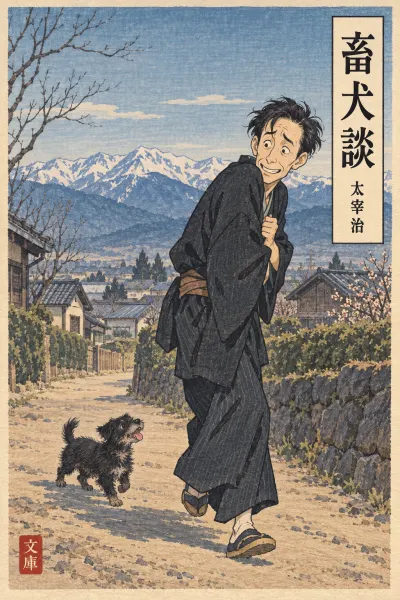
Part 6 of 8 · JLPT N2
畜犬談 Chikukendan, part 6: A Plague of Mange and Delays
In this part
Pochi is to be left behind when the couple move. Then he catches a hideous, foul-smelling skin disease, and the wife begs the narrator to kill him. As the new house in Mitaka is delayed again and again, the narrator's frustration grows until dog fleas reach his own nightclothes and he secretly resolves to act.
AI translation · independently checked
ポチは、やはり置いてゆかれることに、確定した。It was settled, then: Pochi would be left behind after all.
すると、ここに異変が起った。Whereupon a calamity befell us.
ポチが、皮膚病にやられちゃった。Pochi came down with a skin disease.
これが、またひどいのである。And a frightful case it was, too.
さすがに形容をはばかるが、惨状、眼をそむけしむるものがあったのである。Decency forbids me to describe it, but suffice it to say that the spectacle was one to make a man avert his eyes.
おりからの炎熱とともに、ただならぬ悪臭を放つようになった。With the blazing heat of the season, he began to give off a most extraordinary stench.
こんどは家内が、まいってしまった。This time it was my wife who was done in.
「ご近所にわるいわ。殺してください」女は、こうなると男よりも冷酷で、度胸がいい。"It's not fair on the neighbours. Please kill him." Once things come to this, women are colder-hearted than men, and have more nerve.
「殺すのか」私は、ぎょっとした。"Kill him?" I was aghast.
「もう少しの我慢じゃないか」"Can't you put up with it a little longer?"
私たちは、三鷹の家主からの速達を一心に待っていた。We were waiting with all our hearts for an express letter from our landlord in Mitaka.
七月末には、できるでしょうという家主の言葉であったのだが、七月もそろそろおしまいになりかけて、きょうか明日かと、引越しの荷物もまとめてしまって待機していたのであったが、なかなか、通知が来ないのである。The landlord had told us the house would probably be ready by the end of July, and now July was drawing to a close; thinking it would be today, or perhaps tomorrow, we had packed up everything for the move and stood ready, yet the notice simply would not come.
問いあわせの手紙を出したりなどしている時に、ポチの皮膚病がはじまったのである。It was just as we were sending letters of inquiry and the like that Pochi's skin disease began.
見れば、見るほど、酸鼻の極である。The more one looked, the more ghastly it became, the very height of horror.
ポチも、いまはさすがに、おのれの醜い姿を恥じている様子で、とかく暗闇の場所を好むようになり、たまに玄関の日当りのいい敷石の上で、ぐったり寝そべっていることがあっても、私が、それを見つけて、Even Pochi now seemed, as one might expect, ashamed of his own hideous appearance; he took to favouring dark places, and if every so often he did lie sprawled limply on the sunny flagstone by the front door and I happened to catch sight of him,
「わあ、ひでえなあ」と罵倒すると、いそいで立ち上って首を垂れ、閉口したようにこそこそ縁の下にもぐりこんでしまうのである。and abused him with "Ugh, how revolting!", he would scramble to his feet, hang his head, and slink away under the veranda as if thoroughly mortified.
それでも私が外出するときには、どこからともなく足音忍ばせて出てきて、私についてこようとする。Even so, whenever I went out, he would appear from nowhere on stealthy feet and try to follow me.
こんな化け物みたいなものに、ついてこられて、たまるものか、とその都度、私は、だまってポチを見つめてやる。Was I to be trailed about by this monstrous thing? Not on your life! And each time, I would fix Pochi with a silent stare.
あざけりの笑いを口角にまざまざと浮べて、なんぼでも、ポチを見つめてやる。With a sneer of contempt plainly playing at the corners of my mouth, I would stare at Pochi for as long as it took.
これは大へんききめがあった。This proved remarkably effective.
ポチは、おのれの醜い姿にハッと思い当る様子で、首を垂れ、しおしおどこかへ姿を隠す。Pochi, apparently struck by the sudden realisation of his own ugliness, would hang his head and crestfallenly take himself off somewhere out of sight.
「とっても、我慢ができないの。私まで、むず痒くなって」家内は、ときどき私に相談する。"I just can't bear it. It makes even me feel itchy all over," my wife would sometimes confide to me.
「なるべく見ないように努めているんだけれど、いちど見ちゃったら、もうだめね。夢の中にまで出てくるんだもの」"I try my best not to look at him, but once I've seen him, that's it. He even turns up in my dreams."
「まあ、もうすこしの我慢だ」がまんするよりほかはないと思った。"Well, it's only a little longer." There was nothing for it, I thought, but to endure.
たとえ病んでいるとはいっても、相手は一種の猛獣である。Sick he might be, but my adversary was, after all, a species of wild beast.
下手に触ったら噛みつかれる。Lay a careless hand on him, and he would bite.
「明日にでも、三鷹から、返事が来るだろう、引越してしまったら、それっきりじゃないか」"We'll probably hear back from Mitaka tomorrow, if not sooner. Once we've moved, that'll be the end of it, won't it?"
三鷹の家主から返事が来た。The reply came from the landlord in Mitaka.
読んで、がっかりした。I read it and was crushed.
雨が降りつづいて壁が乾かず、また人手も不足で完成までには、もう十日くらいかかる見こみ、というのであった。Owing to the continual rain the walls would not dry, and besides, labour was short, so completion would likely take another ten days or so; such was the gist of it.
うんざりした。I was sick to death of it all.
ポチから逃れるためだけでも、早く、引越してしまいたかったのだ。If only to escape from Pochi, I wanted to be moved out as soon as possible.
私は、へんな焦躁感で、仕事も手につかず、雑誌を読んだり、酒を呑んだりした。Gripped by a strange restlessness, I could not settle to my work, and passed the time reading magazines and drinking.
ポチの皮膚病は一日一日ひどくなっていって、私の皮膚も、なんだか、しきりに痒くなってきた。Pochi's skin disease grew worse with each passing day, and my own skin, too, somehow began to itch incessantly.
深夜、戸外でポチが、ばたばたばた痒さに身悶えしている物音に、幾度ぞっとさせられたかわからない。I cannot count how many times, deep in the night, I was made to shudder by the sound of Pochi outside, thrashing about, flap, flap, flap, in torment from the itch.
たまらない気がした。It was more than I could stand.
いっそひと思いにと、狂暴な発作に駆られることも、しばしばあった。Often I was seized by a violent fit: why not finish it at a single stroke?
家主からは、さらに二十日待て、と手紙が来て、私のごちゃごちゃの忿懣が、たちまち手近のポチに結びついて、こいつあるがために、このように諸事円滑にすすまないのだ、と何もかも悪いことは皆、ポチのせいみたいに考えられ、奇妙にポチを呪咀し、ある夜、私の寝巻に犬の蚤が伝播されてあることを発見するに及んで、ついにそれまで堪えに堪えてきた怒りが爆発し、私はひそかに重大の決意をした。Then came a letter from the landlord telling us to wait a further twenty days, and my tangled resentments at once fastened upon Pochi, who was nearest to hand. It is because this creature exists, I thought, that nothing whatsoever goes smoothly. I came to regard every misfortune of any kind as Pochi's doing, and cursed him in the strangest fashion. And when, one night, I discovered that dog fleas had migrated to my nightclothes, the anger I had held in and held in until then finally exploded, and I secretly made a grave resolution.
Vocabulary
| Word | Meaning | JLPT |
|---|---|---|
| 異変いへん | unexpected disaster; strange turn of eventsA dramatic word, used here with mock-heroic exaggeration. | — |
| 皮膚病ひふびょう | skin disease (here, mange)皮膚 = skin + 病 = illness. | — |
| 惨状さんじょう | dreadful state; miserable sight | — |
| 悪臭あくしゅう | foul smell, stenchUsually paired with 放つ, 'to give off'. | — |
| 冷酷れいこく | cold-hearted, ruthless | N1 |
| 度胸どきょう | nerve, guts度胸がいい = to have plenty of nerve. | — |
| 家主やぬし | landlord; owner of a rented house | N2 |
| 速達そくたつ | express mail | N2 |
| 酸鼻さんび | something gruesome or horrifyingLiterary; 酸鼻の極 = 'the very height of horror'. | — |
| 罵倒ばとう | verbal abuse; to revile someoneUsed as a する verb. | — |
| 縁の下えんのした | the space under the veranda or floor of a houseTraditional houses are raised, so animals can shelter underneath. | — |
| 猛獣もうじゅう | ferocious beast, wild animalComic overstatement for a sick little dog. | — |
| 忿懣ふんまん | pent-up resentment, indignationNowadays usually written 憤懣. | — |
| 蚤のみ | flea | — |
Grammar
〜ば〜ほど N3 the more ..., the more ...
The same verb is repeated, first in the ば conditional and then in the plain form + ほど. The second clause grows in step with the first.
見れば、見るほど、酸鼻の極である。
The more one looked, the more ghastly it became, the very height of horror.
〜て(は)たまるものか N2 I won't stand for ...; as if I'd put up with ...
て-form + たまるものか is a rhetorical question that indignantly rejects a situation. Here it follows a suffering passive (ついてこられて), so the narrator feels imposed upon by being followed.
こんな化け物みたいなものに、ついてこられて、たまるものか
Was I to be trailed about by this monstrous thing? Not on your life!
〜よりほか(は)ない N2 there is nothing to do but ...
Dictionary form + よりほかはない means no other option exists. It is a more formal variant of しかない.
がまんするよりほかはないと思った。
There was nothing for it, I thought, but to endure.
〜しむ(しむる) N1 classical causative: to make (someone) do
しむ is the classical causative, equivalent to modern させる. しむる is its attributive form, modifying もの, and it gives the line its pompous kanbun flavour.
惨状、眼をそむけしむるものがあったのである。
the spectacle was one to make a man avert his eyes.
〜がために N1 because of; for the sake of
A literary form of ために, attached here to the classical-style あるがために, 'because (it) exists'. It sounds weighty and accusatory.
こいつあるがために、このように諸事円滑にすすまないのだ
it is because this creature exists that nothing whatsoever goes smoothly
〜に及んで N1 when things reached the point of ...; upon ...
Dictionary form + に及んで marks the point at which a situation finally reaches a decisive stage. It introduces the last straw before the outburst.
私の寝巻に犬の蚤が伝播されてあることを発見するに及んで
when I discovered that dog fleas had migrated to my nightclothes