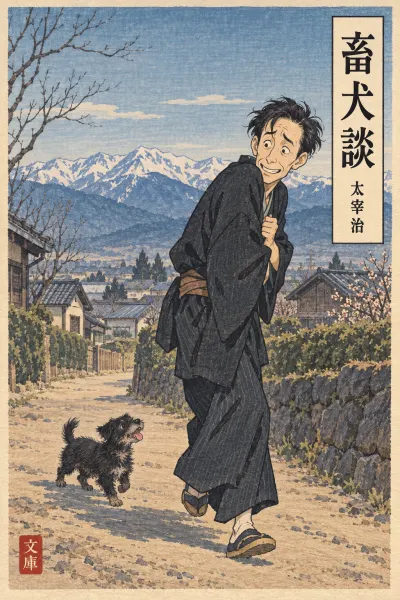
Part 2 of 8 · JLPT N2
畜犬談 Chikukendan, part 2: A Town Overrun with Dogs
In this part
The narrator, renting a tiny cottage on the edge of Kōfu, finds the town teeming with mongrel dogs and devises a cowardly plan to stay safe: smiling, humming nursery songs, getting haircuts and giving up his walking stick. The plan works too well, and the dogs come to like him and follow him around. Furious, he launches into a grand tirade against dogs as servile, treacherous creatures, unlike the free and cheerful sparrow, and admits that he hates them partly because they remind him of himself.
AI translation · independently checked
ことしの正月、山梨県、甲府のまちはずれに八畳、三畳、一畳という草庵を借り、こっそり隠れるように住みこみ、下手な小説あくせく書きすすめていたのであるが、この甲府のまち、どこへ行っても犬がいる。At New Year this year I rented a grass hut on the outskirts of Kōfu, in Yamanashi Prefecture, consisting of an eight-mat room, a three-mat room and a one-mat room, and settled in there as if going into hiding, toiling away at my clumsy novels; and in this town of Kōfu, wherever one goes, there are dogs.
おびただしいのである。They are legion.
往来に、あるいは佇み、あるいはながながと寝そべり、あるいは疾駆し、あるいは牙を光らせて吠えたて、ちょっとした空地でもあるとかならずそこは野犬の巣のごとく、組んずほぐれつ格闘の稽古にふけり、夜など無人の街路を風のごとく、野盗のごとくぞろぞろ大群をなして縦横に駈け廻っている。In the streets they loiter, or sprawl out at full length, or charge about at a gallop, or bark with fangs agleam; wherever there is the least scrap of vacant ground, it inevitably becomes a lair of wild dogs, where they lose themselves in wrestling practice, locked together and tumbling apart; and at night they race this way and that through the deserted streets in great swarming packs, like the wind, like bandits.
甲府の家ごと、家ごと、少くとも二匹くらいずつ養っているのではないかと思われるほどに、おびただしい数である。Their numbers are so prodigious that one is led to suspect every household in Kōfu, every single household, keeps at least two of them.
山梨県は、もともと甲斐犬の産地として知られているようであるが、街頭で見かける犬の姿は、けっしてそんな純血種のものではない。Yamanashi Prefecture, it seems, has long been known as the home of the Kai dog, but the dogs one sees on the street are by no means of any such pure breed.
赤いムク犬が最も多い。Shaggy red dogs are the most common.
採るところなきあさはかな駄犬ばかりである。Every one of them is a worthless, shallow-witted mongrel with not a single redeeming feature.
もとより私は畜犬に対しては含むところがあり、また友人の遭難以来いっそう嫌悪の念を増し、警戒おさおさ怠るものではなかったのであるが、こんなに犬がうようよいて、どこの横丁にでも跳梁し、あるいはとぐろを巻いて悠然と寝ているのでは、とても用心しきれるものでなかった。Now, I had always harboured a grudge against domestic dogs, and since the misfortune that befell a friend of mine my loathing had grown all the stronger, so that I was never for a moment off my guard; but with dogs swarming like this, running rampant down every back alley, or lying coiled up and sleeping at their ease, there was simply no way to be careful enough.
私はじつに苦心をした。I was put to truly great pains.
できることなら、すね当、こて当、かぶとをかぶって街を歩きたく思ったのである。Had it been at all possible, I would have liked to walk the streets in shin guards, arm guards and a helmet.
けれども、そのような姿は、いかにも異様であり、風紀上からいっても、けっして許されるものではないのだから、私は別の手段をとらなければならぬ。Such a costume, however, would look extremely bizarre, and from the standpoint of public decency could never be permitted, and so I must needs resort to other means.
私は、まじめに、真剣に、対策を考えた。Earnestly, seriously, I pondered countermeasures.
私はまず犬の心理を研究した。First of all, I made a study of canine psychology.
人間については、私もいささか心得があり、たまには的確に、あやまたず指定できたことなどもあったのであるが、犬の心理は、なかなかむずかしい。When it comes to human beings, I have some small understanding, and now and then I have even been able to identify things precisely and unerringly, but the psychology of dogs is a very difficult matter.
人の言葉が、犬と人との感情交流にどれだけ役立つものか、それが第一の難問である。To what extent human words are of any use in the exchange of feelings between dog and man: that is the first great problem.
言葉が役に立たぬとすれば、お互いの素振り、表情を読み取るよりほかにない。If words are of no use, there is no option but to read each other's gestures and expressions.
しっぽの動きなどは、重大である。The movements of the tail, for instance, are of grave importance.
けれども、この、しっぽの動きも、注意して見ているとなかなかに複雑で、容易に読みきれるものではない。Yet these movements of the tail, too, prove on careful observation to be quite complex, and are by no means easy to decipher fully.
私は、ほとんど絶望した。I very nearly despaired.
そうして、はなはだ拙劣な、無能きわまる一法を案出した。And so I devised a method, a most clumsy and utterly incompetent one.
あわれな窮余の一策である。A pitiful last resort.
私は、とにかく、犬に出逢うと、満面に微笑を湛えて、いささかも害心のないことを示すことにした。Whenever I met a dog, I resolved, I would at all events wear a broad smile over my whole face, to show that I harboured not the slightest ill will.
夜は、その微笑が見えないかもしれないから、無邪気に童謡を口ずさみ、やさしい人間であることを知らせようと努めた。At night, since the smile might not be visible, I would innocently hum a nursery song and strive to let it be known that I was a gentle human being.
これらは、多少、効果があったような気がする。These measures, I feel, have had a certain effect.
犬は私には、いまだ飛びかかってこない。No dog has yet leapt upon me.
けれどもあくまで油断は禁物である。Nevertheless, one must never, ever let one's guard down.
犬の傍を通る時は、どんなに恐ろしくても、絶対に走ってはならぬ。When passing beside a dog, however terrified you may be, you must on no account run.
にこにこ卑しい追従笑いを浮べて、無心そうに首を振り、ゆっくり、ゆっくり、内心、背中に毛虫が十匹這っているような窒息せんばかりの悪寒にやられながらも、ゆっくりゆっくり通るのである。With a base, fawning grin plastered on my face, I shake my head as though without a care in the world and pass by slowly, ever so slowly, even while inwardly seized by a chill so suffocating it feels as if ten caterpillars were crawling up my back; slowly, slowly, I pass by.
つくづく自身の卑屈がいやになる。I grow thoroughly sick of my own servility.
泣きたいほどの自己嫌悪を覚えるのであるが、これを行わないと、たちまち噛みつかれるような気がして、私は、あらゆる犬にあわれな挨拶を試みる。I feel a self-loathing so strong it makes me want to weep, yet I have a feeling that if I failed to do this I would be bitten on the spot, and so I attempt my pitiful greeting on each and every dog.
髪をあまりに長く伸ばしていると、あるいはウロンの者として吠えられるかもしれないから、あれほどいやだった床屋へも精出してゆくことにした。Since letting my hair grow too long might get me barked at as a suspicious character, I resolved to make diligent visits even to the barber, whom I had so detested.
ステッキなど持って歩くと、犬のほうで威嚇の武器と勘ちがいして、反抗心を起すようなことがあってはならぬから、ステッキは永遠に廃棄することにした。If I go about carrying a walking stick, the dogs, for their part, might mistake it for a menacing weapon and be roused to defiance, which must not be allowed to happen; and so I resolved to abandon the walking stick forever.
犬の心理を計りかねて、ただ行き当りばったり、むやみやたらに御機嫌とっているうちに、ここに意外の現象が現われた。While I was currying favour with them in this haphazard, indiscriminate fashion, unable to fathom the canine mind, an unexpected phenomenon now made its appearance.
私は、犬に好かれてしまったのである。I had ended up being liked by the dogs.
尾を振って、ぞろぞろ後についてくる。Wagging their tails, they come trooping along behind me.
私は、じだんだ踏んだ。I stamped my feet in vexation.
じつに皮肉である。The irony of it is complete.
かねがね私の、こころよからず思い、また最近にいたっては憎悪の極点にまで達している、その当の畜犬に好かれるくらいならば、いっそ私は駱駝に慕われたいほどである。Rather than be liked by the very domestic dog I have always regarded with distaste, and which of late has reached the very pinnacle of my hatred, I would sooner be adored by a camel.
どんな悪女にでも、好かれて気持の悪いはずはない、というのはそれは浅薄の想定である。To suppose that no one could possibly feel unpleasant at being liked, even by the wickedest of women, is a shallow assumption.
プライドが、虫が、どうしてもそれを許容できない場合がある。There are cases where one's pride, one's very temper, simply cannot tolerate it.
堪忍ならぬのである。It is not to be endured.
私は、犬をきらいなのである。I dislike dogs, you see.
早くからその狂暴の猛獣性を看破し、こころよからず思っているのである。I saw through their savage, beastly nature long ago, and have regarded them with distaste ever since.
たかだか日に一度や二度の残飯の投与にあずからんがために、友を売り、妻を離別し、おのれの身ひとつ、家の軒下に横たえ、忠義顔して、かつての友に吠え、兄弟、父母をも、けろりと忘却し、ただひたすらに飼主の顔色を伺い、阿諛追従てんとして恥じず、ぶたれても、きゃんといい尻尾まいて閉口してみせて、家人を笑わせ、その精神の卑劣、醜怪、犬畜生とはよくもいった。For the sake of partaking in a handout of table scraps once or twice a day at most, they sell out their friends, cast off their wives, lay their own bodies down beneath the eaves of a house, put on a loyal face and bark at their former friends, blithely forget even their brothers and their parents, do nothing but watch their master's face for his moods, flatter and fawn without the faintest shame, and even when beaten, give a yelp, tuck their tails and make a show of being cowed, to the amusement of the household; such baseness, such hideousness of spirit! How well the word 'dog-brute' suits them.
日に十里を楽々と走破しうる健脚を有し、獅子をも斃す白光鋭利の牙を持ちながら、懶惰無頼の腐りはてたいやしい根性をはばからず発揮し、一片の矜持なく、てもなく人間界に屈服し、隷属し、同族互いに敵視して、顔つきあわせると吠えあい、噛みあい、もって人間の御機嫌をとり結ぼうと努めている。Though they possess sturdy legs that can easily run ten leagues in a day, and gleaming white, razor-sharp fangs that can fell even a lion, they shamelessly display a slothful, good-for-nothing, rotten and base disposition; without a shred of pride they meekly submit and enslave themselves to the world of men, regard their own kind as enemies, bark and bite at one another whenever they meet face to face, and thereby strive to win the favour of humankind.
雀を見よ。Behold the sparrow!
何ひとつ武器を持たぬ繊弱の小禽ながら、自由を確保し、人間界とはまったく別個の小社会を営み、同類相親しみ、欣然日々の貧しい生活を歌い楽しんでいるではないか。Though but a frail little bird without a single weapon, does it not keep its freedom, run a little society entirely apart from the world of men, live in friendship with its fellows, and joyfully sing and delight in its poor life day after day?
思えば、思うほど、犬は不潔だ。The more I think about it, the more unclean dogs seem to me.
犬はいやだ。I hate dogs.
なんだか自分に似ているところさえあるような気がして、いよいよ、いやだ。I even have a vague feeling that they somehow resemble me, which makes me hate them all the more.
たまらないのである。It is unbearable.
Vocabulary
| Word | Meaning | JLPT |
|---|---|---|
| おびただしいおびただしい | enormous in number; countlessdictionary form: 夥しいUsually written in kana; often used for alarming or excessive quantities. | N1 |
| 草庵そうあん | grass hut; humble cottageA literary, self-deprecating word for one's lodging, borrowed from the image of a hermit's hut. | — |
| 駄犬だけん | mongrel; worthless dogThe prefix 駄 means 'inferior, worthless', as in 駄目 and 駄作. | — |
| 畜犬ちくけん | domestic dog; dogs kept by peopleA stiff, formal word, which suits the mock-scholarly tone of the title. | — |
| 含むところがありふくむところがある | to bear a grudge; to have hard feelingsdictionary form: 含むところがあるLiterally 'to have something one holds inside'. | — |
| 跳梁ちょうりょう | running rampant; prowling freelyLiterary; usually said of villains or pests that act as they please. | — |
| 禁物きんもつ | something to be avoided; tabooCommon set phrase: 油断は禁物 'never let your guard down'. | N1 |
| 追従笑いついしょうわらい | fawning, ingratiating smile追従 is read ついしょう when it means 'flattery' and ついじゅう when it means 'following'. | — |
| 卑屈ひくつ | servility; spinelessnessA な-adjective used here as a noun. | — |
| じだんだ踏んだじだんだをふむ | to stamp one's feet in frustrationdictionary form: 地団駄を踏むAn idiom for helpless anger or regret. | — |
| 慕われたいしたう | to adore; to yearn for; to be devoted todictionary form: 慕うIn the passive form, 慕われる means 'to be loved or looked up to'. | N1 |
| 顔色を伺いかおいろをうかがう | to watch someone's face for their mooddictionary form: 顔色を伺うDescribes anxiously trying to please someone. | — |
| 懶惰らんだ | sloth; idlenessA rare literary compound; modern Japanese would use 怠惰 (たいだ). | — |
| 欣然きんぜん | joyfully; gladlyA kanbun-style adverb that adds to the mock-heroic tone. | — |
Grammar
〜のごとく N1 like ~; as if ~
A classical equivalent of 〜のように. Repeating it piles up similes for comic, epic effect.
夜など無人の街路を風のごとく、野盗のごとくぞろぞろ大群をなして縦横に駈け廻っている
at night they race this way and that through the deserted streets in great swarming packs, like the wind, like bandits
〜きれる/〜しきれない N2 to manage to do ~ completely
Attached to a verb stem, きる means 'to do fully'. In the negative it means the task is too much to finish. Here it combines with 〜ものではない to give 'there was no way to be careful enough'.
とても用心しきれるものでなかった
there was simply no way to be careful enough
〜よりほかにない N2 there is no choice but to ~
Means the same as 〜しかない but sounds more formal. It follows the dictionary form of a verb.
お互いの素振り、表情を読み取るよりほかにない
there is no option but to read each other's gestures and expressions
〜んばかり N1 as if about to ~; almost ~
ん is a classical form of the volitional ぬ/む, attached to the ない-stem (窒息する → 窒息せん). The pattern describes something so extreme that it nearly happens.
窒息せんばかりの悪寒にやられながらも
even while seized by a chill so suffocating it feels like I might choke
〜んがために N1 in order to ~ (literary)
A classical form of 〜ようとするために. It is attached to the ない-stem of a verb (あずかる → あずからん). Its lofty tone is used ironically for something as petty as table scraps.
たかだか日に一度や二度の残飯の投与にあずからんがために、友を売り
for the sake of partaking in a handout of table scraps once or twice a day at most, they sell out their friends
〜ば〜ほど N3 the more ~, the more ~
The same verb is repeated, first in the conditional ば form and then in the dictionary form plus ほど. It shows that a second quality grows along with the first.
思えば、思うほど、犬は不潔だ。
The more I think about it, the more unclean dogs seem to me.