Part 4 of 8 · JLPT N2
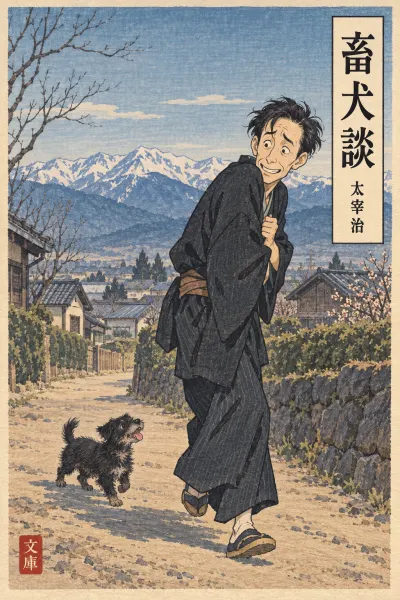
畜犬談 Chikukendan, part 4: An Ugly Shadow with a Taste for Battle
In this part
Pochi grows into a long-bodied, short-legged, turtle-like dog who follows the narrator everywhere and embarrasses him in public. He then starts picking fights with every dog he meets, until a huge German shepherd toys with him and leaves him timid. The narrator says he detests dogfights and fears and loathes Pochi, and he imagines the enemy dog in such a fight turning on him instead.
AI translation · independently checked
「こういう冗談はしないでおくれ。じつに、困るのだ。誰が君に、こんなことをしてくれとたのみましたか?」"Please don't play jokes like this on me. It really puts me in a fix. Who asked you to do me any such favour?"
と、私は、内に針を含んだ言葉を、精いっぱい優しく、いや味をきかせて言ってやることもあるのだが、犬は、きょろりと眼を動かし、いや味を言い聞かせている当の私にじゃれかかる。So I sometimes tell him, in words with a needle hidden inside, as gently as I possibly can yet with a good dose of sarcasm. But the dog merely rolls his eyes about and frolics up to the very man who is lecturing him so sarcastically: me.
なんという甘ったれた精神であろう。What a spoiled, wheedling spirit!
私はこの犬の鉄面皮には、ひそかに呆れ、これを軽蔑さえしたのである。I was privately dumbfounded at this dog's brazen effrontery, and I even held it in contempt.
長ずるに及んで、いよいよこの犬の無能が暴露された。As he grew up, the dog's utter uselessness was laid ever more bare.
だいいち、形がよくない。To begin with, his shape is poor.
幼少のころには、も少し形の均斉もとれていて、あるいは優れた血が雑っているのかもしれぬと思わせるところあったのであるが、それは真赤ないつわりであった。In his puppyhood his proportions had been somewhat better balanced, and there was something about him that made one think some fine blood might be mixed in him, but that proved to be a barefaced lie.
胴だけが、にょきにょき長く伸びて、手足がいちじるしく短い。His body alone has stretched out longer and longer, while his legs are remarkably short.
亀のようである。He is like a turtle.
見られたものでなかった。He was not fit to be seen.
そのような醜い形をして、私が外出すればかならず影のごとくちゃんと私につき従い、少年少女までが、やあ、へんてこな犬じゃと指さして笑うこともあり、多少見栄坊の私は、いくらすまして歩いても、なんにもならなくなるのである。Shaped as unsightly as that, he would follow at my heels like a shadow whenever I went out. Sometimes even boys and girls would point and laugh, "Hey, what a funny-looking dog!" And so I, being something of a show-off, found that however composed an air I put on as I walked, it all came to nothing.
いっそ他人のふりをしようと早足に歩いてみても、ポチは私の傍を離れず、私の顔を振り仰ぎ振り仰ぎ、あとになり、さきになり、からみつくようにしてついてくるのだから、どうしたって二人は他人のようには見えまい。Even when I quickened my pace, thinking I might as well pretend we were strangers, Pochi would not leave my side. He kept looking up into my face again and again, now behind me, now ahead, twining about me as he followed, so that no matter what, the two of us could hardly look like strangers.
気心の合った主従としか見えまい。We could only look like a master and servant of one heart and mind.
おかげで私は外出のたびごとに、ずいぶん暗い憂欝な気持にさせられた。Thanks to him, every single time I went out I was made to feel thoroughly dark and gloomy.
いい修行になったのである。It was excellent spiritual discipline.
ただ、そうして、ついて歩いていたころは、まだよかった。Still, the days when he merely trailed after me were not so bad.
そのうちにいよいよ隠してあった猛獣の本性を暴露してきた。Before long he at last revealed the true nature of the savage beast he had been concealing.
喧嘩格闘を好むようになったのである。He took a liking to quarrels and combat.
私のお伴をして、まちを歩いて行きあう犬、行きあう犬、すべてに挨拶して通るのである。Escorting me through the streets of the town, he would greet every dog we met, one dog after another, as he passed.
つまりかたっぱしから喧嘩して通るのである。That is to say, he picked a fight with each and every one of them as he went.
ポチは足も短く、若年でありながら、喧嘩は相当強いようである。Though short in the leg and young in years, Pochi appears to be a fairly strong fighter.
空地の犬の巣に踏みこんで、一時に五匹の犬を相手に戦ったときはさすがに危く見えたが、それでも巧みに身をかわして難を避けた。When he barged into a dogs' lair on a vacant lot and took on five dogs at once, even he looked to be in danger, but he still nimbly dodged aside and escaped harm.
非常な自信をもって、どんな犬にでも飛びかかってゆく。With tremendous self-assurance he leaps at any dog whatsoever.
たまには勢負けして、吠えながらじりじり退却することもある。Now and then he is overwhelmed by the other dog's fury and retreats inch by inch, barking all the while.
声が悲鳴に近くなり、真黒い顔が蒼黒くなってくる。His voice comes close to a shriek, and his jet-black face turns a pale, bluish black.
いちど小牛のようなシェパアドに飛びかかっていって、あのときは、私が蒼くなった。Once he flew at a German shepherd the size of a calf, and on that occasion it was I who turned pale.
はたして、ひとたまりもなかった。Sure enough, he didn't stand a chance.
前足でころころポチをおもちゃにして、本気につきあってくれなかったのでポチも命が助かった。The shepherd merely rolled Pochi about with its forepaws like a toy and did not take him on in earnest, and that is how Pochi's life was spared.
犬は、いちどあんなひどいめに逢うと、大へん意気地がなくなるものらしい。It seems that once a dog has been through such a terrible ordeal, he loses a great deal of his nerve.
ポチは、それからは眼に見えて、喧嘩を避けるようになった。From then on Pochi visibly began to avoid fights.
それに私は、喧嘩を好まず、否、好まぬどころではない、往来で野獣の組打ちを放置し許容しているなどは、文明国の恥辱と信じているので、かの耳を聾せんばかりのけんけんごうごう、きゃんきゃんの犬の野蛮のわめき声には、殺してもなおあき足らない憤怒と憎悪を感じているのである。Moreover, I do not like fights. Nay, it goes far beyond not liking them: I hold that to leave wild beasts grappling in the public street, and to tolerate it, is a disgrace to a civilized nation. And so, toward that ear-splitting yapping and yelping, that barbarous howling of dogs, I feel a fury and loathing that even killing them would not appease.
私はポチを愛してはいない。I do not love Pochi.
恐れ、憎んでこそいるが、みじんも愛しては、いない。Fear him and hate him I certainly do, but love him? Not one jot.
死んでくれたらいいと思っている。I think it would be a fine thing if he would only die.
私にのこのこついてきて、何かそれが飼われているものの義務とでも思っているのか、途で逢う犬、逢う犬、かならず凄惨に吠えあって、主人としての私は、そのときどんなに恐怖にわななき震えていることか。He comes ambling brazenly after me, and, perhaps believing it to be the duty of a kept dog, with every dog we meet on the road, every single one, he never fails to trade ghastly barks. And how I, as his master, tremble and quake with terror at such moments!
自動車呼びとめて、それに乗ってドアをばたんと閉じ、一目散に逃げ去りたい気持なのである。I feel like hailing a motorcar, jumping in, slamming the door, and fleeing at full tilt.
犬同士の組打ちで終るべきものなら、まだしも、もし敵の犬が血迷って、ポチの主人の私に飛びかかってくるようなことがあったら、どうする。If it were only going to end as a scuffle between the dogs themselves, well and good. But what if the enemy dog, losing its head, should leap at me, Pochi's master?
ないとは言わせぬ。I will not have anyone tell me that it could never happen.
血に飢えたる猛獣である。It is a ravening beast that thirsts for blood.
何をするか、わかったものでない。There is no telling what it might do.
私はむごたらしく噛み裂かれ、三、七、二十一日間病院に通わなければならぬ。I would be cruelly torn to pieces and have to go to the hospital for three times seven, that is, twenty-one days.
犬の喧嘩は、地獄である。A dogfight is hell itself.
私は、機会あるごとにポチに言い聞かせた。At every opportunity I lectured Pochi.
Vocabulary
| Word | Meaning | JLPT |
|---|---|---|
| 鉄面皮てつめんぴ | brazen nerve, shamelessnessLiterally 'iron-faced skin': someone too thick-skinned to feel shame. | — |
| 呆れあきれる | to be dumbfounded, to be appalleddictionary form: 呆れるUsed for amazement mixed with disgust or exasperation. | N2 |
| 暴露ばくろ | exposure, being laid bare暴露する / 暴露される: to reveal or be revealed, usually something bad. | N1 |
| 均斉きんせい | symmetry, good proportions均斉がとれる = to be well proportioned. Modern texts usually write 均整. | — |
| 見栄坊みえぼう | vain person, show-off見栄 (vanity, keeping up appearances) + 坊 (a suffix for a type of person). | — |
| つき従いつきしたがう | to follow closely, to attend upondictionary form: つき従うNormally used of servants or retainers, so it is comic here. | — |
| 主従しゅじゅう | master and servant (read しゅじゅう here; しゅうじゅう is a variant reading)The reading is しゅじゅう, not しゅじゅう with a long う at the end. | — |
| 修行しゅぎょう | ascetic training, spiritual disciplineOriginally a Buddhist term for practice and self-training. | N1 |
| 本性ほんしょう | true nature, real characterOften in 本性を現す / 暴露する, 'to show one's true colours'. | — |
| 退却たいきゃく | retreatA military word, which adds to the mock-heroic tone. | — |
| 意気地いくじ | nerve, backbone, gutsIrregular reading. 意気地がない = spineless, cowardly. | — |
| 恥辱ちじょく | disgrace, shameA formal, strong word for public dishonour. | — |
| 一目散いちもくさん | at full speed, headlongAlmost always 一目散に逃げる / 走る. | — |
| 血迷ってちまよう | to go mad, to lose one's headdictionary form: 血迷うLiterally 'blood-strayed': losing reason in rage or excitement. | — |
Grammar
〜ないでおくれ N3 please don't…
〜ないでおくれ means 'please don't…'. おくれ is お + くれ, a soft, familiar imperative of くれる. It is not related to 遅れる ('to be late'). It turns a negative て-form into a gentle request to someone close or of lower status. Here the narrator mock-pleads with the dog. (example: こういう冗談はしないでおくれ。 — Please don't play jokes like this on me.)
こういう冗談はしないでおくれ。
Please don't play jokes like this on me.
〜まい N2 probably not, surely not
After a verb, まい expresses a negative guess, much like ないだろう. 見えまい means 'would surely not look like'. It is formal and literary.
どうしたって二人は他人のようには見えまい。
No matter what, the two of us could hardly look like strangers.
〜どころではない N2 far from…, much more than…
This pattern says that the first statement is far too weak to describe the real situation. Here 好まぬどころではない means 'it is far beyond merely not liking them', which sets up the narrator's grand denunciation.
否、好まぬどころではない
nay, it goes far beyond not liking them
〜んばかり N1 as if about to…, almost…
ん is the classical volitional む, and 〜んばかり means 'all but doing'. 聾せんばかり means 'almost enough to deafen'. It is a literary form for exaggeration.
かの耳を聾せんばかりのけんけんごうごう
that ear-splitting yapping and yelping
〜てこそいるが N2 I certainly do…, but…
こそ strongly marks one thing as true, and the following が contrasts it with what is not true. The narrator admits fear and hatred so that he can deny love all the more firmly.
恐れ、憎んでこそいるが、みじんも愛しては、いない。
Fear him and hate him I certainly do, but love him? Not one jot.
どんなに〜ことか N2 how very…!
どんなに (or どれほど) with 〜ことか at the end of a sentence makes it an exclamation about the degree of a feeling. Here it stresses how much the narrator trembles in terror.
主人としての私は、そのときどんなに恐怖にわななき震えていることか。
How I, as his master, tremble and quake with terror at such moments!