Part 3 of 8 · JLPT N2
畜犬談 Chikukendan, part 3: The Black Puppy Moves In
In this part
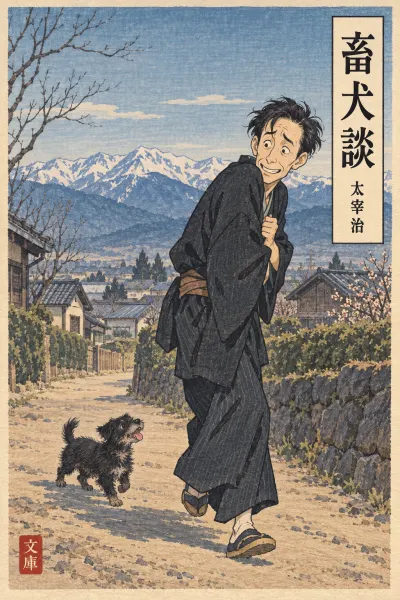
Out on a walk past the regimental parade ground, the narrator is trailed by stray dogs as usual, but one tiny, scruffy black puppy follows him all the way home. Too afraid to drive it off roughly, he tries to placate it with sweets, and it settles into his house for good. Although he nursed it from a starving foundling into a healthy dog, named Pochi, he still cannot feel at ease with it, and complains that it repays him by chewing clogs and dragging the laundry through the mud.
AI translation · independently checked
その犬が、私を特に好んで、尾を振って親愛の情を表明してくるに及んでは、狼狽とも、無念とも、なんとも、いいようがない。And when that dog goes so far as to take a special liking to me, wagging its tail to show its affection, I cannot call what I feel dismay, or mortification, or anything else; there are no words for it.
あまりに犬の猛獣性を畏敬し、買いかぶり節度もなく媚笑を撒きちらして歩いたゆえ、犬は、かえって知己を得たものと誤解し、私を組みしやすしとみてとって、このような情ない結果に立ちいたったのであろうが、何事によらず、ものには節度が大切である。Perhaps it was because I held the dog's savage nature in such excessive awe, overrated it, and went about scattering fawning smiles without the least restraint, that the dog mistook me for a kindred spirit, sized me up as an easy mark, and brought matters to this pitiful pass. Be that as it may, in all things whatsoever, moderation is what matters.
私は、いまだに、どうも、節度を知らぬ。I, alas, still know nothing of moderation.
早春のこと。It happened in early spring.
夕食の少しまえに、私はすぐ近くの四十九聯隊の練兵場へ散歩に出て、二、三の犬が私のあとについてきて、いまにも踵をがぶりとやられはせぬかと生きた気もせず、けれども毎度のことであり、観念して無心平生を装い、ぱっと脱兎のごとく逃げたい衝動を懸命に抑え、抑え、ぶらりぶらり歩いた。A little before supper I went out for a stroll to the parade ground of the Forty-Ninth Regiment close by. Two or three dogs fell in behind me, and I was half dead with the dread that at any moment one of them would sink its fangs into my heel. Yet this happened every time, so I resigned myself to it and put on an air of serene indifference. With all my might I held back, held back, the urge to bolt like a startled hare, and ambled idly along.
犬は私についてきながら、みちみちお互いに喧嘩などはじめて、私は、わざと振りかえって見もせず、知らぬふりして歩いているのだが、内心、じつに閉口であった。As they followed me, the dogs started fighting among themselves along the way. I made a point of never looking round and walked on as though I noticed nothing, but inwardly I was utterly at my wits' end.
ピストルでもあったなら、躊躇せずドカンドカンと射殺してしまいたい気持であった。Had I possessed a pistol, I should have liked to shoot them dead without a moment's hesitation, bang, bang.
犬は、私にそのような、外面如菩薩、内心如夜叉的の奸佞の害心があるとも知らず、どこまでもついてくる。Never suspecting that I harboured such treacherous malice, outwardly a bodhisattva and inwardly a demon, the dogs followed me wherever I went.
練兵場をぐるりと一廻りして、私はやはり犬に慕われながら帰途についた。I made one full circuit of the parade ground and set off for home, still pursued by my canine admirers.
家へ帰りつくまでには、背後の犬もどこかへ雲散霧消しているのが、これまでの、しきたりであったのだが、その日に限って、ひどく執拗で馴れ馴れしいのが一匹いた。Until then it had always been the custom that, by the time I reached home, the dogs behind me would have vanished like mist into thin air. That day of all days, however, there was one that was exceedingly persistent and overfamiliar.
真黒の、見るかげもない小犬である。It was a pitch-black puppy in a truly wretched state.
ずいぶん小さい。It was very small indeed.
胴の長さ五寸の感じである。Its body looked about five inches long.
けれども、小さいからといって油断はできない。But one must not drop one's guard just because a creature is small.
歯は、すでにちゃんと生えそろっているはずである。Its teeth, surely, had already come in, every one of them.
噛まれたら病院に三、七、二十一日間通わなければならぬ。If it bit me, I would have to go to the hospital for three times seven, twenty-one days.
それにこのような幼少なものには常識がないから、したがって気まぐれである。Moreover, such a young creature has no common sense, and is therefore capricious.
いっそう用心をしなければならぬ。All the more reason to be on my guard.
小犬は後になり、さきになり、私の顔を振り仰ぎ、よたよた走って、とうとう私の家の玄関まで、ついてきた。The puppy now fell behind, now ran ahead, gazing up into my face as it tottered along, until at last it had followed me right to my own front door.
「おい。へんなものが、ついてきたよ」"Hey. Some weird thing's followed me home."
「おや、可愛い」"Oh my, how cute!"
「可愛いもんか。追っ払ってくれ、手荒くすると喰いつくぜ、お菓子でもやって」"Cute, my foot. Get rid of it. If you're rough with it, it'll bite, so give it a sweet or something."
れいの軟弱外交である。My usual policy of spineless diplomacy.
小犬は、たちまち私の内心畏怖の情を見抜き、それにつけこみ、ずうずうしくもそれから、ずるずる私の家に住みこんでしまった。The puppy instantly saw through the dread I was hiding, took full advantage of it, and from then on brazenly drifted into living in my house.
そうしてこの犬は、三月、四月、五月、六、七、八、そろそろ秋風吹きはじめてきた現在にいたるまで、私の家にいるのである。And so this dog has been in my house through March, April, May, June, July, August, right up to the present, when the autumn wind is just beginning to blow.
私は、この犬には、幾度泣かされたかわからない。I cannot count how many times this dog has driven me to tears.
どうにも始末ができないのである。There is simply nothing to be done about it.
私はしかたなく、この犬を、ポチなどと呼んでいるのであるが、半年もともに住んでいながら、いまだに私は、このポチを、一家のものとは思えない。Having no choice, I call this dog by some such name as Pochi, yet although we have lived together for half a year, I still cannot think of Pochi as one of the family.
他人の気がするのである。It feels like a stranger.
しっくりゆかない。We do not get along.
不和である。We are at odds.
お互い心理の読みあいに火花を散らして戦っている。We do battle, sparks flying, each trying to read the other's mind.
そうしてお互い、どうしても釈然と笑いあうことができないのである。And try as we might, we can never laugh together with an easy heart.
はじめこの家にやってきたころは、まだ子供で、地べたの蟻を不審そうに観察したり、蝦蟇を恐れて悲鳴を挙げたり、その様には私も思わず失笑することがあって、憎いやつであるが、これも神様の御心によってこの家へ迷いこんでくることになったのかもしれぬと、縁の下に寝床を作ってやったし、食い物も乳幼児むきに軟らかく煮て与えてやったし、蚤取粉などからだに振りかけてやったものだ。When it first came to this house it was still a baby. It would study the ants on the ground with a puzzled look, or yelp in terror at a toad, and the sight sometimes made even me laugh in spite of myself. Hateful as the creature was, I thought that perhaps it had strayed into this house by the will of God, so I made it a bed under the veranda, cooked its food soft as for an infant, and even sprinkled flea powder over it.
けれども、ひとつき経つと、もういけない。But once a month had passed, it was hopeless.
そろそろ駄犬の本領を発揮してきた。Little by little it began to reveal its true nature as a mongrel.
いやしい。It is base.
もともと、この犬は練兵場の隅に捨てられてあったものにちがいない。This dog must originally have been abandoned in a corner of the parade ground.
私のあの散歩の帰途、私にまつわりつくようにしてついてきて、その時は、見るかげもなく痩せこけて、毛も抜けていてお尻の部分は、ほとんど全部禿げていた。On my way home from that walk it tagged along, practically clinging to me, and at the time it was wretchedly emaciated, its fur was falling out, and its rump was almost entirely bald.
私だからこそ、これに菓子を与え、おかゆを作り、荒い言葉一つかけるではなし、腫れものにさわるように鄭重にもてなしてあげたのだ。It was precisely because I am who I am that I gave it sweets, made it rice porridge, never spoke a single harsh word to it, and treated it with the gingerly courtesy of someone handling a boil.
ほかの人だったら、足蹴にして追い散らしてしまったにちがいない。Anyone else would surely have kicked it and sent it packing.
私のそんな親切なもてなしも、内実は、犬に対する愛情からではなく、犬に対する先天的な憎悪と恐怖から発した老獪な駈け引きにすぎないのであるが、けれども私のおかげで、このポチは、毛並もととのい、どうやら一人まえの男の犬に成長することを得たのではないか。In truth, my kind treatment sprang not from any love of dogs but was nothing more than a cunning manoeuvre born of my innate hatred and fear of them. Nevertheless, was it not thanks to me that Pochi's coat grew sleek and that he managed, after a fashion, to grow into a full-fledged male dog?
私は恩を売る気はもうとうないけれども、少しは私たちにも何か楽しみを与えてくれてもよさそうに思われるのであるが、やはり捨犬はだめなものである。I have not the slightest wish to make him feel indebted, yet it does seem to me he might give us a little pleasure of some kind in return. But a stray, it seems, is a hopeless thing after all.
大めし食って、食後の運動のつもりであろうか、下駄をおもちゃにして無残に噛み破り、庭に干してある洗濯物を要らぬ世話して引きずりおろし、泥まみれにする。He wolfs down a huge meal and then, perhaps by way of after-dinner exercise, turns our wooden clogs into toys and chews them to shreds, or, in a show of unwanted helpfulness, drags down the washing hung out to dry in the garden and gets it covered in mud.
Vocabulary
| Word | Meaning | JLPT |
|---|---|---|
| 狼狽ろうばい | dismay, flustered panicFormal word. 狼狽する means 'to be thrown into confusion'. | — |
| 節度せつど | moderation, restraintOften used in 節度を守る (to keep within proper limits). | — |
| 誤解ごかい | misunderstanding誤解する: to misunderstand or mistake one thing for another. | N3 |
| 閉口へいこう | being at one's wits' end, fed upLiterally 'closing the mouth', meaning to be left speechless with annoyance. | N1 |
| 執拗しつよう | persistent, relentlessA na-adjective with a negative nuance. | — |
| 油断ゆだん | carelessness, dropping one's guard油断できない: you can't let your guard down. | N2 |
| 用心ようじん | caution, care用心する: to be careful or on guard. | N3 |
| 軟弱外交なんじゃくがいこう | weak-kneed diplomacyA political term borrowed jokingly for the narrator's appeasement of dogs. | — |
| 見抜きみぬく | to see throughdictionary form: 見抜く見る + 抜く (pierce through): to detect someone's hidden feelings. | — |
| 始末しまつ | dealing with, disposal始末ができない / 始末に負えない: unmanageable, impossible to deal with. | N1 |
| 釈然しゃくぜん | with all doubts cleared, easy at heartLiterary. Usually negative: 釈然としない means 'not quite satisfied'. | — |
| 駄犬だけん | mongrel, worthless curThe prefix 駄 means 'worthless' or 'low grade', as in 駄菓子 (cheap sweets). | — |
| 本領ほんりょう | true character, real nature本領を発揮する: to show what one is really made of. Ironic here. | — |
| 恩を売るおんをうる | to do a favour expecting gratitudeLiterally 'to sell a kindness'. | — |
Grammar
〜に及んでは N1 when it comes to the point of ~
This marks that a situation has reached an extreme stage, and the main clause gives the speaker's reaction to it. Here it stresses that the dog's affection is the last straw.
尾を振って親愛の情を表明してくるに及んでは、狼狽とも、無念とも、なんとも、いいようがない。
when it comes to wagging its tail to proclaim its affection, I cannot say whether it is dismay or mortification.
〜ゆえ N1 because of ~, therefore
ゆえ (故) is a literary equivalent of から or ので. It adds to the narrator's pompous, old-fashioned tone.
節度もなく媚笑を撒きちらして歩いたゆえ
because I went about scattering fawning smiles without restraint
〜のごとく N1 like ~, as if ~
ごとく is the classical form of ように. 脱兎のごとく ('like a fleeing hare') is a set phrase for running away at top speed.
ぱっと脱兎のごとく逃げたい衝動を懸命に抑え
desperately holding back the urge to bolt like a startled hare
〜に限って N2 on that particular occasion only (unusually)
This marks one occasion that breaks the usual pattern, often with a sense of bad luck. Here the usual routine fails on this one day.
その日に限って、ひどく執拗で馴れ馴れしいのが一匹いた。
That day of all days, there was one that was exceedingly persistent and overfamiliar.
〜からといって N3 just because ~ (doesn't mean)
This rejects the obvious conclusion from a reason, and it is usually followed by a negative. Being small does not make the puppy safe.
小さいからといって油断はできない。
One must not drop one's guard just because it is small.
〜にすぎない N3 nothing more than ~
This downplays something as merely or only X. The narrator admits his kindness was only a calculated tactic.
老獪な駈け引きにすぎないのであるが
it was nothing more than a cunning manoeuvre