Upper intermediate · JLPT N2
鏡地獄Kagamijigoku — A Torment of Mirrors
- JLPT N2
- 14,018 characters
- 10 parts
- about 117 minutes
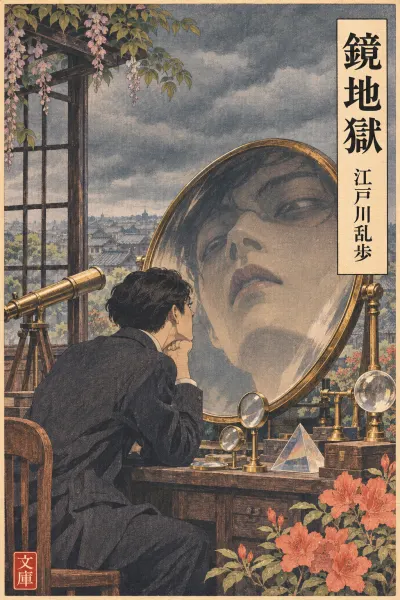
A Torment of Mirrors is a short tale of obsession by Edogawa Ranpo. It opens with a brief frame: on a heavy, overcast day near the end of spring, a group has been trading strange stories, and K offers the last one. It concerns a friend whose boyhood fascination with lenses, prisms and mirrors grows, as he comes into money and freedom, into something darker. In a hilltop laboratory above the city he builds ever more elaborate optical devices. The story's horror comes less from events than from images: a face swelling to fill a wall, a room lined with mirrors, reflections that will not behave. K tells it in a measured, confiding spoken style, addressing his listeners directly. For a learner this is rewarding because the plot is easy to follow and builds steadily. The challenges are the early-twentieth-century language, with archaic negatives and conjectures, and a cluster of optics vocabulary that returns again and again. The descriptions of illusions are dense and abstract in places, so expect to reread a few passages slowly.
Contents
- A Boy Who Loved Mirrors and Lenses
- From a Magic Mirror to Lens Madness
- A Phantom Banknote and Growing Madness
- Telescopes, Fleas and a Giant Face
- Giant Faces and a Room of Mirrors
- A Glass Factory in the Garden
- Phantasmagoria and the Final Madness
- The Rolling Glass Ball
- Madness Inside the Mirror Sphere
- Inside the Sphere of Madness
Before you read
- Learn the optics words first, because the whole story depends on them: 鏡 (かがみ), レンズ, 凹面鏡 (おうめんきょう, concave mirror), 凸面鏡 (とつめんきょう), 望遠鏡 (ぼうえんきょう), 顕微鏡 (けんびきょう), プリズム, 反射 (はんしゃ), 映る/映す (うつる/うつす).
- Notice the shift in register. The short opening frame is in plain literary だ/である style, and K's tale is in polite spoken です/ます style, with forms such as 申す and 〜でありましょう. The servants use humble and honorific speech.
- Expect older negative and conjectural forms: 〜ぬ for 〜ない, 〜まい ('surely not' or 'will not'), and 〜のではあるまいか ('might it not be that…'). K often uses the last one when he speculates about his friend.
- K describes his friend's habits with 〜ては〜ていたものです ('he would … and then …'). Related patterns are 〜たびに ('every time') and 〜ほかはない ('there was nothing to do but').
- The friend gives K commands with 〜たまえ (a familiar, slightly lordly 'do …'). When K stresses the limits of description, watch for 〜べくもない ('could not possibly') and 〜にすぎない ('no more than').
Words to know
The most useful words from the notes across the story.
| Word | Meaning | JLPT |
|---|---|---|
| 凹面鏡おうめんきょう | concave mirror凹 'hollow' is the opposite of 凸 'bulging' (凸面鏡, convex mirror). | — |
| 手ごたえてごたえ | resistance felt in the handdictionary form: 手応えAlso used figuratively for a 'response' or 'sense that something has worked'. | — |
| 小間使こまづかい | maid, chambermaiddictionary form: 小間使いA maid who attends to personal needs in a household. | — |
| 種たね | the secret of a trickBasic meaning 'seed'; 手品の種 is the hidden mechanism of a magic trick. | N3 |
| 莫大ばくだい | enormous; vast (of money or quantity)Commonly paired with 財産 or 費用. | N3 |
| 募ってつのる | to grow stronger; to get worsedictionary form: 募るAlso means 'to recruit, to collect' (募集). | N1 |
| 道楽どうらく | hobby; indulgent pastimeOften suggests a self-indulgent passion; 道楽息子 means 'a spoiled, idle son'. | — |
| 戦慄せんりつ | shudder of horror; tremblingLiterary word; often appears as 戦慄を覚える. | — |
| 耽溺たんでき | losing oneself in, indulging inLiterary word, often used for unhealthy absorption in a pleasure. | — |
| 形相ぎょうそう | facial expression, look (usually fearsome)Used for frightening or intense expressions. | — |
| うごめいているうごめく | to wriggle, to stir, to squirmdictionary form: 蠢くSuggests slow, creepy movement. | — |
| 盥たらい | washtub, basin | — |
| 刹那せつな | instant, momentA Buddhist word for the shortest unit of time; literary. | — |
| 夢中むちゅう | absorbed, crazy about〜に夢中になる: to become absorbed in something. | N3 |
| 装置そうち | device, apparatus | N3 |
Plot summary
Show the full summary (contains spoilers)
K tells of a friend whose family kept foreign curiosities from a Christian ancestor. As a boy the friend loves anything that reflects images. In middle school a concave mirror enchants him, and he begins building optical tricks. He sets up a garden laboratory, and when his parents die of influenza he inherits a fortune and can do as he likes. He spies on houses and servants through telescopes, torments fleas under a microscope, projects his own giant face, and builds a mirrored room he shares with his maid and lover. His health and sanity decline. One morning K is summoned and finds a large glass ball rolling about the laboratory, with laughter coming from inside. He smashes it, and the friend crawls out, completely mad. The ball was a sphere mirrored on the inside, which the friend had secretly ordered. K suspects he entered it to gaze at his reflections. The friend dies still mad.
About the author
His pen name is a Japanese rendering of the name of Edgar Allan Poe, whom he admired. He began with detective stories such as 二銭銅貨 and went on to create the detective Akechi Kogorō. He also wrote many tales of the grotesque and the perverse, of which 人間椅子 is a famous example. Later he wrote the popular Boy Detectives series for young readers and promoted the mystery genre as an editor and critic. Japan's Edogawa Rampo Prize for mystery fiction is named after him.