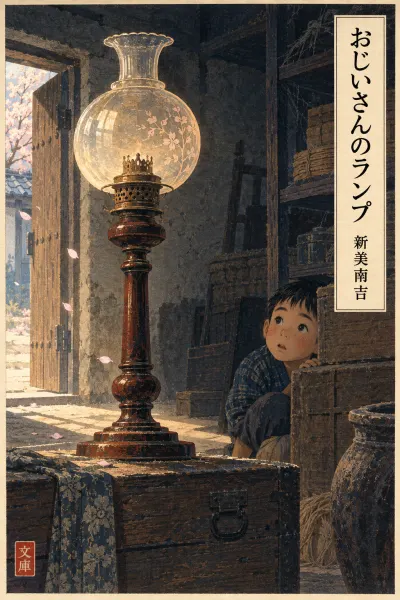
Part 4 of 9 · JLPT N2
おじいさんのランプ Ojiisan no Ranpu, part 4: Minosuke Becomes a Lamp Seller
In this part
Minosuke persuades the lamp shop owner in Ōno to sell him a lamp at the wholesale price, and he carries it home through the dark pass, full of hope. At first no one in the village trusts the new invention, so he lends the lamp for free to the old woman who keeps the village's only shop. Delighted with how bright and useful it is, she buys it, orders from other villagers soon follow, and Minosuke happily devotes himself to selling lamps across the villages.
AI translation · independently checked
「卸値で売れって、そりゃ相手がランプを売る家なら卸値で売ってあげてもいいが、一人一人のお客に卸値で売るわけにはいかんな」Sell it at the wholesale price, you say? Well, if the buyer were a shop that sells lamps, I wouldn't mind selling at wholesale, but I can't go selling at wholesale to every single customer, now, can I?
「ランプ屋なら卸値で売ってくれるだのイ?」So if it's a lamp seller, you'll sell at wholesale, is that right?
「ああ」"Sure."
「そんなら、おれ、ランプ屋だ。卸値で売ってくれ」"Then I'm a lamp seller. Sell it to me at wholesale."
店の人はランプを持ったまま笑い出した。The shopkeeper, still holding the lamp, burst out laughing.
「おめえがランプ屋? はッはッはッはッ」"You, a lamp seller? Ha, ha, ha, ha!"
「ほんとうだよ、おッつあん。おれ、ほんとうにこれからランプ屋になるんだ。な、だから頼むに、今日は一つだけンど卸値で売ってくれや。こんど来るときゃ、たくさん、いっぺんに買うで」"It's true, mister. I really am going to be a lamp seller from now on. So please, today it's only one, but sell it to me at wholesale, won't you? Next time I come, I'll buy a whole lot at once."
店の人ははじめ笑っていたが、巳之助の真剣なようすに動かされて、いろいろ巳之助の身の上をきいたうえ、At first the shopkeeper laughed, but he was moved by how earnest Minosuke was, and after asking him all about his circumstances,
「よし、そんなら卸値でこいつを売ってやろう。ほんとは卸値でもこのランプは十五銭じゃ売れないけど、おめえの熱心なのに感心した。負けてやろう。そのかわりしっかりしょうばいをやれよ。うちのランプをどんどん持ってって売ってくれ」"All right, then, I'll let you have this one at wholesale. To tell the truth, even at wholesale I couldn't sell this lamp for fifteen sen, but I'm impressed by how keen you are. I'll knock the price down for you. In return, mind you run your business properly. Take plenty of our lamps and sell them for us."
といって、ランプを巳之助に渡した。he said, and handed the lamp to Minosuke.
巳之助はランプのあつかい方を一通り教えてもらい、ついでに提燈がわりにそのランプをともして、村へむかった。Minosuke was shown the basics of how to handle the lamp, and then, while he was at it, lit it to use in place of a paper lantern and set off toward his village.
藪や松林のうちつづく暗い峠道でも、巳之助はもう恐くはなかった。Even on the dark mountain path over the pass, lined all the way with thickets and pine woods, Minosuke was no longer afraid.
花のように明かるいランプをさげていたからである。For he was carrying a lamp as bright as a flower.
巳之助の胸の中にも、もう一つのランプがともっていた。In Minosuke's heart, too, another lamp had been lit.
文明開化に遅れた自分の暗い村に、このすばらしい文明の利器を売りこんで、村人たちの生活を明かるくしてやろうという希望のランプが――It was a lamp of hope: the hope of bringing this wonderful tool of civilisation to his own dark village, left behind by civilisation and enlightenment, and of brightening the lives of the villagers—
巳之助の新しいしょうばいは、はじめのうちまるではやらなかった。At first, Minosuke's new business did not catch on at all.
百姓たちは何でも新しいものを信用しないからである。That was because the farmers had no trust in anything new.
そこで巳之助はいろいろ考えたあげく、村で一軒きりのあきないやへそのランプを持っていって、ただで貸してあげるからしばらくこれを使って下さいと頼んだ。So, after much thought, Minosuke took the lamp to the only shop in the village and asked them to use it for a while, saying he would lend it to them for free.
雑貨屋の婆さんは、しぶしぶ承知して、店の天井に釘を打ってランプを吊し、その晩からともした。The old woman who kept the general store reluctantly agreed, hammered a nail into the shop's ceiling, hung the lamp from it, and lit it from that evening on.
五日ほどたって、巳之助が草鞋を買ってもらいに行くと、雑貨屋の婆さんはにこにこしながら、こりゃたいへん便利で明かるうて、夜でもお客がよう来てくれるし、釣銭をまちがえることもないので、気に入ったから買いましょう、といった。About five days later, when Minosuke went to get her to buy some straw sandals from him, the old woman at the general store said with a big smile that the lamp was very handy and bright, that customers came in plenty even at night, and that she never made mistakes with the change any more, so she liked it and would buy it.
その上、ランプのよいことがはじめてわかった村人から、もう三つも注文のあったことを巳之助にきかしてくれた。On top of that, she told Minosuke that villagers who had now seen for the first time how good lamps were had already ordered as many as three of them.
巳之助はとびたつように喜んだ。Minosuke was so happy he could have flown.
そこで雑貨屋の婆さんからランプの代と草鞋の代を受けとると、すぐその足で、走るようにして大野へいった。So, taking the money for the lamp and the sandals from the old woman at the general store, he went straight off to Ōno, almost at a run.
そしてランプ屋の主人にわけを話して、足りないところは貸してもらい、三つのランプを買って来て、注文した人に売った。There he explained things to the owner of the lamp shop, borrowed what he was short, bought three lamps, brought them back, and sold them to the people who had ordered them.
これから巳之助のしょうばいははやって来た。From then on, Minosuke's business began to flourish.
はじめは注文をうけただけ大野へ買いにいっていたが、少し金がたまると、注文はなくてもたくさん買いこんで来た。At first he went to Ōno to buy only as many as he had orders for, but once he had saved a little money, he bought in plenty even without orders.
そして今はもう、よその家の走り使いや子守をすることはやめて、ただランプを売るしょうばいだけにうちこんだ。And now he gave up running errands and minding babies for other households, and threw himself entirely into the business of selling lamps.
物干台のようなわくのついた車をしたてて、それにランプやほやなどをいっぱい吊し、ガラスの触れあう涼しい音をさせながら、巳之助は自分の村や附近の村々へ売りにいった。He fitted out a cart with a frame like a clothes-drying rack, hung it full of lamps, lamp chimneys and the like, and, with the cool sound of glass clinking against glass, went round selling in his own village and the villages nearby.
巳之助はお金も儲かったが、それとは別に、このしょうばいがたのしかった。Minosuke made money, but quite apart from that, he enjoyed this business.
今まで暗かった家に、だんだん巳之助の売ったランプがともってゆくのである。One by one, in houses that had always been dark, the lamps Minosuke had sold were being lit.
暗い家に、巳之助は文明開化の明かるい火を一つ一つともしてゆくような気がした。Minosuke felt as if he were lighting the bright fire of civilisation and enlightenment in those dark houses, one after another.
Vocabulary
| Word | Meaning | JLPT |
|---|---|---|
| 卸値おろしね | wholesale priceFrom 卸す (to sell wholesale) + 値 (price). | — |
| 真剣しんけん | serious, earnestLiterally 'a real sword', as opposed to a wooden practice one. | N3 |
| 身の上みのうえ | one's circumstances, personal history | — |
| 感心かんしんする | to be impressed, to admiredictionary form: 感心するOften used by a senior person praising someone younger. | — |
| 負けてまける | to give a discount, knock the price downdictionary form: 負けるBesides 'to lose', a common shopping sense: 少し負けてください. | N4 |
| 峠道とうげみち | road over a mountain pass峠 is a kanji created in Japan: 山 + 上 + 下. | — |
| 文明ぶんめいかいか | civilisation and enlightenmentdictionary form: 文明開化Meiji-era slogan for Japan's adoption of Western ideas and technology. | — |
| 利器りき | useful device, convenient toolLiterary; mostly in 文明の利器 'the conveniences of civilisation'. | — |
| はやらなかったはやる | to catch on, to do good businessdictionary form: 流行るOf shops and businesses: to be thriving. | N2 |
| 信用しんようする | to trust, to have confidence indictionary form: 信用する | — |
| しぶしぶしぶしぶ | reluctantly, grudginglydictionary form: 渋々 | — |
| 承知しょうちする | to agree, consentdictionary form: 承知する | — |
| 釣銭つりせん | change (money given back)Today usually お釣り. | — |
| うちこんだうちこむ | to devote oneself to, throw oneself intodictionary form: 打ち込むUsed with に: 仕事に打ち込む. | N1 |
Grammar
〜わけにはいかない N3 cannot (for social or moral reasons)
Says something is impossible not physically but because it would be wrong or unreasonable. Here いかん is the colloquial contraction of いかない.
一人一人のお客に卸値で売るわけにはいかんな
I can't go selling at wholesale to every single customer
〜たまま N4 while still (in a state)
Verb in た-form + まま shows a state that continues unchanged while something else happens: he laughed without putting the lamp down.
店の人はランプを持ったまま笑い出した。
The shopkeeper, still holding the lamp, burst out laughing.
Dialect 〜に / 〜で / だのイ N1 sentence-final particles in Owari/Chita speech
In this local (Mikawa/Owari-type) dialect, sentence-final 〜に after a verb (頼むに) adds a softening, persuasive nuance like 'so…' or 'you see', and sentence-final 〜で (買うで) is an assertive particle like standard よ/ぞ ('I'll buy lots, I will'). だのイ seeks confirmation like standard だろう/だよね, and だけンど is だけど.
な、だから頼むに、今日は一つだけンど卸値で売ってくれや。こんど来るときゃ、たくさん、いっぺんに買うで
So please, today it's only one, but sell it to me at wholesale, won't you? Next time I come, I'll buy a whole lot at once.
〜てやろう N3 I'll do (something) for someone
てやる is the plain, downward version of てあげる, and the volitional やろう expresses resolve. Here it shows Minosuke's determination to brighten the villagers' lives.
村人たちの生活を明かるくしてやろうという希望のランプが
a lamp of hope of brightening the lives of the villagers
〜たあげく N2 after much (trouble/thought), finally
Follows a verb in た-form or a noun + の and marks the end result of a long or difficult process.
そこで巳之助はいろいろ考えたあげく
So, after much thought, Minosuke
〜ような気がする N3 to feel as if, to have the feeling that
Expresses a subjective impression rather than a fact; here Minosuke feels as if each lamp spreads civilisation itself.
文明開化の明かるい火を一つ一つともしてゆくような気がした。
He felt as if he were lighting the bright fire of civilisation and enlightenment, one after another.