Part 2 of 9 · JLPT N2
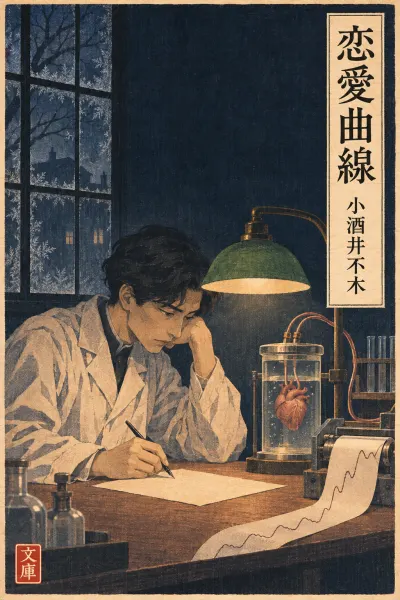
恋愛曲線 Ren'aikyokusen, part 2: Why a Jilted Man Studies the Heart
In this part
The narrator explains that after a heartbreak half a year ago he shut himself away in the laboratory and devoted himself to research on the heart. A letter announcing his friend's wedding stirred up his buried memories and led him to plan a gift, the 'love curve.' Before describing it, he explains that a heart cut from the body, even from a human corpse, can keep beating, and he imagines how his friend's and Yukie's hearts would beat if taken out and set side by side.
AI translation · independently checked
半ヶ年前に、失恋の痛手を負った僕は、その後世間の交渉を絶って、研究室に閉じこもり、ひたすら生理学的研究に従事した。Half a year ago, having suffered the wound of disappointed love, I broke off all dealings with the world, shut myself up in the laboratory, and devoted myself single-mindedly to physiological research.
それからというものは、研究そのものが僕の生命であり、又恋人であった。From that time on, research itself was my life, and my sweetheart as well.
時には、雨の日の前に古い肋膜炎の跡が痛み出すように、心の古傷も疼き出すことがあったが、何事も過去のことゝ諦めて、研究に邁進し、やっと近頃悲しい記憶を下積にすることが出来、君たちの結婚の日取までうっかり忘れるところであったが、先日はからずも、ある人から、君が愈よ明日結婚するという手紙を貰い、それがため、下積みにされた記憶が、非常な勢で浮み上り、遂に今回の贈り物を計画するに至ったのである。At times, just as the scar of an old pleurisy begins to ache before a rainy day, the old wound in my heart would begin to throb. Yet I resigned myself to the thought that it all belonged to the past, and pressed on with my research, and only lately had I succeeded in burying my sad memories so deep that I had very nearly forgotten even the date fixed for your wedding. But the other day, quite unexpectedly, I received a letter from someone telling me that you were at last to be married tomorrow. Because of it, the buried memories rose up again with tremendous force, and in the end they led me to plan the present gift.
君は実業家であるから、科学者なるものがどんな生活を営み、どんなことを考え、どんな研究を行って居るかということを恐らくは知るまいと思う。As you are a man of business, I imagine you have very likely no idea what sort of life those people called scientists lead, what sort of things they think about, or what sort of research they carry out.
外見上では、科学者の生活はいかにも冷たいものであり、又その研究事項はいかにも殺風景極まるものであるが、真の科学者は常に人類同胞を念頭に置き、人類に対する至上の愛を以て活動しつゝあるのであって、従って、真の科学者には――似而非科学者はいざ知らず……恐らく、誰よりも温かい血が流れて居るべき筈である。To outward appearance, the life of a scientist is cold indeed, and the matters he investigates are as dreary as can be. Yet the true scientist always keeps his fellow human beings in mind and works with the highest love for humanity; and so in the veins of the true scientist (I cannot speak for the false ones…) there ought, I dare say, to flow blood warmer than anyone else's.
実際誰よりも温い血が流れて居なくては真の科学者たることは出来ないのだ。In fact, unless blood warmer than anyone else's flows in his veins, a man cannot be a true scientist.
さて僕が、失恋の痛苦を味ってから選んだ研究題目は何であるかというに、君よ、笑うなかれ、心臓の生理学的研究だ。Now, what subject of research did I choose after tasting the pain of lost love? Do not laugh, my friend: it was the physiology of the heart.
然し僕は、ブロークン・ハートに因んで、この題目を選んだ訳では決して無い。But I by no means chose this subject as a play on the words 'broken heart.'
それほどの茶気は僕には無いのだ。I have no such taste for whimsy.
破れた心臓の修理を行うために、先ず心臓の研究に取りかゝったと言えば頗る小説的であるが、僕はたゞ、学生時代から心臓の機能に非常に興味を持って居たから、好きな題目を選んだのに過ぎない。If I were to say that I set about studying the heart first of all in order to repair a broken one, it would sound very much like a novel; but in truth I had been greatly interested in the workings of the heart since my student days, and I merely chose a subject I liked.
ところがこの偶然選んだ研究題目がはからずも役に立って、君の一生に最も目出度かるべき儀式に、恋愛曲線を贈り得るに至ったのである。As it happens, however, this subject, chosen by chance, has proved unexpectedly useful, so that I am able to present a love curve for what should be the most joyful ceremony of your life.
恋愛曲線!A love curve!
これから愈よ恋愛曲線の説明に移ろうと思うが、その前に一言、心臓が普通どんな方法で研究されて居るかを述べて置かねばならない。I shall now at last turn to an explanation of the love curve, but before that I must say a word about the methods by which the heart is ordinarily studied.
心臓の機能を完全に知るためには、心臓を体外へ切り出して検査するのが最もよい方法である。In order to understand the functions of the heart fully, the best method is to cut it out of the body and examine it.
心臓は、たといこれを体外へ切り出しても、適当な条件を与うれば、平気で搏動を続けるものだ。Even when the heart has been cut out of the body, provided it is given suitable conditions, it calmly goes on beating.
単に下等な動物の心臓ばかりでなく、一般温血動物から人間に至るまで、その心臓は身体を離れても独立に、拡張、収縮の二運動を繰り返すのだ。This is true not only of the hearts of lower animals: in warm-blooded animals generally, and even in human beings, the heart, though separated from the body, goes on independently repeating its two movements of dilation and contraction.
心臓を切り出せばその個体は死ぬ、個体は死んでも心臓は動き続ける!Cut out the heart and the individual dies; yet though the individual dies, the heart goes on moving!
何と不思議な現象ではないか。Is that not a marvellous phenomenon?
試みに今、君の心臓を取り出して搏たせて見たら、どんな状態だろうか、又、試みに今、雪江さんの心臓を切り出して搏たせて見たら、どんな状態だろうか。Suppose I were now to take out your heart and set it beating, what would it look like? And suppose I were now to cut out Miss Yukie's heart and set it beating, how would it behave?
更に君の心臓と雪江さんの心臓とを並べ搏たせたならば、どんな現象が見らるゝだろうか。And further, if I set your heart and Miss Yukie's heart beating side by side, what phenomena might be observed?
君!My friend!
手足や胴体を具えた人間には兎角偽りが多いが心臓は文字通り赤裸々だから、誰憚らぬ搏ち方をするにちがいない、結婚を目の前に控えた君たちの心臓を思って、このような愚にもつかぬ想像をめぐらせながら、僕は今、この手紙を書きつゝあるのだ。A human being furnished with arms, legs and a trunk is all too prone to falsehood, but the heart is, quite literally, naked, so it must surely beat without deferring to anyone. Thinking of the hearts of you two, with your wedding close at hand, and turning over such foolish fancies in my mind, I am now writing this letter.
思わずも記述がわき道へはいったが、動物は勿論人間の心臓も、その個体が死んだ後でさえ、これを切り出して適当な条件の下に置けば再び動き出すものだ。My account has wandered off onto a side path without my meaning it to, but the heart, not only of animals but of human beings as well, even after the individual has died, will start moving again if it is cut out and placed under suitable conditions.
クリアブコという人は、死後二十時間を経た人間の死体から、心臓を切り出して、これを動かして見たところが約一時間、たしかに動き続けたということだ。A man named Kuliabko cut the heart out of a human corpse twenty hours after death and tried to set it moving, and it is reported that it certainly continued to move for about an hour.
人間が死んでも、心臓だけが、二十時間も余計に生きて居るということは見様によって、如何に心臓が生に対する執着の強いものだかということを知るに足ろう。That the heart alone should remain alive for as much as twenty hours after the person has died is, in a certain light, enough to show how strong a heart's attachment to life is.
むかしの人が恋愛のシムボルとしてハートを選んだのも、偶然でないような気がする。I feel that it was no accident that people of old chose the heart as the symbol of love.
だから、考え様によっては、心臓にこそ、人生のあらゆる神秘が蔵せられて居るといってよいかも知れない。So, from one point of view, it may well be said that all the mysteries of human life are stored in the heart above all.
かくて、人生の神秘を探ろうと思った僕が、心臓を研究の対象としたのも、故無きに非ずと言えるだろう。Thus it may be said that it was not without reason that I, wishing to probe the mysteries of human life, made the heart the object of my research.
Vocabulary
| Word | Meaning | JLPT |
|---|---|---|
| 失恋しつれん | disappointed love; being rejected in love失 'lose' + 恋 'love'. | N2 |
| 痛手いたで | severe wound; heavy blowOften figurative: an emotional or financial blow. Used with 負う 'to suffer'. | — |
| 閉じこもりとじこもる | to shut oneself up, to stay indoors and cut offdictionary form: 閉じこもる | — |
| 疼き出すうずく | to throb, to achedictionary form: 疼くUsed for both physical pain and the ache of old emotional wounds. | — |
| 邁進しまいしんする | to press forward, to push on vigorouslydictionary form: 邁進するFormal written word. | — |
| 殺風景さっぷうけい | dreary, bleak, lacking charmHere strengthened by 極まる 'extremely'. | — |
| 似而非えせ | false, sham, pseudo-dictionary form: 似非Usually written 似非; this spelling comes from a classical Chinese phrase 'resembling but not.' | — |
| 茶気ちゃき | playfulness, a taste for jokesOld-fashioned; compare 茶目っ気 (ちゃめっけ). | — |
| 搏動はくどう | beating, pulsation (of the heart)Now usually written 拍動. 搏つ (うつ) 'to beat' appears later in the passage. | — |
| 収縮しゅうしゅく | contractionPaired here with 拡張 'dilation'. | — |
| 赤裸々せきらら | stark naked; utterly frank and unhiddenNormally figurative ('candid'); here used half-literally of the heart. | — |
| 憚らぬはばかる | to hold back out of deference or feardictionary form: 憚る誰憚らぬ = 'without regard for anyone'; ぬ is the literary negative. | — |
| 執着しゅうちゃく | attachment, clingingOften negative in tone: an attachment one cannot let go of. | N1 |
Grammar
〜に至る N2 to come to (the point of) ~; to end up ~ing
Attached to a dictionary-form verb, it marks the final result of a long chain of events. Here the revived memories finally lead the writer to plan his gift.
遂に今回の贈り物を計画するに至ったのである
in the end they led me to plan the present gift
〜まい N2 probably not ~ (negative conjecture)
まい after a verb expresses the speaker's guess that something is not the case. Here 知るまいと思う means 'I suppose you do not know.'
恐らくは知るまいと思う
I imagine you very likely have no idea
〜はいざ知らず N1 I can't speak for ~; ~ is another matter
It sets aside one case so as to make a point about another. The writer excludes false scientists from his claim about warm blood.
似而非科学者はいざ知らず
I cannot speak for the false ones
〜なかれ N1 do not ~ (classical prohibition)
なかれ follows the dictionary form of a verb to make a solemn, literary command not to do something. 笑うなかれ means 'do not laugh.'
君よ、笑うなかれ
Do not laugh, my friend
〜に過ぎない N2 merely ~; nothing more than ~
It plays a matter down to something simple. The writer insists that he merely chose a subject he liked, with no romantic motive.
好きな題目を選んだのに過ぎない
I merely chose a subject I liked
〜つつある N2 to be in the process of ~
Attached to the verb stem (written 〜つゝ in older texts), it describes an action in progress, in a formal written register. Here it stresses that the letter is being written at this very moment.
僕は今、この手紙を書きつゝあるのだ
I am now writing this letter