Upper intermediate · JLPT N2
恋愛曲線Ren'aikyokusen — A Curve for Love
- JLPT N2
- 13,469 characters
- 9 parts
- about 112 minutes
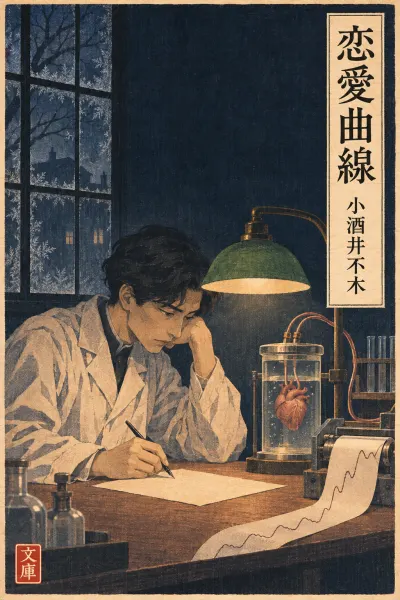
Kozakai Fuboku's 恋愛曲線 ("A Curve for Love"), published in January 1926, is a short story told entirely as one letter. On the night before his former rival's wedding, a poor physiologist sits in his laboratory and writes to the groom, A, about a wedding gift: a "love curve", recorded from a beating heart. As he explains, step by step, how he keeps excised hearts alive and traces their beats on photographic paper, the reader begins to sense that something about this gift is very wrong. The tone is courteous, ceremonious and coldly scientific all at once, and that contrast creates the story's unease. For learners, the challenge is the prose. It uses written plain style, kanbun-influenced phrasing such as 〜ねばならぬ and 〜せしめる, and real laboratory vocabulary. The reward is that the letter is built as a clear, stepwise explanation, so the logic is easy to follow even when individual sentences are dense. The final pages turn into short, urgent present-tense passages.
Contents
Before you read
- Learn the old written spellings early. 然し is しかし, and 居る (いる) appears where modern texts would use kana. Expect plain だ/である endings throughout, even though the letter is addressed to a person.
- Expect classical-flavoured grammar that recurs often: 〜ねばならぬ (must), 〜ざるを得ない (cannot help but), 〜せしめる/〜しめる (causative, "make something do"), 〜に過ぎない (no more than), and 〜つつある (in the process of). Recognising these on sight will unlock most of the long sentences.
- Pre-learn the laboratory vocabulary of Parts 3–6: 心臓 (heart), 摘出 (excision), 曲線 (curve), the term for Locke's solution, 心電計 (electrocardiograph), and 印画紙 (photographic paper). The method is explained in order, so these words repeat and build on each other.
- Read the polite, generous passages about A and Yukie with some suspicion. Much of the story's tension comes from the gap between the letter's ceremonious courtesy and what the experiments actually involve.
- In Part 9 the narration shifts into short present-tense entries written as events happen. Read them in that clipped rhythm, and pay attention to every mention of blood and of the heart's beating.
Words to know
The most useful words from the notes across the story.
| Word | Meaning | JLPT |
|---|---|---|
| 失恋しつれん | heartbreak, disappointment in love失恋させる means 'to break someone's heart'. | N2 |
| 搏動はくどう | beating, pulsation (of the heart)Now usually written 拍動. 搏つ (うつ) 'to beat' appears later in the passage. | — |
| 極致きょくち | the ultimate, the very height | — |
| 執着しゅうちゃく | attachment, clingingOften negative in tone: an attachment one cannot let go of. | N1 |
| 麻酔ますい | anaesthesia麻酔をかける means "to anaesthetise". | N1 |
| 情緒じょうちょ | emotion, feelingAlso read じょうしょ. In modern Japanese often 'atmosphere, charm' (情緒がある). | N1 |
| 静脈じょうみゃく | veinOpposite: 動脈 (どうみゃく, artery). Note じょう, not せい. | — |
| 凝固ぎょうこ | clotting, coagulation | — |
| 搏たせるうつ | to beat (of the heart or pulse)dictionary form: 搏つLiterary kanji; modern texts normally write 打つ. Compare 搏動 (はくどう), "heartbeat". | N4 |
| 刺戟しげき | stimulusOlder spelling; today it is written 刺激. | N3 |
| 所謂いわゆる | so-called; what one callsUsually written in kana today. 僕の所謂 means 'what I call.' | N3 |
| 頻りにしきりに | constantly; uncontrollably | N3 |
| 顫えるふるえる | to trembleOld kanji. The modern spelling is 震える. | N3 |
| 曲線きょくせん | curve (on a graph or recording)Key word of the story's title; opposite of 直線 (straight line). | N2 |
| 推定すいてい | inference, estimationCommon in news: 推定年齢 = estimated age. | N2 |
Plot summary
Show the full summary (contains spoilers)
On the eve of A's wedding to Yukie, the narrator, who lost her to A's wealth, writes to announce a unique gift. Since his heartbreak he has studied the heart. He keeps excised hearts beating with Locke's solution and records their motion with Einthoven's electrocardiograph. He then tries to record how emotions in the blood change these curves. Rabbits and dogs prove unsuitable, so he draws his own blood while reading moving novels. He revives the heart of a young woman who was abandoned by her lover. When it weakens, his blood makes it trace a "curve of lost love" before it stops. Reasoning that two such minuses should make a plus, he takes the heart of the woman who wrote to tell him of the marriage. Finally he reveals that this woman is Yukie, who fled her money-driven engagement and came to him. He feeds her heart his own arterial blood to record the curve, and as his blood runs out, her heart is about to stop.
About the author
Kozakai Fuboku (小酒井不木) was a Japanese medical scientist and writer from Aichi Prefecture. He settled in Nagoya, where he wrote widely on medicine, crime and detective fiction. He also produced his own mystery stories, many drawing on medical and physiological knowledge, as 恋愛曲線 does. He is remembered as an early encourager of Edogawa Ranpo and as an important figure in the growth of Japanese detective fiction. He died in 1929, aged thirty-eight.