Part 7 of 9 · JLPT N2
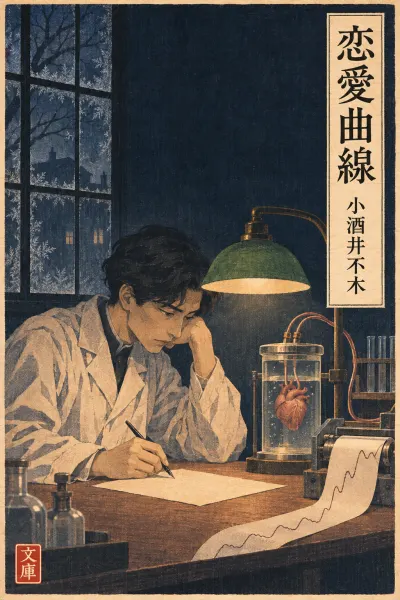
恋愛曲線 Ren'aikyokusen, part 7: From Lost Love to a Curve of Love
In this part
The heart the narrator has been testing weakens. He pours his own blood into it, and it records a strange 'curve of lost love' before stopping for good. Obsessed now with recording a curve of love itself, he reasons that two 'minuses' of lost love, multiplied together, should make a plus. He reveals that he has found a woman at the height of lost love: the person who wrote to tell him of his friend's marriage to Yukie.
AI translation · independently checked
ふと、気がついて見ると、心臓は著しくその力を弱めた。Then, coming to myself with a start, I looked and saw that the heart had grown markedly weaker.
無理もない。Small wonder.
搏ちかけてから凡そ一時間を経て居たのだ。About an hour had passed since it had begun to beat.
思わぬ空想に時を費して、情緒研究を忘れて居た僕は、科学者としての冷静を失ったことを恥じつゝ、折角貴重な材料を得ながら、これを無駄にするのは勿体ないと考えた。I had lost myself in unexpected fancies and forgotten my study of the emotions. I was ashamed to have lost the composure proper to a scientist, yet I thought it a pity to let such precious material go to waste when I had gone to the trouble of obtaining it.
そうして、咄嗟の間に思いついたのが、失恋の情緒の研究だ。And what occurred to me in that instant was a study of the emotion of lost love.
失恋をした人の心臓へ、失恋をした僕の血液を通じて曲線をとったならば、それこそ理想的な失恋曲線が得られるのではないか。If I passed my blood, the blood of a man disappointed in love, through the heart of one who had been disappointed in love, and took its curve, would I not obtain the ideal curve of lost love?
僕は手早く、例によって、左の腕より血液を取り、それをこの心臓の中へ流しこんで、電気心働計を働かせた。Quickly, as usual, I drew blood from my left arm, let it flow into this heart, and set the electrocardiograph working.
だんだん弱って来た心臓は、僕の血液に触れるなり、急に勢を増して、凡そ三十回ほどはげしく搏動したが、又忽ち力を弱めて、今度はぱったりやんでしまった。The heart had been weakening steadily, but the moment it touched my blood it suddenly gathered strength and beat violently some thirty times. Then all at once it weakened again, and this time it stopped altogether.
即ち、心臓は死んだのである。That is to say, the heart had died.
永久に死んだのである。It had died for ever.
でも、曲線だけは、鮮かに現像され、分析研究して見たところ、悲哀とも、苦痛とも、憤怒とも、恐怖とも、どれにも類しない。Yet the curve, at least, developed vividly. When I analysed and studied it, I found that it resembled none of them: not sorrow, not pain, not rage, not fear.
又、どれにも類して居るような性質を持って居た。And yet it had a character that seemed to resemble every one of them.
さて、失恋曲線を作った僕は、失恋の反対の情緒たる恋愛曲線を得たいものだと思うに至った。Now, having made a curve of lost love, I came to wish that I might obtain a curve of love, the emotion that is its opposite.
蓋し、飽くことを知らぬ科学者の欲望である。This, no doubt, is the insatiable appetite of the scientist.
然し、嘗ては恋愛を感じても、今は失恋をしか感じない僕が、どうして恋愛曲線を作ることが出来よう。But how could I, who once felt love but now feel nothing but lost love, possibly produce a curve of love?
これは及びもつかぬことである。It was utterly beyond my reach.
こう考えて諦めようとすればする程、愈よ作って見たくて仕様がなくなった。Yet the more I reasoned thus and tried to give it up, the more I longed, past all bearing, to try to make one.
そうして、後にはこれが一種の強迫観念になってしまった。And in time it became a kind of obsession.
といって、君に対して甚だ失礼な言葉ではあるが、君とはちがって雪江さん以外に、何人にも恋を感じなかった僕が、今更、誰に真実の恋を感ずることが出来よう。And yet, though these words are most discourteous to you, I am not like you: I have never felt love for anyone but Yukie. For whom, at this late hour, could I feel true love?
実際、僕は、真実の恋を雪江さん以外の人には感じ得ないのだ。Indeed, I am incapable of feeling true love for anyone other than Yukie.
して見れば、到底恋愛曲線は得られない訳だ。Seen in that light, a curve of love was quite impossible to obtain.
と思っても、やはり一旦強迫観念となったものは容易に去らない。Even so, a thing that has once become an obsession does not easily leave one.
で、致し方がないから、失恋を転じて恋愛となすべき方法はないものかと、僕は頻りに考をめぐらしたよ。So, having no other choice, I racked my brains over and over, wondering whether there might be some means of turning lost love into love.
そうして、考えて、考えて、僕は一時発狂するかと思うほど考えたのである。And I thought, and thought, and thought, until I feared I might go mad for a time.
ところが、はからずも、先日、ある人から、君と雪江さんとが、愈よ結婚するという通知を受取ったのである。Then, quite unexpectedly, I received word the other day from a certain person that you and Yukie were at last to be married.
すると、恰も焼け杭に火のついたように、失恋の悲しみは、僕の体内で猛然として燃え出した。At that, like a charred stake catching fire again, the grief of my lost love blazed up fiercely within me.
いわば、僕は失恋の絶頂に達したのである。I had reached, so to speak, the very summit of lost love.
と、その時、僕はこの絶頂に達した失恋をそのまま応用して、恋愛曲線を書くことが出来るという信念を得たのである。And at that moment I became convinced that I could draw a curve of love by applying this lost love, just as it stood at its summit.
君は数学で、マイナスとマイナスとを乗ずるとプラスになるということを習ったであろう。You will have learned in mathematics that a minus multiplied by a minus makes a plus.
僕はこの原理を応用して、失恋を恋愛に変えようと思ったのだ。I resolved to apply this principle and change lost love into love.
即ち、失恋の絶頂に達した僕の血液を、失恋の絶頂に達した女の心臓に通過せしめたならば、その時に描いた曲線こそは、恋愛の極致をあらわすものだと僕は考えたのだ。That is, I reasoned as follows. Suppose I caused my blood, at the summit of lost love, to pass through the heart of a woman at the summit of lost love. Then the curve drawn at that moment would surely express the very height of love.
こういうと君は、失恋の絶頂に達した女を何処から連れて来るかと訊ねるであろう。When I say this, you will doubtless ask where I was to bring such a woman from.
然し、その心配は無用である。But that concern is needless.
何となれば、僕が以上の如き原理を考え出したのも、実は失恋の絶頂に達した女を見つけたが為であって、その女こそは、外ならぬ、君と雪江さんとの結婚を知らせて来た手紙の主なのである。For in truth I devised the principle I have described only because I had found a woman at the summit of lost love. That woman is none other than the writer of the letter that informed me of your marriage to Yukie.
Vocabulary
| Word | Meaning | JLPT |
|---|---|---|
| 著しくいちじるしい | markedly, remarkablydictionary form: 著しいFormal written word, common in scientific and news writing. | N1 |
| 勿体ないもったいない | wasteful; a pity to wasteUsually written in kana today. | N2 |
| 咄嗟とっさ | an instant; on the spur of the momentUsually appears as 咄嗟に or 咄嗟の間に. | N1 |
| 失恋しつれん | lost love; disappointment in loveA key story word. It is the 'minus' the narrator hopes to turn into love (恋愛). | N2 |
| 搏動はくどう | to beat, pulsate (of the heart)Technical term. 拍動 is the modern spelling. | — |
| 強迫観念きょうはくかんねん | obsession, obsessive idea | — |
| 今更いまさら | now, at this late stageImplies that it is too late or pointless now. | N1 |
| 到底とうてい | (not) possibly, utterly (impossible)Used with negative or impossible outcomes. | N1 |
| 焼け杭に火のついたやけぐいにひがつく | a charred stake catching fire againdictionary form: 焼け杭に火がつくIdiom for an old love flaring up again. Usually 焼け木杭 (やけぼっくい) today. | — |
| 絶頂ぜっちょう | summit, peak, climax | — |
| 極致きょくち | the ultimate, the very height | — |
| 外ならぬほかならぬ | none other thanAlso written 他ならぬ. Puts emphasis on who or what it is. | — |
| 主ぬし | the person responsible; (here) the writer手紙の主 = the sender of a letter. | — |
Grammar
〜なり N1 as soon as, the moment that
Attached to a dictionary-form verb, it shows that a second event follows immediately and often unexpectedly. Here the heart surges the instant it meets the blood.
僕の血液に触れるなり、急に勢を増して
the moment it touched my blood, it suddenly gathered strength
〜ば〜ほど N3 the more ..., the more ...
The conditional form is followed by the same verb plus ほど. Here the harder he tries to give up, the stronger his desire grows.
諦めようとすればする程、愈よ作って見たくて仕様がなくなった
the more I tried to give it up, the more I longed, past all bearing, to try to make one
〜て仕様がない N3 unbearably, can't help (feeling)
Attached to the て-form of an adjective or a たい-form, it expresses a feeling too strong to control. 仕様がない is the older, fuller form of しょうがない.
作って見たくて仕様がなくなった
I longed, past all bearing, to try to make one
どうして〜ことが出来よう N2 how could one possibly ...? (rhetorical)
The volitional form of 出来る is used with どうして or 誰に to ask a rhetorical question whose answer is 'it is impossible'. The style is literary.
どうして恋愛曲線を作ることが出来よう
how could I possibly produce a curve of love?
〜せしめる N1 to cause / make (someone or something) do
This is a classical causative, equivalent to modern 〜させる. Its stiff, formal tone suits the scientific explanation.
女の心臓に通過せしめたならば
if I caused it to pass through the heart of a woman
何となれば〜為である N1 for, the reason is that ...
何となれば opens a formal explanation, much like なぜなら, and the sentence closes on a reason marked with 為 (ため). Here the clause ends in 〜が為であって before continuing.
何となれば、僕が以上の如き原理を考え出したのも、実は失恋の絶頂に達した女を見つけたが為であって
For in truth I devised the principle I have described only because I had found a woman at the summit of lost love