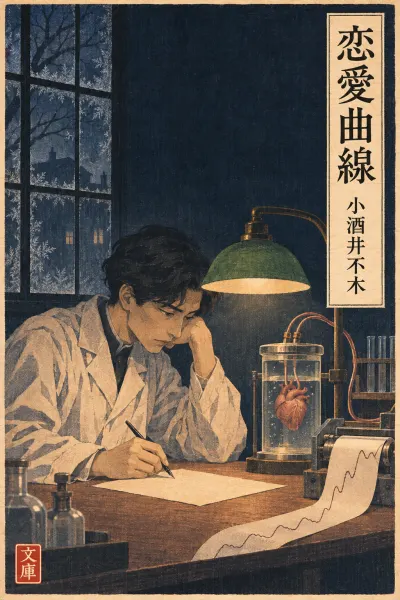
Part 4 of 9 · JLPT N2
恋愛曲線 Ren'aikyokusen, part 4: The Heart Beats Alone
In this part
The narrator describes the isolated heart beating in its warm box and likens its all-or-nothing beating to true love, which no money or outside force can sway. He then explains how a heart's motion is recorded as a curve, first on soot-blackened paper and then with Einthoven's electrocardiograph, which writes the heart's electrical currents onto photographic paper. The 'love curve' he means to send to his addressee is one of these photographic tracings.
AI translation · independently checked
心臓を働かせる箱の中の空気の温度も、やはり摂氏三十七度内外にしてある。The air inside the box in which the heart is made to work is likewise kept at about thirty-seven degrees Celsius.
そうしてロック氏液は箱の上から流すようになって居り、心臓を通過した液は箱の下へ落ち去るようになって居る。Locke's solution is arranged to flow in from the top of the box, and the fluid that has passed through the heart drains away to the bottom of the box.
箱の中で、心臓だけが働いて居る光景は、到底君には想像も及ばぬ程、厳粛な感じを与えるものだ。The sight of a heart working all alone inside that box gives an impression of such solemnity as you could never begin to imagine.
切出された心臓は立派な一個の生物だ。A heart, once cut out, is a living creature in its own right.
薔薇のような紅い地色に黄の小菊の花弁を散らしたような肉体を持つ魔性の生物は、渚に泳ぎ寄る水母のように、収縮と拡張の二運動を律動的に繰返すのだ。This uncanny creature, whose flesh is a rose-red ground strewn as if with the petals of small yellow chrysanthemums, repeats its two movements of contraction and expansion in rhythm, like a jellyfish swimming in towards the shore.
又、じっとその運動を眺めて居ると、心臓は恰も自分の自由意志をもって動いて居るかのように思われる。And if one watches its motion steadily, the heart seems to move exactly as if by its own free will.
ある時はその心臓に小さな目鼻が出来て、母体から切り離されたことを恨んで居るかのように見え、ある時は又浮世の空気に触れたことを喜ぶかのように見え、更にある時は、心臓だけを切り出して生物本来の心臓機能を研究しようとする科学者の愚を笑って居るかのようにも見える、然し、これはただ僕の幻覚に過ぎぬのであって、元来心臓は体内にあっても体外に切り出されても、その全力を尽して働くもので all or nothing(皆か然らずんば無)の法則が厳然として行われつゝあるのだ。At times small eyes and a nose seem to form upon it, and it appears to resent having been cut away from the body that bore it; at other times it appears to rejoice at touching the air of this fleeting world; and at still other times it even seems to be laughing at the folly of the scientist who cuts out the heart alone and hopes to study the function a heart has in a living creature. Yet this is no more than an illusion of mine. By its very nature a heart, whether inside the body or cut out of it, works with all its strength, and the law of 'all or nothing' holds over it without exception.
即ち心臓は、一旦働らこうと決心したならば全力を尽して働くのだ。That is to say, once a heart has resolved to work, it works with all its strength.
いわば心臓ほど忠実な働き工合をするのは、めったに見られないのだ。One might say that a thing working as faithfully as the heart is seldom to be seen.
この点がまた、恋愛のシムボルたるに最も適して居ると僕は思う。And it is this point, I believe, that makes it supremely fit to be the symbol of love.
即ち、どんな刺戟が来ても、刺戟の多寡によって搏ち方をちがえるということをせず、搏つならば全力を尽して搏ち、搏たぬ時は決して搏たぬという心臓の性質は、ちょうど金力やその他の外力にはびくともせぬ真の恋愛の性質に比較すべきであろうと思う。That is, the nature of the heart, which, whatever stimulus comes, never varies its beat according to the strength of that stimulus, but beats with all its strength if it beats at all and does not beat in the least when it does not, ought, I think, to be compared precisely with the nature of true love, which does not yield an inch to the power of money or to any other outside force.
真に恋する同志には、たといどんな障碍物がその間に横わって居ろうとも、かのラジオの電波が通うように、その心臓の搏動の波は互に通い合うと思う。Between two people truly in love, I believe, the waves of their heartbeats reach each other just as radio waves do, whatever obstacles may lie between them.
実際、君は知って居るかどうかは知らぬが、心臓は、動く度毎に電気を発生するもので、その電気を研究するために、電気心働計なるものが考案されて居る。In fact, though I do not know whether you are aware of it, the heart produces electricity each time it moves, and an instrument called the electrocardiograph has been devised to study that electricity.
そうしてこの電気心働計こそは僕の所謂恋愛曲線の製造元なのだ。And it is this electrocardiograph that is the maker of what I call the love curve.
だが、電気心働計の説明にうつる前に、以上の如く切り出した心臓の運動を、如何にして分析し研究するかということを語って置かねばならない。But before I go on to explain the electrocardiograph, I must tell you how the motion of a heart cut out as described above is analysed and studied.
たゞ肉眼で観察したゞけでは、精確な比較研究をすることが出来ぬから、どうしてもその運動を適当に記録しなければならない。Observation with the naked eye alone does not allow precise comparative study, so the motion must in one way or another be suitably recorded.
その運動を記録したものが即ち「曲線」なのだ。The record of that motion is what is called a 'curve.'
従って恋愛曲線なる語は、恋愛運動の記録ということを意味するのだ。It follows that the term 'love curve' means a record of the motions of love.
君は、地震が地震計によって曲線として記録されることを聞いたであろう。You will have heard that earthquakes are recorded as curves by a seismograph.
今、煤を塗った紙を円筒に巻きつけて、それを規則的に廻転せしめ、運動する物体から突出した細い挺子の先をその紙に触れしめると、その物体の運動するに従って、特殊な曲線が白くあらわれる。Suppose paper coated with soot is wound around a cylinder, the cylinder is made to turn at a steady rate, and the tip of a slender lever projecting from a moving object is made to touch the paper: as the object moves, a distinctive curve appears in white.
心臓の運動もこれと同じ方法によって煤紙に書かせることが出来るのであるけれど、僕は特に心臓の発生する電気に興味を持ったので、主として前記の電気心働計を使って、研究の歩を進めたのだ。The motion of the heart can also be made to write itself on soot-blackened paper by this same method, but since I was particularly interested in the electricity the heart produces, I advanced my research chiefly with the electrocardiograph mentioned above.
すべて筋肉が運動する際には、必ず多少の電気が発生する。Whenever any muscle moves, some amount of electricity is always produced.
所謂動物電気なるものがこれであるが心臓も筋肉で出来た臓器であるから搏動ごとに電気が発生する訳だ。This is what is called animal electricity, and since the heart too is an organ made of muscle, it naturally follows that electricity is produced with every beat.
そうしてその電気の発生の有様を、曲線であらわそうとする器械が電気心働計なるものだ。And the instrument designed to show the production of that electricity as a curve is what is called the electrocardiograph.
この器械を最初に発明した人はオランダのアイントーウェンという人だ。The first man to invent this instrument was Einthoven of Holland.
曲線といっても、前に述べたような簡単なものではなく、その原理は聊か複雑である。Though I call it a curve, it is not so simple a thing as the one I described earlier; its principle is somewhat complicated.
心臓から出る電気を一定の方法によって導き、それを蜘蛛の糸よりも細い、白金で鍍金した石英糸に通過せしめ、糸の両側に電磁石を置くと、糸を通過する電流の多寡によって、その糸が左右に振れるから、その糸をアーク燈で照すと、糸の影が左右に大きく振れ、それを細い隙間をとおして、写真用の感光紙に直接感ぜしめ、然る後現像すれば、心臓の電気の消長を示す曲線が、白くあらわれる訳である。The electricity coming from the heart is led off by a fixed method and passed through a quartz thread plated with platinum, finer than a spider's silk, with an electromagnet placed on either side of the thread; the thread then swings left and right according to the strength of the current passing through it, so that when it is lit by an arc lamp, its shadow swings widely left and right; this shadow is let fall through a narrow slit directly onto photographic paper, and when the paper is afterwards developed, a curve showing the rise and fall of the heart's electricity appears in white.
感光紙は活動写真のフィルムのように巻きつけて具えられてあるから、二十分、三十分間の心臓運動の模様も、自由に連続的に曲線としてあらわすことが出来るのである。The photographic paper is fitted in a roll like the film of a moving picture, so that even twenty or thirty minutes of the heart's motion can be shown freely and continuously as a curve.
僕が君に送らんとする恋愛曲線も、この感光紙にあらわれた曲線に外ならない。The love curve I intend to send you is nothing other than a curve that appeared on this photographic paper.
Vocabulary
| Word | Meaning | JLPT |
|---|---|---|
| 厳粛げんしゅく | solemn, graveUsed as a na-adjective, as in 厳粛な感じ, 'a solemn feeling.' | — |
| 魔性ましょう | demonic, uncanny, bewitchingOften used of something beautiful but dangerous. | — |
| 律動的りつどうてき | rhythmicThe suffix 的 turns a noun into a na-adjective or adverb (律動的に). | — |
| 幻覚げんかく | illusion, hallucination | — |
| 忠実ちゅうじつ | faithful, loyal | N1 |
| 刺戟しげき | stimulusOlder spelling; today it is written 刺激. | N3 |
| 多寡たか | amount; how much or how littleLiterary. The kanji mean 'many' and 'few.' | — |
| びくともせぬびくともしない | not budge an inch, be unmoveddictionary form: びくともしないせぬ is the old negative form of する. | — |
| 障碍物しょうがいぶつ | obstacleNow usually written 障害物. | — |
| 考案こうあん | devising, designing (a device or method) | — |
| 煤すす | soot | — |
| 感光紙かんこうし | photographic (light-sensitive) paper | — |
| 消長しょうちょう | rise and fall, waxing and waningThe kanji mean 'fade' and 'grow.' | — |
| 所謂いわゆる | so-called; what one callsUsually written in kana today. 僕の所謂 means 'what I call.' | N3 |
Grammar
恰も〜かのように N2 as if, just as though
The pattern かのように presents something as if it were true, while implying that it is not. The adverb 恰も (あたかも) strengthens this 'just as if' sense.
心臓は恰も自分の自由意志をもって動いて居るかのように思われる
the heart seems to move exactly as if by its own free will
〜に過ぎぬ N2 be nothing more than
This is a literary form of 〜に過ぎない. The narrator uses it to play down his fancies as mere illusion.
これはただ僕の幻覚に過ぎぬのであって
this is no more than an illusion of mine
〜たる N1 being (in the role of), as
たる is a literary copula placed after a noun. Here シムボルたる means 'to be a symbol,' and it is followed by に適する, 'to be suited to.'
恋愛のシムボルたるに最も適して居る
is supremely fit to be the symbol of love
たとい〜ようとも N1 no matter how / even if
たとい (modern たとえ) combines with the volitional form plus とも to mean 'whatever may be the case.' Here the volitional form is 居ろう (おろう).
たといどんな障碍物がその間に横わって居ろうとも
whatever obstacles may lie between them
〜しめる N1 cause to do (literary causative)
This is a classical causative ending, equivalent to modern 〜させる. 廻転せしめ means 'make it turn' and 触れしめる means 'make it touch.' It gives the description of the procedure a formal, scientific tone.
それを規則的に廻転せしめ
the cylinder is made to turn at a steady rate
〜に外ならない N1 be nothing other than
外ならない (ほかならない) firmly identifies one thing with another. Here it states that the 'love curve' is simply the tracing on the photographic paper.
この感光紙にあらわれた曲線に外ならない
is nothing other than a curve that appeared on this photographic paper