Part 6 of 9 · JLPT N2
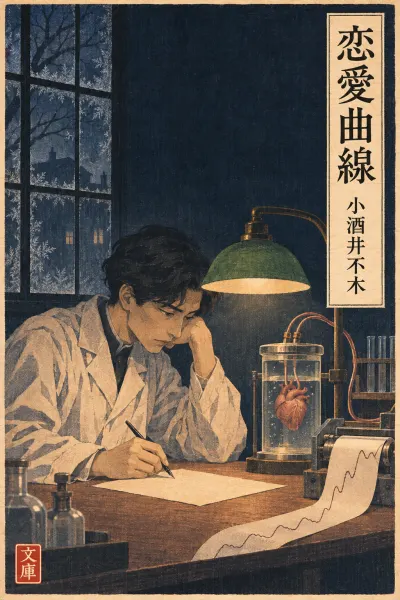
恋愛曲線 Ren'aikyokusen, part 6: A Broken-Hearted Girl's Heart Beats Again
In this part
The narrator records emotion curves by drawing his own blood while reading moving novels and perfusing it through rabbit, dog and sheep hearts. He learns to tell the curves apart by sight. Wanting to test a human heart, he obtains the heart of a nineteen-year-old woman who died of tuberculosis after being abandoned by her lover, and when he revives it in Locke's solution he is overwhelmed by sympathy, since he too has been disappointed in love.
AI translation · independently checked
こういう訳であるから、諸種の情緒発現の際の血液が心臓に及ぼす影響を理想的に曲線に描かしめるためには、人間について実験するより外はないのである。Such being the case, if the effect of the blood on the heart during the various emotions is to be traced as a curve in the ideal way, there is no other course than to experiment on human beings.
人間ならば、怒った時の血液、悲しい時の血液、嬉しい時の血液が比較的容易に採取し得られるからだ。For with human beings, blood taken in anger, blood taken in sorrow and blood taken in joy can be collected with comparative ease.
さり乍ら、人間の実験で困ることは人間の心臓が容易に手に入り難いことだ。The difficulty with experiments on humans, however, is that a human heart is not easily obtained.
死んだ人の心臓でも滅多に手に入り難いのであるから、況んや生きた人の心臓をやだ。Even the heart of a dead person can seldom be had; how much less, then, the heart of a living one!
で、已むを得ないから僕は兎の心臓で実験することにした。And so, having no alternative, I resolved to experiment with the hearts of rabbits.
又、血液の点に就て言っても、誰も喜んで血液を提供してくれるものはないから、僕は自分自身の血液で実験することにした。Likewise, as regards the blood, there was no one who would gladly furnish me with his own, so I resolved to experiment with my own blood.
即ち僕は、色々な小説を読んで或は悲しみ、或は憤り、或は嬉しい思いをして、その度毎に注射針をもって、左の腕の静脈から五瓦ずつの血液を取って、実験をしたのだ。That is to say, I read various novels and was by turns saddened, angered and gladdened, and on each occasion I drew five grams of blood from a vein in my left arm with a hypodermic needle and carried out the experiment.
兎の場合でも犬の場合でもそうだが、すべて血液を採るときは、凝固を防ぐために、注射針の中へ、一定量の蓚酸ナトリームを入れて置くのだ。It is the same whether one is dealing with rabbits or with dogs: whenever blood is taken, a fixed quantity of sodium oxalate is first placed in the needle to prevent clotting.
かくて得た曲線を研究して見ると、嬉しい時、悲しい時、苦しい時などによって、その曲線に明かに差異が認められた。On studying the curves thus obtained, I found clear differences among them according to whether I had been joyful, sorrowful, distressed and so forth.
恐怖の時の曲線は、やはりアドレナリンを流した時の曲線に類似し、快楽の時の曲線はモルヒネを流した時の曲線に類似して居たが、それはたゞ類似して居るというに過ぎないのであって、微細な点に至っては、それぞれ特殊な差異が認められるのであった。The curve of fear did, as one might expect, resemble the curve produced by perfusing adrenaline, and the curve of pleasure resembled that produced by perfusing morphine; but this was no more than a resemblance, and in the finer details each showed its own particular differences.
そうして、後に、僕は練習によって、どれが恐怖の曲線か、どれが愉快の曲線か、どれがアドレナリンの曲線か、どれがモルヒネの曲線かということを、曲線を見たゞけで区別することが出来るようになった。In time, through practice, I became able to tell merely by looking at a curve which was the curve of fear, which the curve of delight, which the curve of adrenaline and which the curve of morphine.
なお又、この曲線は兎の心臓を用いても、犬の心臓を用いても、又新たに羊の心臓を用いても、同じような変化を来すものであることを経験したのである。I further found that these curves showed the same changes whether I used a rabbit's heart or a dog's heart, or, newly, a sheep's heart.
然し君、学問研究に従事するものは、誰しも研究上の欲が深くなるもので、兎と犬と羊とについて同じような結果が出たならば、それで満足すべきであるのに、僕は一歩進んで何とかして人間の心臓について実験を試みたいと思うようになったのだ。But you see, my friend, anyone engaged in scholarly research is bound to grow greedy in his inquiries; once the same results had been obtained with rabbits, dogs and sheep, I ought to have been content, yet I went a step further and came to wish that I might somehow attempt the experiment on a human heart.
前に書いたとおり、人間の心臓は、死後二十時間を経ても、なお且つ搏動せしめることが出来るから、せめて死体の心臓でもよいから手に入れたいものだと、病理解剖の教室や、臨床科の教室の人に頼んで置いたのである。As I wrote earlier, a human heart can still be made to beat even twenty hours after death, so, wishing to obtain at least a heart from a corpse, I had put in a request with the people in the department of pathological anatomy and in the clinical departments.
するとこゝに、運よくも、ある女の心臓を一個手に入れることが出来た。Then, as luck would have it, I was able to obtain the heart of a certain woman.
その女は十九歳の結核患者であった。She was a consumptive patient, nineteen years of age.
彼女は、恋する男に捨てられて、絶望のあまり健康を害し、内科に入院して不帰の客となったのだが、生前彼女の口癖のように、「私の心臓にはきっと大きなひびが入って居ます。どうか、死んだら、くれぐれも心臓を解剖して医学の参考にして下さい」と言ったそうだ。Abandoned by the man she loved, she had ruined her health in her despair, been admitted to the department of internal medicine, and there departed, never to return; while she lived, I am told, she would say, almost as a habit, "There must surely be a great crack in my heart. When I die, I beg you, please be sure to dissect my heart and let it serve the study of medicine."
ちょうど僕の友人がその受持だったので、彼女の遺言に従って、僕がその心臓を貰ったのだ。As it happened, a friend of mine had charge of her, and so, in accordance with her last wishes, I received the heart.
いま迄、兎や犬や羊の心臓を切り出すことに馴れて居た僕も、たとい死体であるとはいえ、その女の蝋のように冷たく且白い皮膚に手を触れてメスをあてた時は、一種異様の戦慄が、指先の神経から全身の神経に伝播した。Accustomed as I was by then to cutting out the hearts of rabbits, dogs and sheep, when I touched that woman's skin, cold and white as wax, and set my scalpel to it, corpse though it was, a strange sort of shudder spread from the nerves of my fingertips to every nerve in my body.
然し、薄い脂肪の層、いやに紅い筋肉層、肋骨と、順次に切り進んで胸廓を開き、心嚢を破って心臓を出した時分には、僕はやはりいつもの冷静に立ち帰って居た。Yet by the time I had cut my way through layer by layer, the thin fat, the unpleasantly red muscle, the ribs, had opened the chest, broken through the pericardium and taken out the heart, I had returned to my usual composure.
もとより彼女の心臓にひゞは入って居なかったけれども、心臓は著しく痩せて居た。There was, of course, no crack in her heart, but the heart was remarkably wasted.
これ迄、動物の生きた心臓のみを目撃して来た僕にとっては、はじめ、心臓らしい気さえ起らなかった。To me, who until then had seen only the living hearts of animals, it did not at first even seem like a heart.
死後十五時間を経て居たが、異様にひやりとしたので、僕は切り出した心臓を手につかんだまゝ暫らくぼんやりした。Fifteen hours had passed since her death, yet it felt strangely chill, and I stood for a while in a daze with the heart I had cut out still in my hand.
はっと我に返って、暖かいロック氏液の中へ入れてよく洗い、次で箱の中へ装置して、ロック氏液を流すと、はじめ心臓は宛も眠って居るかのようであったが、暫くしてぱくりくりと動き出し、間もなく、威勢よく搏ち出した。Coming to myself with a start, I placed it in warm Locke's solution and washed it well, then mounted it in the box and let the Locke's solution flow; at first the heart seemed almost to be asleep, but after a while it began to stir, flick, flick, and before long it was beating vigorously.
予期したことではあるが、僕にはその女が蘇生したように思われ、何ともいえぬ荘厳な感に打たれて、僕はいつの間にか実験ということを忘れて、その微妙な運動を見つめた。It was what I had expected, yet it seemed to me as though the woman had come back to life; I was struck by an indescribable sense of solemnity, and before I knew it I had forgotten the experiment altogether and was gazing at those delicate movements.
そうして、その心臓の持主について考えた。And I thought about the heart's owner.
失恋!Disappointed love!
何という悲しい運命であろう。What a sorrowful fate!
僕はその時、人ごとならず思ったよ。At that moment, I tell you, I did not feel it to be some stranger's affair.
僕も同じく失恋の苦しみを味う人間ではないか。Am I not, too, a man who tastes the pain of disappointed love?
嘗てこの持主の生きて居た時分この心臓はいかにはげしく、又、いかに悲しく搏ったことであろう。Once, while its owner was alive, how violently, and how sorrowfully, this heart must have beaten!
その古い、苦しい記憶も、今はロック氏液によって洗い去られたと見え、何のこだわりもなく収縮、拡張の二運動を繰返して居る。Those old and painful memories seem now to have been washed away by the Locke's solution, and it repeats its two motions of contraction and dilation without the least hindrance.
恐らく彼女の失恋以後、一日として、この心臓は平静な搏ち方をしなかったであろう。Very likely, from the time her love was lost, there was not a single day on which this heart beat calmly.
搏て!Beat!
搏て!Beat!
ロック氏液はいくらでもあるから、搏って、搏って搏ちつくすがよい。There is Locke's solution in plenty, so beat, and beat, and beat until you are spent!
Vocabulary
| Word | Meaning | JLPT |
|---|---|---|
| 情緒じょうちょ | emotion, feelingAlso read じょうしょ. In everyday use it often means 'atmosphere, charm' (異国情緒). | N1 |
| 採取さいしゅ | collecting, taking (a sample)Used for blood, fingerprints, minerals and the like. | — |
| 已むを得ないやむをえない | unavoidable; there being no choiceUsually written やむを得ない today. | N2 |
| 静脈じょうみゃく | veinOpposite: 動脈 (どうみゃく, artery). Note じょう, not せい. | — |
| 凝固ぎょうこ | clotting, coagulation | — |
| 差異さい | difference, discrepancyA formal word; 違い is the everyday equivalent. | N1 |
| 類似るいじ | resemblance; to resembleUsed as 〜に類似する, 'to resemble ~'. | N1 |
| 搏動はくどう | beating, pulsation (of the heart)Now usually written 拍動. The kanji 搏 is also read う(つ) later in the passage. | — |
| 不帰の客ふきのきゃく | one who has diedLiterally 'a guest who does not return'. Used in the euphemism 不帰の客となる, 'to pass away'. | — |
| 戦慄せんりつ | shudder, thrill of horrorA literary word for trembling with fear or awe. | — |
| 蘇生そせい | revival, coming back to life | — |
| 失恋しつれん | disappointed love, heartbreak失 (lose) + 恋 (love). A key word for the whole story. | N2 |
| 人ごとならずひとごとではない | not someone else's affair; something that concerns oneself (人ごとならず: classical negative continuative of the copula なり)dictionary form: 人ごとではないならず is the classical negative of なる/だ. Often written 他人事. | — |
Grammar
〜しめる N1 to make / let (literary causative)
A classical causative attached to the negative stem, equivalent to modern 〜せる/させる. 描かしめる means 'to cause (the heart) to draw', and in the scientific prose it suggests a stiff, formal tone.
理想的に曲線に描かしめるためには
in order to have it traced as a curve in the ideal way
〜より外はない N2 there is no choice but to ~
The dictionary form plus より外(ほか)はない states that this is the only option left. The modern equivalent is 〜ほかない or 〜しかない.
人間について実験するより外はないのである。
there is no other course than to experiment on human beings.
〜得る N2 can ~, be able to ~
The verb stem plus 得る (える/うる) expresses possibility in formal written style. Here it is combined, somewhat redundantly, with the potential ending in 採取し得られる, 'can be collected'.
比較的容易に採取し得られるからだ。
for it can be collected with comparative ease.
況んや〜をや N1 let alone ~; how much less ~
A kanbun-derived construction. The first clause gives the easier case, and いわんや〜をや introduces the harder case as even more impossible. Here the hearts of the dead are rare, so the hearts of the living are out of the question.
況んや生きた人の心臓をやだ。
how much less, then, the heart of a living one!
〜に過ぎない N2 no more than ~; merely ~
This pattern limits a statement to that much and no more. The narrator stresses that the emotion curves only resembled the drug curves and were not identical to them.
それはたゞ類似して居るというに過ぎないのであって
but this was no more than a resemblance
一〜として〜ない N1 not even a single ~
One plus a counter, followed by として and a negative, gives a strong 'not even one'. 一日として〜しなかった means 'there was not a single day on which ~'.
一日として、この心臓は平静な搏ち方をしなかったであろう。
there was not a single day on which this heart beat calmly.