Upper intermediate · JLPT N2
鮨Sushi — The Sushi Shop Below the Slope
- JLPT N2
- 13,153 characters
- 10 parts
- about 110 minutes
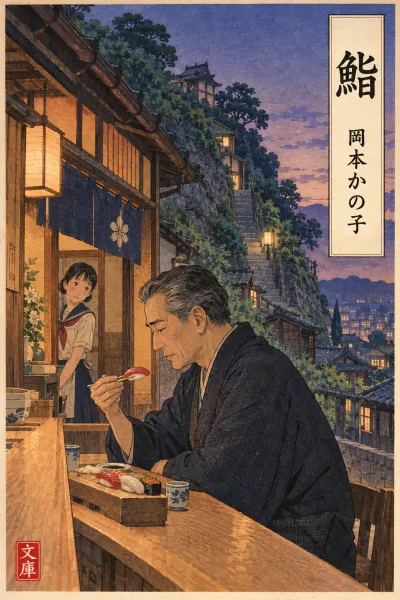
Okamoto Kanoko's 鮨 is a quiet, character-driven story set in a small sushi shop, Fukuzushi, in a hilly Tokyo neighbourhood of slopes and cliffs where the downtown and uptown districts meet. Tomoyo, the owners' schoolgirl daughter, waits on a varied crowd of regulars. She becomes curious about one of them, Minato, a melancholy, refined gentleman of over fifty whom everyone calls 'Sensei'. When she finally asks him why he eats sushi so often, he answers with a long story from his childhood about a sickly boy who could hardly bear to eat, and about his mother. The tone is delicate and observant rather than dramatic. Much of the pleasure lies in small details: the order in which Minato eats, the owner's private dishes for favoured customers, the play of light at dusk. For learners the main challenges are the dense literary narration and the prewar spellings. The dialogue is everyday Tokyo speech and offers some relief. The middle section, told as a story within the story, has a clear and moving shape that rewards careful reading.
Contents
- A Quiet Sushi Shop Among the Slopes
- Father's Secret Snack and a Quiet Household
- Fish in a Stream and a Quiet Regular
- Tomoyo's Quiet Jealousy
- A Chance Meeting on the Main Street
- A Boy Who Could Not Eat
- A Mother Bows to Her Son
- A Mother's Sushi Wins Over Her Son
- A Mother's Sushi Heals the Boy
- The Sensei Disappears from Fukuzushi
Before you read
- Learn the prewar kanji spellings early. The narration writes 仕舞う for しまう (as in 〜て仕舞う), 呉れる for くれる, and 乍ら for ながら. Once you recognise these, many sentences that look difficult turn out to be simple.
- Keep track of who is speaking and in what voice. The owner uses brisk downtown speech (あたし, contractions like 〜ちまう). Tomoyo is casual and girlish, Minato is courteous and educated, and the mother in his story speaks in warm, coaxing tones. Speech style often tells you who is talking even without a speaker tag.
- Expect a frame shift in Parts 5–10. Minato's reminiscence starts out told about 'a child' in the third person, and the narrator only links that boy to Minato at the end. Read Parts 6–9 as a story within the story.
- Learn the food and sushi vocabulary before you start: 鮨, 握る, 玉子 (egg), 海苔 (laver), 烏賊 (squid), 白身 (white fish), 酢 (vinegar), and 煎餅 (rice crackers). These words carry the emotional turning point in Parts 7–8.
- Watch for the recurring patterns that build the literary narration, especially 〜の如く for similes, 〜に違いない for the narrator's inferences, and 〜だの〜だの for lists of customers' habits and complaints.
Words to know
The most useful words from the notes across the story.
| Word | Meaning | JLPT |
|---|---|---|
| 常連じょうれん | regular customer | — |
| 刺戟しげき | stimulation, excitementOlder spelling of 刺激. | N3 |
| 拵えてこしらえる | to make; to preparedictionary form: 拵えるSomewhat old-fashioned, colloquial word for 作る. | N2 |
| 却ってかえって | on the contrary; if anythingMarks a result opposite to what one would expect. | N2 |
| 性分しょうぶん | nature, temperament | — |
| 河鹿かじか | kajika frog, a stream frog kept for its beautiful songPrized in summer for its cool, clear call. | — |
| 咀嚼そしゃく | chewing, masticationA formal, medical-sounding word; also used figuratively for 'digesting' ideas. | — |
| 晩酌ばんしゃく | a drink of sake with the evening meal | — |
| 手品師てじなし | conjurer, magician手品 = conjuring trick; 〜師 marks a professional. | — |
| 先生せんせい | Sensei: a respectful title for a teacher, doctor or learned personUsed here as a nickname for a refined customer whose job nobody knows. | N5 |
| 叮嚀ていねい | careful, painstakingdictionary form: 丁寧Older spelling of 丁寧; today usually means 'polite', but here it means 'with great care'. | N4 |
| 譲ってゆずる | to hand over, to transfer (ownership)dictionary form: 譲る | N3 |
| 一致いっち | coinciding, matching一致する = to match; 一致しかけ = beginning to match. | N3 |
| 下町したまち | the old downtown districts (of Tokyo)Contrasted with 山の手, the hilly uptown residential districts; the two words suggest different social worlds. | N2 |
| 遠足えんそく | school outing, excursion遠足会 is an older way to say a school trip event. | N2 |
Plot summary
Show the full summary (contains spoilers)
Tomoyo grows up serving the male regulars at her parents' sushi shop. She takes their teasing lightly but becomes fascinated by the aloof Minato. She tries to catch his eye, snatches away his sake cup out of a strange jealousy, and then grows shy around him. One early-summer day they meet by chance and sit together on a cliff-edge lot. Minato tells her about a boy who found food repellent until his mother made sushi for him with her own hands. Through that sushi the boy learned to eat and grew strong, but he drifted into idleness as his family declined, and he was left with a lasting melancholy. Minato reveals that the boy was himself and that sushi brings back his mother. He gives Tomoyo his ghost fish and never returns. In time Tomoyo only vaguely imagines him eating at some other sushi shop.
About the author
Okamoto Kanoko was a Tokyo-born writer who first became known as a tanka poet in the circle of Yosano Akiko. She was also a serious student of Buddhism and wrote and lectured on it. She was married to the cartoonist Okamoto Ippei, and their son was the artist Okamoto Tarō. She turned to fiction only in the last years of her life, and in a short burst of activity she produced the works she is best remembered for, including 'Rōgishō' (老妓抄) and 'Boshi jojō' (母子叙情). Her prose is known for its rich, sensuous imagery and its interest in desire, vitality and the bond between mother and child.