Part 3 of 10 · JLPT N2
鮨 Sushi, part 3: Fish in a Stream and a Quiet Regular
In this part
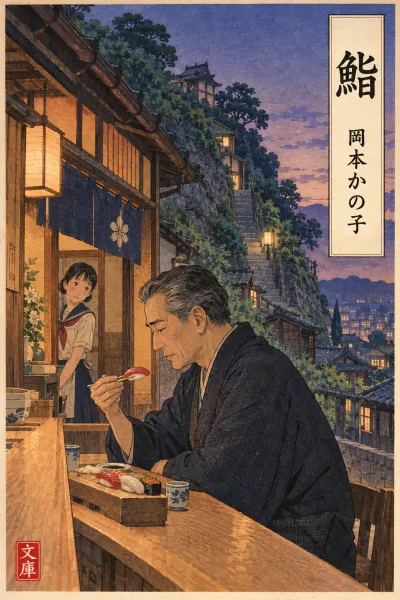
Tomoyo compares the coming and going of Fukuzushi's customers to fish drifting through a spring stream, with herself as the moss they briefly touch. She handles their teasing lightly and is the shop's modest signboard girl. The narration then introduces Minato, a melancholy, refined bachelor of somewhat over fifty whom the shop calls 'Sensei,' and whose fixed order of eating sushi the owner knows by heart.
AI translation · independently checked
ともよは学校の遠足会で多摩川べりへ行ったことがあった。Tomoyo had once gone to the banks of the Tamagawa on a school outing.
春さきの小川の淀みの淵を覗いていると、いくつも鮒が泳ぎ流れて来て、新茶のような青い水の中に尾鰭を閃めかしては、杭根の苔を食んで、また流れ去って行く。As she peered into a deep, still pool in a little stream in early spring, crucian carp came swimming down with the current one after another. Flicking their tails and fins in the water, which was as green as new-season tea, they nibbled at the moss on the base of a stake and then drifted away again.
するともうあとの鮒が流れ溜って尾鰭を閃めかしている。And then other carp had already drifted in and gathered there, flicking their tails and fins.
流れ来り、流れ去るのだが、その交替は人間の意識の眼には留まらない程すみやかでかすかな作業のようで、いつも若干の同じ魚が、其処に遊んでいるかとも思える。They came and they went, yet the changeover seemed so swift and so faint that the human eye never caught it, and one could almost believe that the same few fish were always playing there.
ときどきは不精そうな鯰も来た。Now and then a lazy-looking catfish came along too.
自分の店の客の新陳代謝はともよにはこの春の川の魚のようにも感ぜられた。To Tomoyo, the turnover of customers at her family's shop seemed rather like the fish in that spring stream.
(たとえ常連というグループはあっても、そのなかの一人々々はいつか変っている)自分は杭根のみどりの苔のように感じた。(Even if there was a group you could call regulars, each one of them had changed before you knew it.) She felt like the green moss on the base of the stake.
みんな自分に軽く触れては慰められて行く。Everyone brushed lightly against her, took a little comfort, and moved on.
ともよは店のサーヴィスを義務とも辛抱とも感じなかった。Tomoyo felt that serving in the shop was neither a duty nor something to endure.
胸も腰もつくろわない少女じみたカシミヤの制服を着て、有合せの男下駄をカランカラン引きずって、客へ茶を運ぶ。Dressed in a girlish cashmere school uniform that did nothing to shape her bust or hips, and dragging along a pair of men's wooden clogs she had found lying about, clattering as she went, she carried tea out to the customers.
客が情事めいたことをいって揶揄うと、ともよは口をちょっと尖らし、片方の肩を一しょに釣上げてWhen a customer teased her with some flirtatious remark, Tomoyo would purse her lips a little, hitch up one shoulder at the same time, and
「困るわそんなこと、何とも返事できないわ」"Oh, don't say things like that, I've no idea how to answer you."
という。she would say.
さすがに、それには極く軽い媚びが声に捩れて消える。Even so, at such moments the faintest trace of coquetry twisted into her voice and faded away.
客は仄かな明るいものを自分の気持ちのなかに点じられて笑う。The customer would laugh, feeling something softly bright kindled within him.
ともよは、その程度の福ずしの看板娘であった。That, more or less, was the modest extent to which Tomoyo served as Fukuzushi's signboard girl.
客のなかの湊というのは、五十過ぎぐらいの紳士で、濃い眉がしらから顔へかけて、憂愁の蔭を帯びている。Among the customers was one called Minato, a gentleman of somewhat over fifty, whose face, from the heavy inner ends of his eyebrows downward, was touched by a shadow of melancholy.
時によっては、もっと老けて見え、場合によっては情熱的な壮年者にも見えるときもあった。At times he looked older still, and at others he might even seem a passionate man in the prime of life.
けれども鋭い理智から来る一種の諦念といったようなものが、人柄の上に冴えて、苦味のある顔を柔和に磨いていた。Yet a kind of resignation, born of a keen intellect, shone clearly through his character and had polished his rather bitter face into gentleness.
濃く縮れた髪の毛を、程よくもじょもじょに分け仏蘭西髭を生やしている。His thick, curly hair was parted into a pleasantly loose tousle, and he wore a French-style beard.
服装は赫い短靴を埃まみれにしてホームスパンを着ている時もあれば、少し古びた結城で着流しのときもある。As for his clothes, sometimes he wore homespun, with his red low shoes covered in dust, and at other times a somewhat worn kimono of Yūki silk, worn casually without a formal overskirt.
独身者であることはたしかだが職業は誰にも判らず、店ではいつか先生と呼び馴れていた。That he was a bachelor was certain, but no one knew what he did for a living, and at the shop they had at some point grown used to calling him Sensei.
鮨の食べ方は巧者であるが、強いて通がるところも無かった。He ate sushi like an expert, yet there was nothing forced about him, no effort to show off as a connoisseur.
サビタのステッキを床にとんとつき、椅子に腰かけてから体を斜に鮨の握り台の方へ傾け、硝子箱の中に入っている材料を物憂そうに点検する。He would tap his hydrangea-wood walking stick on the floor, sit down on a chair, lean sideways toward the sushi counter, and languidly inspect the ingredients in the glass case.
「ほう。今日はだいぶ品数があるな」"Well, now. You've quite a selection today."
と云ってともよの運んで来た茶を受け取る。he would say, taking the tea that Tomoyo had brought him.
「カンパチが脂がのっています、それに今日は蛤も――」"The amberjack is nice and rich, and today we've got clams too—"
ともよの父親の福ずしの亭主は、いつかこの客の潔癖な性分であることを覚え、湊が来ると無意識に俎板や塗盤の上へしきりに布巾をかけながら云う。Tomoyo's father, the owner of Fukuzushi, had at some point come to realise that this customer was fastidious about cleanliness, and whenever Minato came, he would say this while unconsciously wiping the chopping board and the lacquered serving board over and over with a cloth.
「じゃ、それを握って貰おう」"Then I'll have you make me some of those."
「はい」"Yes, sir."
亭主はしぜん、ほかの客とは違った返事をする。Without thinking, the owner answered him in a different way from his other customers.
湊の鮨の喰べ方のコースは、いわれなくともともよの父親は判っている。Even without being told, Tomoyo's father knew the course Minato followed when he ate sushi.
鮪の中とろから始って、つめのつく煮ものの鮨になり、だんだんあっさりした青い鱗のさかなに進む。He began with medium-fatty tuna, went on to sushi of simmered toppings brushed with sweet tsume glaze, and gradually moved on to lighter, blue-scaled fish.
そして玉子と海苔巻に終る。And he finished with egg and seaweed rolls.
それで握り手は、その日の特別の注文は、適宜にコースの中へ加えればいいのである。So the man making the sushi needed only to slip that day's special items into the course wherever they suited.
湊は、茶を飲んだり、鮨を味わったりする間、片手を頬に宛てがうか、そのまま首を下げてステッキの頭に置く両手の上へ顎を載せるかして、じっと眺める。While drinking his tea or savouring his sushi, Minato would either rest one hand against his cheek, or else lower his head and set his chin on his two hands, which lay on top of his stick, and gaze steadily.
眺めるのは開け放してある奥座敷を通して眼に入る裏の谷合の木がくれの沢地か、水を撒いてある表通りに、向うの塀から垂れ下がっている椎の葉の茂みかどちらかである。What he gazed at was either the marshy ground hidden among the trees in the hollow of the valley behind the shop, seen through the inner room that had been left wide open, or the thick leaves of a chinquapin tree hanging down from the wall opposite, over the front street that had been sprinkled with water.
Vocabulary
| Word | Meaning | JLPT |
|---|---|---|
| 遠足えんそく | school outing, excursion遠足会 is an older way to say a school trip event. | N2 |
| 淀みよどみ | still, stagnant part of a stream; poolFrom 淀む (to stagnate). 淀みなく means 'fluently, without pause'. | — |
| 閃めかしてひらめかす | to flash, to flick (something) so it glintsdictionary form: 閃めかすModern spelling 閃かす. Related to 閃く (to flash, to come to mind suddenly). | — |
| 新陳代謝しんちんたいしゃ | turnover, renewal (the new replacing the old)Also the biological term for metabolism. | — |
| 常連じょうれん | regular customer(s) | — |
| 慰められてなぐさめる | to comfort, to consoledictionary form: 慰めるPassive here: the customers are comforted by her. | N2 |
| 揶揄うからかう | to tease, to make fun ofUsually written in kana today. 揶揄 read as やゆ means 'ridicule'. | N2 |
| 媚びこび | coquetry, an ingratiating charmVerb: 媚びる (to flatter, to fawn on). | — |
| 看板娘かんばんむすめ | a pretty girl who attracts customers to a shopLiterally 'signboard daughter': she is as good as the shop sign. | — |
| 憂愁ゆうしゅう | melancholy, gloomLiterary word. | — |
| 諦念ていねん | resignation, acceptance born of understandingLiterary. Shares its kanji with 諦める (to give up). | — |
| 先生せんせい | Sensei: a respectful title for a teacher, doctor or learned personUsed here as a nickname for a refined customer whose job nobody knows. | N5 |
| 物憂そうものうい | languid, listless, wearydictionary form: 物憂い〜そう: 'looking ~'. | — |
| 潔癖けっぺき | fastidious about cleanliness; scrupulous潔癖症 means compulsive cleanliness. | — |
Grammar
〜ては N3 do A and then B (repeatedly)
The て-form plus は describes an action that happens again and again, each time followed by the next action. Here the carp keep flicking their fins, nibbling, and drifting away.
尾鰭を閃めかしては、杭根の苔を食んで、また流れ去って行く
flicking their tails and fins, they nibble the moss on the stake, then drift away again
AともBとも〜ない N2 neither A nor B
Two quoted items, each marked with とも, followed by a negative verb deny both possibilities. Tomoyo felt her service in the shop to be neither a duty nor something to endure (辛抱).
ともよは店のサーヴィスを義務とも辛抱とも感じなかった。
Tomoyo felt that serving in the shop was neither a duty nor something to endure.
〜めいた N1 -ish, having the air of
Attached to a noun, めいた (from めく) means something carries a hint of that quality without being fully it. 情事めいたこと is a remark with a flirtatious ring.
客が情事めいたことをいって揶揄うと
When a customer teased her with some flirtatious remark
〜時もあれば〜ときもある N2 sometimes A, at other times B
The pattern 〜もあれば〜もある lists two contrasting cases that both occur ('sometimes A, sometimes B'). Here ば is a listing use, not a true conditional. It shows how Minato's dress varies from day to day.
ホームスパンを着ている時もあれば、少し古びた結城で着流しのときもある
sometimes he wore homespun, and at other times a somewhat worn kimono of Yūki silk, worn casually
〜なくとも N2 even without ~, even if not ~
A literary form of 〜なくても. The owner knows Minato's order even without being told.
いわれなくともともよの父親は判っている
Even without being told, Tomoyo's father knew