Part 4 of 10 · JLPT N2
鮨 Sushi, part 4: Tomoyo's Quiet Jealousy
In this part
Tomoyo becomes fascinated by Minato's distant gaze and quietly tries to make him look at her, while her father dismisses it as mischief. Among the regulars Minato is well liked because he repays every small kindness generously, but Tomoyo dislikes how eagerly he responds. When he starts drinking with other customers, she snatches his cup away, driven less by concern for his health than by an odd jealousy.
AI translation · independently checked
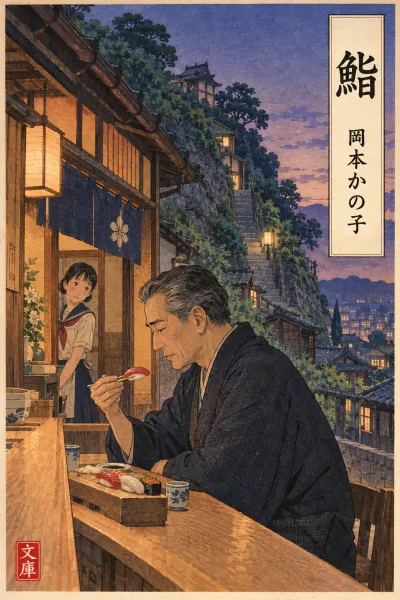
ともよは、初めは少し窮屈な客と思っていただけだったが、だんだんこの客の謎めいた眼の遣り処を見慣れると、お茶を運んで行ったときから鮨を喰い終るまで、よそばかり眺めていて、一度もその眼を自分の方に振向けないときは、物足りなく思うようになった。At first Tomoyo had merely thought of him as a rather stiff customer, but as she slowly grew used to the mysterious way he let his eyes wander, she began to feel let down whenever, from the moment she brought his tea until he finished his sushi, he looked only elsewhere and never once turned those eyes toward her.
そうかといって、どうかして、まともにその眼を振向けられ自分の眼と永く視線を合せていると、自分を支えている力を暈されて危いような気がした。And yet, when for some reason he did turn them full on her and their gazes held for a long time, she felt as though the strength that kept her steady were being blurred away, and that she was in danger.
偶然のように顔を見合して、ただ一通りの好感を寄せる程度で、微笑して呉れるときはともよは父母とは違って、自分をほぐして呉れるなにか暖味のある刺戟のような感じをこの年とった客からうけた。But when their eyes met as if by chance and he smiled at her with no more than an ordinary friendliness, Tomoyo felt something from this elderly customer that she never felt from her parents, a kind of warm stimulation that seemed to loosen her up.
だからともよは湊がいつまでもよそばかり見ているときは土間の隅の湯沸しの前で、絽ざしの手をとめて、たとえば、作り咳をするとか耳に立つものの音をたてるかして、自分ながらしらずしらず湊の注意を自分に振り向ける所作をした。So whenever Minato kept looking away, Tomoyo would pause in her silk-gauze embroidery beside the kettle in the corner of the earthen-floored entrance and, without quite realising it herself, do something to draw his attention, such as a fake cough or a noise sharp enough to catch the ear.
すると湊は、ぴくりとして、ともよの方を見て、微笑する。Then Minato would give a little start, look toward Tomoyo, and smile.
上歯と下歯がきっちり合い、引緊って見える口の線が、滑かになり、仏蘭西髭の片端が目についてあがる――父親は鮨を握り乍らちょっと眼を挙げる。The firm-looking line of his mouth, upper and lower teeth neatly together, would soften, and one tip of his French moustache would visibly lift. Her father, shaping sushi, would glance up for a moment.
ともよのいたずら気とばかり思い、また不愛想な顔をして仕事に向う。Taking it for nothing more than Tomoyo's mischief, he would put on his sullen face again and turn back to his work.
湊はこの店へ来る常連とは分け隔てなく話す。Minato talked with all the regulars who came to the shop, treating each of them alike.
競馬の話、株の話、時局の話、碁、将棋の話、盆栽の話――大体こういう場所の客の間に交される話題に洩れないものだが、湊は、八分は相手に話さして、二分だけ自分が口を開くのだけれども、その寡黙は相手を見下げているのでもなく、つまらないのを我慢しているのでもない。Horse racing, stocks, the state of the nation, go, shogi, bonsai: the talk generally keeps to the topics customers trade in places like this. Minato let the other person do eight-tenths of the talking and opened his mouth for only two-tenths, yet his silence was neither a way of looking down on them nor of enduring boredom.
その証拠には、盃の一つもさされるとThe proof was that whenever someone offered him a cup of sake,
「いやどうも、僕は身体を壊していて、酒はすっかりとめられているのですが、折角ですから、じゃ、まあ、頂きましょうかな」といって、細いがっしりとしている手を、何度も振って、さも敬意を表するように鮮かに盃を受取り、気持ちよく飲んでまた盃を返す。"Oh dear, really, my health has broken down and I've been told to give up drink altogether, but since you're so kind, well then, I suppose I'll have a little," he would say, waving his thin but sturdy hand several times. Then, as if to show his respect, he would take the cup with a deft flourish, drink it with obvious pleasure, and hand it back.
そして徳利を器用に持上げて酌をしてやる。Then he would nimbly lift the flask and pour for the other man.
その挙動の間に、いかにも人なつこく他人の好意に対しては、何倍にかして返さなくては気が済まない性分が現れているので、常連の間で、先生は好い人だということになっていた。In all this his nature showed through: he was warmly sociable and could not rest until he had repaid other people's kindness several times over. So among the regulars it was agreed that Sensei was a good man.
ともよは、こういう湊を見るのは、あまり好かなかった。Tomoyo did not much like seeing Minato this way.
あの人にしては軽すぎるというような態度だと思った。She thought it far too frivolous a manner for a man like him.
相手客のほんの気まぐれに振り向けられた親しみに対して、ああまともに親身の情を返すのは、湊の持っているものが減ってしまうように感じた。She felt that returning such heartfelt warmth so earnestly for friendliness the other customer had shown on a mere whim made Minato lose something of what he had.
ふだん陰気なくせに、一たん向けられると、何という浅ましくがつがつ人情に饑えている様子を現わす年とった男だろうと思う。Usually so gloomy, yet the moment friendliness was turned his way, what a shamefully greedy old man he showed himself to be, she thought, starving for human warmth.
ともよは湊が中指に嵌めている古代埃及の甲虫のついている銀の指輪さえそういうときは嫌味に見えた。At such times even the silver ring set with an ancient Egyptian scarab that Minato wore on his middle finger looked distasteful to Tomoyo.
湊の対応ぶりに有頂天になった相手客が、なお繰り返して湊に盃をさし、湊も釣り込まれて少し笑声さえたて乍らその盃の遣り取りを始め出したと見るときは、ともよはつかつかと寄って行ってWhenever she saw the other customer, thrilled by Minato's response, offering him the cup again and again, and Minato, carried along, beginning to trade cups back and forth, even letting out a little laugh, Tomoyo would march straight over
「お酒、あんまり呑んじゃ体にいけないって云ってるくせに、もう、よしなさい」"You keep saying too much sake is bad for you, so that's enough now."
と湊の手から盃をひったくる。and snatch the cup from Minato's hand.
そして湊の代りに相手の客にその盃をつき返して黙って行って仕舞う。Then she would thrust the cup back at the other customer in Minato's place and walk off without a word.
それは必しも湊の体をおもう為でなく、妙な嫉妬がともよにそうさせるのであった。It was not necessarily out of concern for Minato's health. It was a strange jealousy that made Tomoyo act this way.
Vocabulary
| Word | Meaning | JLPT |
|---|---|---|
| 窮屈きゅうくつ | stiff, uncomfortable to be aroundLiterally 'cramped'. Used of people, it means formal and hard to relax with. | N1 |
| 謎めいたなぞめく | to seem mysteriousdictionary form: 謎めく〜めく means 'to have an air of', as in 春めく (to feel like spring). | — |
| 物足りなくものたりない | unsatisfying, feeling something is missingdictionary form: 物足りない | N1 |
| 刺戟しげき | stimulus, stimulationOlder spelling of 刺激. | N3 |
| 所作しょさ | action, gesture, behaviourA literary word, also used for movements in theatre and dance. | — |
| 常連じょうれん | regular customer | — |
| 分け隔てなくわけへだて | (without) discrimination; treating everyone alikedictionary form: 分け隔て | — |
| 寡黙かもく | taciturnity, saying little | — |
| 盃さかずき | sake cup盃をさす means to offer someone a cup of sake, a gesture of friendship. | N1 |
| 徳利とっくり | sake flask酌をする, also used here, means to pour sake for someone. | — |
| 性分しょうぶん | nature, temperament | — |
| 浅ましくあさましい | shameful, wretched, basedictionary form: 浅ましい | N1 |
| 有頂天うちょうてん | elated, carried away with delightOriginally a Buddhist term for the highest heaven. | — |
| 嫉妬しっと | jealousy | N1 |
Grammar
〜ようになる N4 to come to (do / feel)
Attached to a verb, it marks a gradual change into a new state or habit. Here Tomoyo's feeling changes over time.
物足りなく思うようになった
she came to feel let down
〜なくては気が済まない N2 cannot feel satisfied unless...
気が済む means 'to feel settled'. Combined with 〜なくては, it describes someone who cannot rest until they have done something.
何倍にかして返さなくては気が済まない性分
a nature that could not rest until it had repaid kindness several times over
〜にしては N3 for (someone or something), considering...
Indicates that something falls short of or differs from what you would expect of the person mentioned.
あの人にしては軽すぎるというような態度だと思った。
She thought it far too frivolous a manner for a man like him.
〜くせに N2 even though; despite (with criticism)
A contrast that carries a note of blame or irritation: 'even though…'. Here Tomoyo uses it to scold Minato for drinking when he himself says it is bad for his health.
お酒、あんまり呑んじゃ体にいけないって云ってるくせに、もう、よしなさい
You keep saying too much sake is bad for you, so that's enough now.
必ずしも〜ない N3 not necessarily
A partial negation: the stated reason is not the whole story. Here it is written in older style as 必しも.
それは必しも湊の体をおもう為でなく
It was not necessarily out of concern for Minato's health
〜させる (causative) N4 to make someone do
An emotion, jealousy, is the subject that makes Tomoyo act. This is a typical literary use of the causative.
妙な嫉妬がともよにそうさせるのであった
it was a strange jealousy that made Tomoyo act this way