Part 7 of 10 · JLPT N2
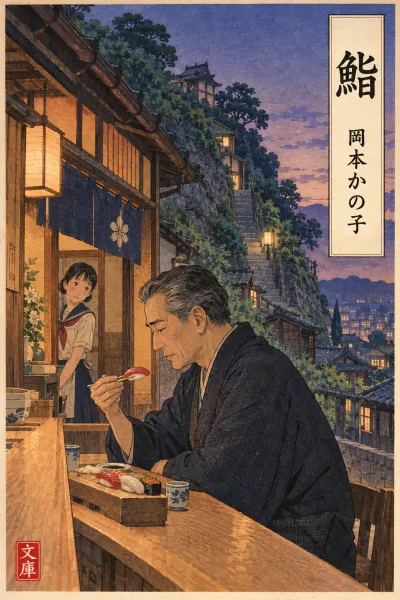
鮨 Sushi, part 7: A Mother Bows to Her Son
In this part
The delicate boy finds egg and laver the foods that suit him best, and he chews sour fruit picked around the city's hills. When the school blames his family for his thinness and his father takes it out on his mother, she bows before him and begs him to eat. He forces down the family's ordinary meal and vomits at once, and the next day his mother sets out brand-new cooking tools on the veranda, seats him across from her and places a plate before him.
AI translation · independently checked
母親はおろおろの声である。His mother's voice was flustered and distraught.
こういう心配の揚句、玉子と浅草海苔が、この子の一ばん性に合う喰べものだということが見出されたのだった。After all this worry, it was found that eggs and Asakusa laver were the foods that suited the child best.
これなら子供には腹に重苦しいだけで、穢されざるものに感じた。With these, the child felt nothing worse than a heaviness in his stomach, and he sensed them to be things that had not been defiled.
子供はまた、ときどき、切ない感情が、体のどこからか判らないで体一ぱいに詰まるのを感じる。At times, too, the child would feel an aching, wistful emotion well up from somewhere in his body he could not name until it filled him completely.
そのときは、酸味のある柔いものなら何でも噛んだ。At such times he would chew anything soft that had a sour taste.
生梅や橘の実を捥いで来て噛んだ。He would pick unripe plums or tachibana oranges and come back chewing them.
さみだれの季節になると子供は都会の中の丘と谷合にそれ等の実の在所をそれらを啄みに来る烏のようによく知っていた。When the season of the early-summer rains came, the child knew where those fruits were to be found among the hills and hollows of the city, as well as the crows that came to peck at them knew it.
子供は、小学校はよく出来た。At primary school the child did very well.
一度読んだり聞いたりしたものは、すぐ判って乾板のように脳の襞に焼きつけた。Anything he had read or heard once he understood at once, and it was burned into the folds of his brain like an image on a photographic plate.
子供には学課の容易さがつまらなかった。To the child, the lessons were dull because they were so easy.
つまらないという冷淡さが、却って学課の出来をよくした。That cool indifference born of boredom only made his schoolwork better.
家の中でも学校でも、みんなはこの子供を別もの扱いにした。At home and at school alike, everyone treated this child as a being apart.
父親と母親とが一室で言い争っていた末、母親は子供のところへ来て、しみじみとした調子でいった。After his father and mother had quarrelled in one of the rooms, his mother came to him and spoke in a heartfelt tone.
「ねえ、おまえがあんまり痩せて行くもんだから学校の先生と学務委員たちの間で、あれは家庭で衛生の注意が足りないからだという話が持上ったのだよ。それを聞いて来てお父つあんは、ああいう性分だもんだから、私に意地くね悪く当りなさるんだよ」"You see, because you keep getting thinner and thinner, talk started up among your teachers and the school board members that it must be because your family doesn't pay enough attention to hygiene. Your father heard about it, and being the sort of man he is, he's been taking it out on me most spitefully."
そこで母親は、畳の上へ手をついて、子供に向ってこっくりと、頭を下げた。Then his mother placed her hands on the tatami and, facing the child, bowed her head low.
「どうか頼むから、もっと、喰べるものを喰べて、肥ってお呉れ、そうして呉れないと、あたしは、朝晩、いたたまれない気がするから」"Please, I'm begging you—eat the food that's put in front of you and put on some weight. If you don't, I'll feel I can hardly bear it, morning and night."
子供は自分の畸形な性質から、いずれは犯すであろうと予感した罪悪を、犯したような気がした。The child felt as though he had committed the sin he had always sensed his deformed nature would lead him to commit sooner or later.
わるい。It was wrong.
母に手をつかせ、お叩頭をさせてしまったのだ。He had made his mother put her hands to the floor and bow to him.
顔がかっとなって体に慄えが来た。His face burned, and a trembling came over his body.
だが不思議にも心は却って安らかだった。And yet, strangely, his heart felt calm instead.
すでに、自分は、こんな不孝をして悪人となってしまった。He had already done this undutiful thing and become a wicked person.
こんな奴なら自分は滅びて仕舞っても自分で惜しいとも思うまい。If he was that kind of wretch, then even if he perished, he himself would surely feel no regret.
よし、何でも喰べてみよう、喰べ馴れないものを喰べて体が慄え、吐いたりもどしたり、その上、体じゅうが濁り腐って死んじまっても好いとしよう。Very well, he would try eating anything at all; even if eating food he was not used to made his body shake, made him retch and throw up, and on top of that turned his whole body foul and rotten until he died, so be it.
生きていてしじゅう喰べものの好き嫌いをし、人をも自分をも悩ませるよりその方がましではあるまいか――Wouldn't that be better than living on, forever fussing over what he would and would not eat, tormenting others and himself?
子供は、平気を装って家のものと同じ食事をした。Pretending to be at ease, the child ate the same meal as the rest of the household.
すぐ吐いた。He vomited at once.
口中や咽喉を極力無感覚に制御したつもりだが嚥み下した喰べものが、母親以外の女の手が触れたものと思う途端に、胃嚢が不意に逆に絞り上げられた――女中の裾から出る剥げた赤いゆもじや飯炊婆さんの横顔になぞってある黒鬢つけの印象が胸の中を暴力のように掻き廻した。He had meant to keep his mouth and throat as numb as he possibly could, yet the moment he thought that the food he had swallowed had been touched by the hands of women other than his mother, his stomach suddenly wrung itself the wrong way round—the image of the worn red underskirt showing beneath the maid's hem, and of the black hair-oil traced along the old cook's profile, churned through his chest with a kind of violence.
兄と姉はいやな顔をした。His elder brother and sister made sour faces.
父親は、子供を横顔でちらりと見たまま、知らん顔して晩酌の盃を傾けていた。His father merely glanced at the child out of the corner of his eye and went on tilting his evening cup of sake as if he had not noticed.
母親は子供の吐きものを始末しながら、恨めしそうに父親の顔を見てCleaning up what the child had brought up, his mother looked reproachfully at his father's face
「それご覧なさい。あたしのせいばかりではないでしょう。この子はこういう性分です」"There, you see? It isn't all my fault, is it? This child is just made this way."
と嘆息した。she said with a sigh.
しかし、父親に対して母親はなお、おずおずはしていた。Even so, his mother was still timid before his father.
その翌日であった。It was the next day.
母親は青葉の映りの濃く射す縁側へ新しい茣蓙を敷き、俎板だの庖丁だの水桶だの蠅帳だの持ち出した。On the veranda, where the reflected green of the young leaves fell deep, his mother spread a new rush mat and brought out a chopping board, a kitchen knife, a water pail, a screened food cupboard and the like.
それもみな買い立ての真新しいものだった。Every one of them was brand-new, freshly bought.
母親は自分と俎板を距てた向側に子供を坐らせた。His mother sat the child down on the side opposite her, with the chopping board between them.
子供の前には膳の上に一つの皿を置いた。In front of the child, on a small tray table, she set a single plate.
Vocabulary
| Word | Meaning | JLPT |
|---|---|---|
| おろおろおろおろ | flustered, at a loss, distraughtMimetic word for anxious confusion. It is often used as おろおろする. | — |
| 揚句あげく | in the end, after (much …)Usually written 挙句 today. The pattern Nの挙句 means 'after a long stretch of N'. | — |
| 性に合うしょうにあう | to suit one's natureIn this expression 性 is read しょう, not せい. | — |
| 切ないせつない | aching, painfully wistful | N1 |
| 捥いでもぐ | to pick or pluck (fruit)dictionary form: 捥ぐThis kanji is rare. The word is usually written もぐ. | — |
| 橘たちばな | tachibana orange (a small native Japanese citrus)There is no English equivalent, so the Japanese name is kept in the translation. | — |
| 啄みついばむ | to peck at (as birds do)dictionary form: 啄む | — |
| 別もの扱いべつものあつかい | treating someone as a being apartdictionary form: 別物扱いThe noun 〜扱い means 'treatment as ~'. | — |
| 意地くね悪くいじくねわるい | spiteful, nastydictionary form: 意地くね悪いAn old colloquial, stronger form of 意地悪い. | — |
| いたたまれないいたたまれない | unbearable; unable to stay put for distressdictionary form: 居たたまれない | — |
| 不孝ふこう | lack of filial piety, undutiful behaviour toward one's parentsDo not confuse it with 不幸 (misfortune), which has the same reading. | — |
| 装ってよそおう | to pretend, to feigndictionary form: 装うThe phrase 平気を装う means 'to pretend to be calm'. | — |
| 晩酌ばんしゃく | a drink of sake with the evening meal | — |
| 始末しまつ | cleaning up, dealing with | N1 |
Grammar
〜ざる N1 not ~ (classical negative before a noun)
ざる is the attributive form of the classical negative ず, and it modifies the noun that follows. Here 穢されざるもの means 'things that have not been defiled'.
穢されざるものに感じた
he sensed them to be things that had not been defiled
却って N2 on the contrary, instead
却って marks a result that is the opposite of what one would expect. Boredom would normally hurt his schoolwork, but here it improved it.
つまらないという冷淡さが、却って学課の出来をよくした。
That cool indifference born of boredom only made his schoolwork better.
〜もんだから N3 because (explanatory, colloquial)
もんだから is the spoken form of ものだから. It gives a reason, often as an excuse or a justification, and it appears twice in the mother's speech.
おまえがあんまり痩せて行くもんだから
because you keep getting thinner and thinner
〜てお呉れ N4 please do ~ (for me)
This is an old-fashioned spelling of 〜ておくれ. It is a gentle, intimate request that a parent or older person makes to a younger one.
肥ってお呉れ
put on some weight
〜まい N2 will probably not ~ / surely won't ~
まい is a literary negative of conjecture or intention. 思うまい means 'would surely not feel', and ではあるまいか in the next sentence asks 'wouldn't it be ~?'
自分で惜しいとも思うまい。
he himself would surely feel no regret.
〜た途端に N2 the moment ~, just as ~
〜途端に means 'the moment ~, just as ~'. It usually follows the past tense (〜た途端に) but here follows the dictionary form 思う, and it marks something sudden happening immediately upon an action or thought. Here his stomach rebels the instant the thought crosses his mind.
母親以外の女の手が触れたものと思う途端に、胃嚢が不意に逆に絞り上げられた
the moment he thought it had been touched by the hands of women other than his mother, his stomach suddenly wrung itself upside down