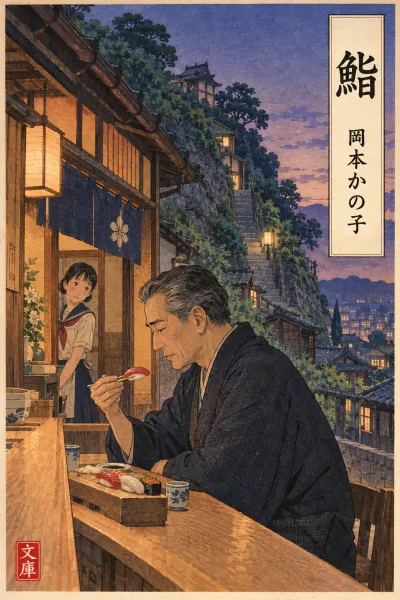
Part 6 of 10 · JLPT N2
鮨 Sushi, part 6: A Boy Who Could Not Eat
In this part
Minato's story turns to a strange, delicate child who hates most food, eats rice crackers as if listening to music, and feels that eating defiles his body. His family's fortunes are slowly declining under a proud, timid father. Faint with hunger at sunset, the boy calls out to an imagined 'Mother', but his real mother answers and begs him to eat properly.
AI translation · independently checked
その子供は小さいときから甘いものを好まなかった。From the time he was small, the child did not care for sweet things.
おやつにはせいぜい塩煎餅ぐらいを望んだ。For a snack he would ask for a salted rice cracker at most.
食べるときは、上歯と下歯を叮嚀に揃え円い形の煎餅の端を規則正しく噛み取った。When he ate one, he would carefully line up his upper and lower teeth and bite off the edge of the round cracker in a neat, regular way.
ひどく湿っていない煎餅なら大概好い音がした。As long as the cracker was not too damp, it usually made a pleasing sound.
子供は噛み取った煎餅の破片をじゅうぶんに咀嚼して咽喉へきれいに嚥み下してから次の端を噛み取ることにかかる。The child would chew the broken-off piece thoroughly and swallow it cleanly down his throat before setting about biting off the next edge.
上歯と下歯をまた叮嚀に揃え、その間へまた煎餅の次の端を挟み入れる――いざ、噛み破るときに子供は眼を薄く瞑り耳を澄ます。Once again he carefully lined up his upper and lower teeth, and once again slipped the next edge of the cracker between them. Then, at the very moment of biting through, the child half closed his eyes and listened intently.
ぺちんPechin.
同じ、ぺちんという音にも、いろいろの性質があった。Even that same pechin sound came in many different kinds.
子供は聞き慣れてその音の種類を聞き分けた。The child had grown so used to it that he could tell the kinds of sound apart.
ある一定の調子の響きを聞き当てたとき、子供はぷるぷると胴慄いした。When he caught one particular tone ringing out, the child would shiver all over.
子供は煎餅を持った手を控えて、しばらく考え込む。He would hold back the hand that held the cracker and sink into thought for a while.
うっすら眼に涙を溜めている。His eyes would be faintly brimming with tears.
家族は両親と、兄と姉と召使いだけだった。The family was just his parents, an elder brother, an elder sister, and the servants.
家中で、おかしな子供と云われていた。Everyone in the house called him a strange child.
その子供の喰べものは外にまだ偏っていた。His eating was lopsided in other ways too.
さかなが嫌いだった。He disliked fish.
あまり数の野菜は好かなかった。He did not like many vegetables.
肉類は絶対に近づけなかった。Meat of any kind he would not go near.
神経質のくせに表面は大ように見せている父親はときどきHis father, a nervous man who nevertheless put on an easygoing air, would sometimes
「ぼうずはどうして生きているのかい」"How on earth does the boy stay alive?"
と子供の食事を覗きに来た。he would say, coming to peer at the child's meal.
一つは時勢のためでもあるが、父親は臆病なくせに大ように見せたがる性分から、家の没落をじりじり眺め乍ら「なに、まだ、まだ」とまけおしみを云って潰して行った。Partly it was the times, but the father was timid by nature and always wanted to look easygoing. He watched the family's fortunes slowly sink, saying stubbornly, "Oh, it's nothing, not yet, not yet," and so let everything go to ruin.
子供の小さい膳の上には、いつものように炒り玉子と浅草海苔が、載っていた。On the child's small meal tray there was, as always, scrambled egg and dried Asakusa seaweed.
母親は父親が覗くとその膳を袖で隠すようにしてWhenever the father peeped in, the mother would half hide the tray with her sleeve and say,
「あんまり、はたから騒ぎ立てないで下さい、これさえ気まり悪がって喰べなくなりますから」"Please don't make such a fuss from the side. He'll get embarrassed and stop eating even this."
その子供には、実際、食事が苦痛だった。For that child, in truth, meals were torment.
体内へ、色、香、味のある塊団を入れると、何か身が穢れるような気がした。Whenever he put a lump of something with colour, smell and taste inside his body, he felt as though he were somehow being defiled.
空気のような喰べものは無いかと思う。He wondered whether there might be some food that was like air.
腹が減ると饑えは充分感じるのだが、うっかり喰べる気はしなかった。When his stomach was empty he felt the hunger well enough, but he could not bring himself to simply eat.
床の間の冷たく透き通った水晶の置きものに、舌を当てたり、頬をつけたりした。He would press his tongue or lay his cheek against the cold, clear crystal ornament in the alcove.
饑えぬいて、頭の中が澄み切ったまま、だんだん、気が遠くなって行く。Starved through and through, his head perfectly clear, he would gradually grow faint.
それが谷地の池水を距ててA―丘の後へ入りかける夕陽を眺めているときででもあると(湊の生れた家もこの辺の地勢に似た都会の一隅にあった。)子どもはこのままのめり倒れて死んでも関わないとさえ思う。If this happened while he was gazing across the pond in the hollow at the evening sun beginning to sink behind A— Hill (the house where Minato was born was also in a corner of the city whose lie of the land resembled this area), the child would even think he would not mind pitching forward just as he was and dying.
だが、この場合は窪んだ腹に緊く締めつけてある帯の間に両手を無理にさし込み、体は前のめりのまま首だけ仰のいてBut at such times he would force both hands into the sash tied tightly round his hollow belly, and with his body still bent forward, tilt only his head back and
「お母さあん」"Mo-ther!"
と呼ぶ。he would call.
子供の呼んだのは、現在の生みの母のことではなかった。The one the child was calling was not the mother he had now, the one who had given birth to him.
子供は現在の生みの母は家族じゅうで一番好きである。Of all his family, the child loved that mother, the one who had borne him, best.
けれども子供にはまだ他に自分に「お母さん」と呼ばれる女性があって、どこかに居そうな気がした。Yet he felt that there was still another woman whom he could call "Mother", and that she might be somewhere.
自分がいま呼んで、もし「はい」といってその女性が眼の前に出て来たなら自分はびっくりして気絶して仕舞うに違いないとは思う。He did think that if, when he called now, that woman were to answer "Yes" and appear before his eyes, he would surely be so startled that he would faint.
しかし呼ぶことだけは悲しい楽しさだった。But the calling itself was a sad kind of pleasure.
「お母さあん、お母さあん」"Mo-ther, Mo-ther!"
薄紙が風に慄えるような声が続いた。The voice went on, like thin paper trembling in the wind.
「はあい」"Ye-es,"
と返事をして現在の生みの母親が出て来た。answered the mother who had borne him, coming out.
「おや、この子は、こんな処で、どうしたのよ」"Why, child, what are you doing in a place like this?"
肩を揺って顔を覗き込む。She shook his shoulder and peered into his face.
子供は感違いした母親に対して何だか恥しく赫くなった。The child somehow felt ashamed before his mother, who had misunderstood, and turned red.
「だから、三度々々ちゃんとご飯喰べてお呉れと云うに、さ、ほんとに後生だから」"That's why I keep telling you to eat your meals properly, three times a day. Come now, I'm begging you, really."
Vocabulary
| Word | Meaning | JLPT |
|---|---|---|
| 叮嚀ていねい | careful, painstakingdictionary form: 丁寧Older spelling of 丁寧; today usually means 'polite', but here it means 'with great care'. | N4 |
| 咀嚼そしゃく | chewing, masticationA formal, medical-sounding word; also used figuratively for 'digesting' ideas. | — |
| 聞き分けたききわける | to tell apart by eardictionary form: 聞き分けるVerb stem + 分ける means 'to distinguish by ~ing', as in 見分ける 'tell apart by sight'. | — |
| 胴慄いどうぶるい | a shiver running through the whole bodydictionary form: 胴震いLiterally 'trunk-trembling'; 慄 is an older kanji used here for 震. | — |
| 偏ってかたよる | to be lopsided, unbalanceddictionary form: 偏るCommon in 偏った食事 'an unbalanced diet'. | N2 |
| 大ようおおよう | easygoing, generous, unfussydictionary form: 大様Also written 鷹揚. The father only acts this way on the surface. | — |
| 没落ぼつらく | downfall, ruin (of a family or class) | N1 |
| まけおしみまけおしみ | refusal to admit defeat, sour grapesdictionary form: 負け惜しみUsually used as 負け惜しみを言う 'to talk as if one hasn't lost'. | — |
| 膳ぜん | individual low meal tray (with legs)Before shared dining tables, each family member ate from their own tray. | N1 |
| 穢れるけがれる | to become impure, defiledSuggests spiritual or ritual impurity, not just physical dirt. | N1 |
| 気が遠くなってきがとおくなる | to grow faint, feel one is losing consciousnessdictionary form: 気が遠くなる | — |
| 気絶きぜつ | fainting, passing out | — |
| 後生ごしょう | for pity's sake; please, I beg youBuddhist word for 'the next life'; 後生だから is an old, pleading 'I beg you'. Read こうせい it means 'younger people'. | — |
Grammar
〜くせに N3 even though, despite (critical tone)
Joins a fact with something that contradicts it, with a note of disapproval. Here the father is nervous, yet pretends to be relaxed.
神経質のくせに表面は大ように見せている父親
his father, a nervous man who nevertheless put on an easygoing air
〜たがる N4 (someone else) wants to ~
Verb stem + たがる describes a third person's desire or tendency. 見せたがる means he always wanted to appear a certain way.
父親は臆病なくせに大ように見せたがる性分から
because the father was timid by nature and always wanted to look easygoing
〜乍ら(ながら) N4 while ~ing
Verb stem + ながら shows two actions at once. 乍ら is the older kanji spelling, now written in kana.
家の没落をじりじり眺め乍ら「なに、まだ、まだ」とまけおしみを云って
watching the family's fortunes slowly sink, saying stubbornly, "Oh, it's nothing, not yet, not yet"
〜とさえ思う N3 even think that ~
さえ marks an extreme case: 'even'. The boy goes as far as thinking he would not mind dying.
子どもはこのままのめり倒れて死んでも関わないとさえ思う。
the child would even think he would not mind pitching forward just as he was and dying.
〜に違いない N3 must surely ~, there is no doubt that ~
Expresses strong certainty based on the speaker's judgement. Here the boy is sure he would faint from shock.
自分はびっくりして気絶して仕舞うに違いないとは思う
he did think that he would surely be so startled that he would faint
〜てお呉れ(くれ) N4 please do ~ (for me)
て-form + おくれ is a soft, old-fashioned request, typical of a parent speaking to a child. 呉れ is the older kanji spelling of くれ.
三度々々ちゃんとご飯喰べてお呉れと云うに
I keep telling you to eat your meals properly, three times a day