Part 6 of 8 · JLPT N2
トカトントン Tokatonton, part 6: A Secret on the Beach, Then Hammering
In this part
On the beach, Hanae tells the narrator that the savings she deposits belong to the innkeeper's wife and begs him to keep it secret. Just as he is overcome with love for her, real hammering sounds from a nearby shed, and all his feeling drains away; he leaves coldly and stops caring about her. He then explains his long-held disgust with politics, including how he skipped the April election, until a workers' demonstration in Aomori seemed to prove him wrong.
AI translation · independently checked
「いらっしゃい。坐ると風が当らなくて、あたたかいわ」"Come and sit. When you sit down the wind doesn't reach you, and it's warm."
私は花江さんが両脚を前に投げ出して坐っている個所から、二メートルくらい離れたところに腰をおろしました。I sat down about two metres from where Hanae was sitting with her legs stretched out in front of her.
「呼び出したりして、ごめんなさいね。でも、あたし、あなたに一こと言わずには居られないのよ。あたしの貯金の事、ね、へんに思っていらっしゃるんでしょう?」"I'm sorry for calling you out like this. But I just can't help saying one thing to you. About my savings. You think it's strange, don't you?"
私も、ここだと思い、しゃがれた声で答えました。I, too, felt that this was the moment, and answered in a hoarse voice.
「へんに、思っています。」"Yes, I do think it's strange."
「そう思うのが当然ね」と言って花江さんは、うつむき、はだかの脚に砂を掬って振りかけながら、「あれはね、あたしのお金じゃないのよ。あたしのお金だったら、貯金なんかしやしないわ。いちいち貯金なんて、めんどうくさい」"Of course you would," said Hanae, and, looking down and scooping up sand to sprinkle over her bare legs, she went on, "That money isn't mine, you know. If it were mine, I'd never bother putting it in the bank. Saving it every single time is such a nuisance."
成る程と思い、私は黙ってうなずきました。That makes sense, I thought, and nodded without a word.
「そうでしょう? あの通帳はね、おかみさんのものなのよ。でも、それは絶対に秘密よ。あなた、誰にも言っちゃだめよ。おかみさんが、なぜそんな事をするのか、あたしには、ぼんやりわかっているんだけど、でも、それはとても複雑している事なんですから、言いたくないわ。つらいのよ、あたしは。信じて下さる?」"You see? That bankbook belongs to the mistress. But it's an absolute secret. You mustn't tell anyone. I have a vague idea why the mistress does it, but it's all very complicated, so I don't want to talk about it. It's hard for me, you know. Will you believe me?"
すこし笑って花江さんの眼が妙に光って来たと思ったら、それは涙でした。She gave a little laugh, and just as I thought her eyes had taken on a strange glitter, I saw that it was tears.
私は花江さんにキスしてやりたくて、仕様がありませんでした。I wanted to kiss Hanae so badly I could hardly bear it.
花江さんとなら、どんな苦労をしてもいいと思いました。With Hanae, I thought, I would gladly endure any hardship at all.
「この辺のひとたちは、みんな駄目ねえ。あたし、あなたに、誤解されてやしないかと思って、あなたに一こと言いたくって、それできょうね、思い切って」"The people round here are all hopeless. I was afraid you might have got the wrong idea about me, and I wanted to say just one thing to you, so today I finally made up my mind and..."
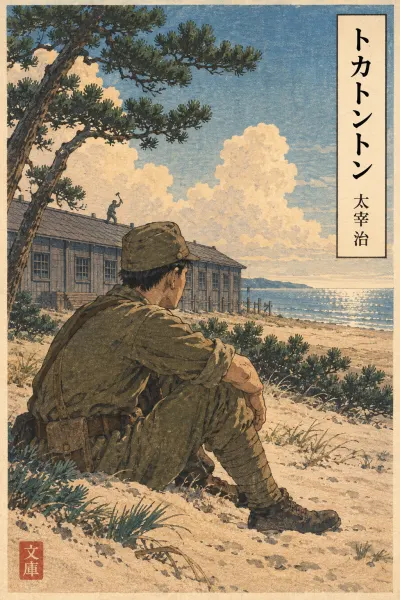
その時、実際ちかくの小屋から、トカトントンという釘打つ音が聞えたのです。At that moment, from a shed nearby, there really came the sound of nails being hammered: *tokatonton*.
この時の音は、私の幻聴ではなかったのです。This time the sound was no hallucination of mine.
海岸の佐々木さんの納屋で、事実、音高く釘を打ちはじめたのです。In Mr. Sasaki's storehouse on the beach, someone had in fact begun loudly hammering nails.
トカトントン、トントントカトン、とさかんに打ちます。*Tokatonton, tontontokaton*: the hammering went on and on.
私は、身ぶるいして立ち上りました。I shuddered and stood up.
「わかりました。誰にも言いません。」花江さんのすぐうしろに、かなり多量の犬の糞があるのをそのとき見つけて、よっぽどそれを花江さんに注意してやろうかと思いました。"I understand. I won't tell anyone." Just then I noticed a fairly large heap of dog droppings right behind Hanae, and I was sorely tempted to point it out to her.
波は、だるそうにうねって、きたない帆をかけた船が、岸のすぐ近くをよろよろと、とおって行きます。The waves rolled lazily, and a boat with a dirty sail went staggering past close to the shore.
「それじゃ、失敬」"Well then, good day."
空々漠々たるものでした。Everything felt utterly empty and hollow.
貯金がどうだって、俺の知った事か。Her savings, whatever they were, what did I care?
もともと他人なんだ。She was a stranger to begin with.
ひとのおもちゃになったって、どうなったって、ちっともそれは俺に関係した事じゃない。Whether she was someone's plaything, or whatever became of her, it had nothing whatever to do with me.
ばかばかしい。How ridiculous.
腹がへった。I was hungry.
それからも、花江さんは相変らず、一週間か十日目くらいに、お金を持って来て貯金して、もういまでは何千円かの額になっていますが、私には少しも興味がありません。After that Hanae went on as before, bringing money to deposit every week or ten days, and by now it amounts to several thousand yen, but I have not the slightest interest in it.
花江さんの言ったように、それはおかみさんのお金なのか、または、やっぱり花江さんのお金なのか、どっちにしたって、それは全く私には関係の無い事ですもの。Whether it is the mistress's money, as Hanae said, or Hanae's own after all, either way it has nothing whatsoever to do with me.
そうして、いったいこれは、どちらが失恋したという事になるのかと言えば、私には、どうしても、失恋したのは私のほうだというような気がしているのですけれども、しかし、失恋して別段かなしい気も致しませんから、これはよっぽど変った失恋の仕方だと思っています。And if you ask which of us, in the end, was the one disappointed in love, I can't help feeling that it was I; and yet, since being disappointed doesn't make me feel especially sad, I think this must be a very odd way of being disappointed in love.
そうして私は、またもや、ぼんやりした普通の局員になったのです。And so once again I became an ordinary, absent-minded post office clerk.
六月にはいってから、私は用事があって青森へ行き、偶然、労働者のデモを見ました。After June began, I went to Aomori on an errand and happened to see a workers' demonstration.
それまでの私は社会運動または政治運動というようなものには、あまり興味が無い、というよりは、絶望に似たものを感じていたのです。Until then I had had little interest in social or political movements; or rather, I had felt about them something close to despair.
誰がやったって、同じ様なものなんだ。Whoever runs things, it all comes to much the same.
また自分が、どのような運動に参加したって、所詮はその指導者たちの、名誉慾か権勢慾の乗りかかった船の、犠牲になるだけの事だ。And whatever movement I joined, in the end I would only end up a sacrifice to some venture the leaders had already embarked on out of their lust for fame or power.
何の疑うところも無く堂々と所信を述べ、わが言に従えば必ずや汝自身ならびに汝の家庭、汝の村、汝の国、否全世界が救われるであろうと、大見得を切って、救われないのは汝等がわが言に従わないからだとうそぶき、そうして一人のおいらんに、振られて振られて振られとおして、やけになって公娼廃止を叫び、憤然として美男の同志を殴り、あばれて、うるさがられて、たまたま勲章をもらい、沖天の意気を以てわが家に駈け込み、かあちゃんこれだ、と得意満面、その勲章の小箱をそっとあけて女房に見せると、女房は冷たく、あら、勲五等じゃないの、せめて勲二等くらいでなくちゃねえ、と言い、亭主がっかり、などという何が何やらまるで半気狂いのような男が、その政治運動だの社会運動だのに没頭しているものとばかり思い込んでいたのです。I had been convinced that the only people absorbed in such political or social movements were men like this: a man who, without a shred of doubt, boldly states his convictions and makes a grand show of declaring, "Follow my words, and you yourselves, your families, your villages, your country, nay, the whole world, shall surely be saved," then sneers that if you are not saved it is because you did not follow his words; who is jilted and jilted and jilted again by a single courtesan, and in desperation cries out for the abolition of licensed prostitution; who indignantly punches a handsome comrade, runs wild, makes himself a nuisance, happens to receive a decoration, rushes home in soaring spirits, says "Look at this, dear!" beaming with pride, and gently opens the little box to show his wife, only for her to say coldly, "Oh, it's only the Fifth Class? It ought to be at least the Second Class," leaving the husband crestfallen; in short, a man who hardly knows what's what, practically half mad.
それですから、ことしの四月の総選挙も、民主主義とか何とか言って騒ぎ立てても、私には一向にその人たちを信用する気が起らず、自由党、進歩党は相変らずの古くさい人たちばかりのようでまるで問題にならず、また社会党、共産党は、いやに調子づいてはしゃいでいるけれども、これはまた敗戦便乗とでもいうのでしょうか、無条件降伏の屍にわいた蛆虫のような不潔な印象を消す事が出来ず、四月十日の投票日にも私は、伯父の局長から自由党の加藤さんに入れるようにと言われていたのですが、はいはいと言って家を出て海岸を散歩して、それだけで帰宅しました。So when the general election came this April and everyone was making a fuss about democracy and whatnot, I could not bring myself to trust any of those people at all. The Liberals and the Progressives seemed to be the same stale old faces as ever and were out of the question. The Socialists and Communists were terribly carried away and excited, but this was perhaps what you would call cashing in on defeat, and I could not shake off an unclean impression of maggots swarming on the corpse of unconditional surrender. On polling day, the tenth of April, my uncle the postmaster had told me to vote for Mr. Katō of the Liberal Party; I said, "Yes, yes," left the house, took a walk along the beach, and simply came home.
社会問題や政治問題に就いてどれだけ言い立てても、私たちの日々の暮しの憂鬱は解決されるものではないと思っていたのですが、しかし、私はあの日、青森で偶然、労働者のデモを見て、私の今までの考えは全部間違っていた事に気がつきました。I had believed that however much one argued about social and political problems, the gloom of our everyday lives would never be solved that way. But that day in Aomori, seeing the workers' demonstration by chance, I realised that everything I had thought until then was wrong.
Vocabulary
| Word | Meaning | JLPT |
|---|---|---|
| 投げ出してなげだす | to stretch out (one's legs); to throw outdictionary form: 投げ出す脚を投げ出す: to sit with legs stretched out casually. | N1 |
| 貯金ちょきん | savings; (making) a depositThe narrator works at a post office, which also handled savings accounts. | N3 |
| 通帳つうちょう | bankbook; passbook | N2 |
| おかみさんおかみさん | the mistress; the landlady (of the inn)Used for the woman who runs an inn, shop or restaurant. | — |
| 幻聴げんちょう | auditory hallucination幻 'illusion' + 聴 'hearing'. | — |
| 納屋なや | storehouse; shed (for tools or fishing gear) | — |
| 身ぶるいみぶるい | a shudder; shiveringdictionary form: 身震いUsed with する: 身ぶるいする 'to shudder'. | — |
| 空々漠々くうくうばくばく | utterly empty and vague; hollowLiterary four-character expression, usually followed by たる. | — |
| 失恋しつれん | being disappointed in love; heartbreak | N2 |
| 所詮しょせん | in the end; after all (resigned tone)Implies that nothing better can be expected. | — |
| 大見得を切っておおみえをきる | to make a grand, showy declarationdictionary form: 大見得を切るFrom the dramatic poses (見得) struck by kabuki actors. | — |
| おいらんおいらん | high-ranking courtesandictionary form: 花魁Old-fashioned word for a top courtesan of the licensed quarters. | — |
| 一向にいっこうに | (not) at allUsed with a negative: 一向に〜ない. | — |
| 便乗びんじょう | taking advantage of a situation; jumping on the bandwagon | — |
Grammar
〜ずにはいられない N2 can't help doing
The negative stem 言わ + ずには + いられない means the speaker cannot keep from doing something. Here 居られない is written in kanji, but it is the same pattern.
あなたに一こと言わずには居られないのよ
I just can't help saying one thing to you.
〜たくて仕様がない N3 want to do something unbearably much
仕様がない (しょうがない) after a て-form expresses an overwhelming feeling. With 〜たくて it means a desire so strong it cannot be held back.
私は花江さんにキスしてやりたくて、仕様がありませんでした。
I wanted to kiss Hanae so badly I could hardly bear it.
〜て(は)いやしないか / 〜しやしない N1 emphatic negative; 'mightn't it be that…'
やしない is a colloquial, emphatic contraction of 〜はしない. In されてやしないかと思って it expresses worry that something might be the case. In sentence 6, しやしない means 'would never do'.
あなたに、誤解されてやしないかと思って
I was afraid you might have got the wrong idea about me
〜たって N3 even if; no matter (how/who)
A casual form of 〜ても. With question words it means 'no matter who/what', as in 誰がやったって and どうなったって.
誰がやったって、同じ様なものなんだ。
Whoever runs things, it all comes to much the same.
〜ものとばかり思い込む N2 to be firmly convinced that (wrongly)
とばかり思う means 'to think nothing but that'. It usually signals a belief that later proves mistaken, which is exactly what happens after the demonstration.
その政治運動だの社会運動だのに没頭しているものとばかり思い込んでいたのです。
I had been convinced that it was only such men who were absorbed in political or social movements.
〜ものではない N2 is not something that (can/will) happen
Attached to a verb, ものではない states a general truth: by nature, this does not happen. Here it means the gloom of daily life is simply not the kind of thing that politics solves.
私たちの日々の暮しの憂鬱は解決されるものではないと思っていたのですが
I had believed that the gloom of our everyday lives would never be solved that way