Part 2 of 8 · JLPT N2
トカトントン Tokatonton, part 2: A Hammer Breaks the Spell
In this part
A young man writes to a novelist for advice about a strange affliction. On the day of Japan's surrender, a young lieutenant urges the soldiers to fight on and die, and the narrator feels ready to die too, until the faint sound of a hammer from behind the barracks drains all feeling from him. Ever since, whenever he is moved or inspired, the *tokatonton* returns and leaves him hollow, as it did one evening at the public bath when he was about to finish a long account of his army days.
AI translation · independently checked
教えていただきたい事があるのです。There is something I should like you to teach me.
本当に、困っているのです。I am truly at a loss.
しかもこれは、私ひとりの問題でなく、他にもこれと似たような思いで悩んでいるひとがあるような気がしますから、私たちのために教えて下さい。What is more, this is not my problem alone; I have a feeling that there are others, too, who are troubled by thoughts much like these, so please teach us, for all our sakes.
横浜の工場にいた時も、また軍隊にいた時も、あなたに手紙を出したい出したいと思い続け、いまやっとあなたに手紙を差上げる、その最初の手紙が、このようなよろこびの少い内容のものになろうとは、まったく、思いも寄らない事でありました。Both when I was at the factory in Yokohama and when I was in the army, I kept thinking that I wanted to write to you, wanted so much to write to you, and now at last I am sending you a letter. I never in the least imagined that this very first letter would turn out to hold so little joy.
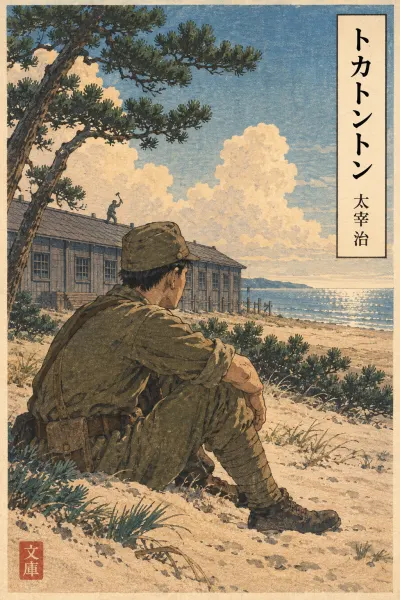
昭和二十年八月十五日正午に、私たちは兵舎の前の広場に整列させられて、そうして陛下みずからの御放送だという、ほとんど雑音に消されて何一つ聞きとれなかったラジオを聞かされ、そうして、それから、若い中尉がつかつかと壇上に駈けあがって、At noon on the fifteenth of August, in the twentieth year of Shōwa, we were made to line up in the square in front of the barracks, and then we were made to listen to a radio broadcast that was said to come from His Majesty himself, though it was so drowned in static that we could not make out a single word. And then, after that, a young lieutenant strode briskly forward and ran up onto the platform,
「聞いたか。わかったか。日本はポツダム宣言を受諾し、降参をしたのだ。しかし、それは政治上の事だ。われわれ軍人は、あく迄も抗戦をつづけ、最後には皆ひとり残らず自決して、以て大君におわびを申し上げる。自分はもとよりそのつもりでいるのだから、皆もその覚悟をして居れ。いいか。よし。解散」"Did you hear? Do you understand? Japan has accepted the Potsdam Declaration and surrendered. But that is a political matter. We soldiers will keep fighting to the very end, and at the last every one of us, to the last man, will take his own life, and in that way make our apology to His Majesty. I fully intend to do so myself, so all of you be prepared for it too. Understood? Good. Dismissed!"
そう言って、その若い中尉は壇から降りて眼鏡をはずし、歩きながらぽたぽた涙を落しました。With that, the young lieutenant stepped down from the platform, took off his glasses, and walked away, his tears falling drop by drop.
厳粛とは、あのような感じを言うのでしょうか。I wonder whether that kind of feeling is what is meant by solemnity.
私はつっ立ったまま、あたりがもやもやと暗くなり、どこからともなく、つめたい風が吹いて来て、そうして私のからだが自然に地の底へ沈んで行くように感じました。As I stood there rooted to the spot, I felt as though everything around me grew dim and hazy, a cold wind came blowing from nowhere in particular, and my body was sinking of its own accord into the depths of the earth.
死のうと思いました。I thought I would die.
死ぬのが本当だ、と思いました。I thought that dying was the right thing to do.
前方の森がいやにひっそりして、漆黒に見えて、そのてっぺんから一むれの小鳥が一つまみの胡麻粒を空中に投げたように、音もなく飛び立ちました。The woods ahead were strangely hushed and looked jet black, and from the treetops a flock of little birds rose without a sound, like a pinch of sesame seeds tossed into the air.
ああ、その時です。Ah, it was then.
背後の兵舎のほうから、誰やら金槌で釘を打つ音が、幽かに、トカトントンと聞えました。From the barracks behind me came, faintly, the sound of someone driving a nail with a hammer: *tokatonton*.
それを聞いたとたんに、眼から鱗が落ちるとはあんな時の感じを言うのでしょうか、悲壮も厳粛も一瞬のうちに消え、私は憑きものから離れたように、きょろりとなり、なんともどうにも白々しい気持で、夏の真昼の砂原を眺め見渡し、私には如何なる感慨も、何も一つも有りませんでした。The instant I heard it (I wonder whether this is the feeling people mean when they say the scales fall from one's eyes), the tragic grandeur and the solemnity vanished in a moment. As if a spirit possessing me had let me go, I came to, blinking, and in a mood utterly flat and hollow I gazed out over the sands at high noon in summer, and I felt nothing whatsoever, nothing at all.
そうして私は、リュックサックにたくさんのものをつめ込んで、ぼんやり故郷に帰還しました。And so I stuffed my rucksack full of things and returned, in a daze, to my hometown.
あの、遠くから聞えて来た幽かな、金槌の音が、不思議なくらい綺麗に私からミリタリズムの幻影を剥ぎとってくれて、もう再び、あの悲壮らしい厳粛らしい悪夢に酔わされるなんて事は絶対に無くなったようですが、しかしその小さい音は、私の脳髄の金的を射貫いてしまったものか、それ以後げんざいまで続いて、私は実に異様な、いまわしい癲癇持ちみたいな男になりました。That faint sound of a hammer from far away stripped the illusion of militarism from me so cleanly that it was almost uncanny, and it seems I will never again be intoxicated by that nightmare with its air of tragic grandeur and solemnity. But perhaps that small sound struck the very bull's-eye of my brain, for it has gone on from that day to this, and I have become a truly strange man, like someone afflicted with a wretched epilepsy.
と言っても決して、兇暴な発作などを起すというわけではありません。That is not to say that I have violent fits or anything of the kind.
その反対です。It is quite the opposite.
何か物事に感激し、奮い立とうとすると、どこからとも無く、幽かに、トカトントンとあの金槌の音が聞えて来て、とたんに私はきょろりとなり、眼前の風景がまるでもう一変してしまって、映写がふっと中絶してあとにはただ純白のスクリンだけが残り、それをまじまじと眺めているような、何ともはかない、ばからしい気持になるのです。Whenever something stirs me and I try to rouse myself to action, from nowhere in particular comes that faint sound of the hammer, *tokatonton*, and at once I come to, blinking, and the scene before my eyes changes completely. It is as though a film had suddenly stopped, leaving nothing behind but a pure white screen, and I were staring blankly at it, and I fall into an indescribably empty, foolish mood.
さいしょ、私は、この郵便局に来て、さあこれからは、何でも自由に好きな勉強ができるのだ、まず一つ小説でも書いて、そうしてあなたのところへ送って読んでいただこうと思い、郵便局の仕事のひまひまに、軍隊生活の追憶を書いてみたのですが、大いに努力して百枚ちかく書きすすめて、いよいよ今明日のうちに完成だという秋の夕暮、局の仕事もすんで、銭湯へ行き、お湯にあたたまりながら、今夜これから最後の章を書くにあたり、オネーギンの終章のような、あんなふうの華やかな悲しみの結び方にしようか、それともゴーゴリの「喧嘩噺」式の絶望の終局にしようか、などひどい興奮でわくわくしながら、銭湯の高い天井からぶらさがっている裸電球の光を見上げた時、トカトントン、と遠くからあの金槌の音が聞えたのです。At first, when I came to this post office, I thought: now at last I can study whatever I like, freely. First I will write a story or something and send it to you to read. In spare moments from my post office work I tried writing my memories of army life. I worked very hard and had written close to a hundred manuscript sheets, and one autumn evening, when it was finally to be finished within a day or two, I had finished my work at the office and gone to the public bath. Warming myself in the hot water, I was thrilled and terribly excited, wondering whether the last chapter I was about to write that night should end in brilliant sorrow, like the close of Onegin, or in a despairing finale in the manner of Gogol's "Quarrel Story." I looked up at the light of the bare bulb hanging from the bathhouse's high ceiling, and just then, from far away, I heard that hammer: *tokatonton*.
とたんに、さっと浪がひいて、私はただ薄暗い湯槽の隅で、じゃぼじゃぼお湯を掻きまわして動いている一個の裸形の男に過ぎなくなりました。At once the wave drew back, and I was no more than a single naked man in a corner of the dim bathtub, sloshing the hot water around.
Vocabulary
| Word | Meaning | JLPT |
|---|---|---|
| 降参こうさん | surrender, giving inEveryday word, also used for 'I give up' in games. 降伏 is the more formal military term. | — |
| 自決じけつ | suicide (to take responsibility or preserve honour)Also means 'self-determination' in political contexts. | — |
| 覚悟かくご | resolve, being prepared (for something grave)覚悟をする / 覚悟して: to brace oneself for death, hardship and the like. | N3 |
| 厳粛げんしゅく | solemnity; solemnA key word of the passage. The hammer's sound destroys exactly this feeling. | — |
| 漆黒しっこく | jet blackLiterally 'lacquer black' (漆 = lacquer). Literary. | — |
| 金槌かなづち | hammerAlso slang for someone who cannot swim (they sink like a hammer). | N1 |
| 釘くぎ | nail釘を打つ: to drive in a nail. | N2 |
| 憑きものつきもの | possessing spiritFrom 憑く (to possess, haunt). 憑きものが落ちる = to come to one's senses. | — |
| 白々しいしらじらしい | flat, empty, disenchantedOften means 'transparent, barefaced' (a lie). Here it describes a cold, deflated mood. | — |
| 幻影げんえい | illusion, phantom | — |
| 癲癇てんかん | epilepsy〜持ち = a person who has (a condition). Usually written in kana today. | — |
| 感激かんげき | being deeply moved or stirred | N2 |
| はかないはかない | empty, fleeting, futileKanji 儚い. A classic word for transient, insubstantial things. | N1 |
| 銭湯せんとう | public bathhouseA paid neighbourhood bath. Common when few homes had their own bath. | — |
Grammar
〜ていただきたい N4 I would like you to (do)
The humble verb いただく (receive) plus たい expresses a polite wish for someone else's action. With のです it becomes an earnest, explanatory request that opens the letter.
教えていただきたい事があるのです。
There is something I should like you to teach me.
〜させられる (causative-passive) N3 to be made to (do)
整列させられて and 聞かされ show that the soldiers acted under orders, not by choice. 聞かされる is the contracted form of 聞かせられる.
私たちは兵舎の前の広場に整列させられて
we were made to line up in the square in front of the barracks
〜(よ)うとは思いも寄らない N2 never imagined that ...
The volitional form (なろう) plus とは marks an unexpected outcome, and 思いも寄らない means 'never even crossed my mind'. Together they express strong surprise.
このようなよろこびの少い内容のものになろうとは、まったく、思いも寄らない事でありました。
I never in the least imagined that it would turn out to hold so little joy.
〜たとたん(に) N3 the moment (something happened)
A past-tense verb plus とたんに shows that a sudden change follows immediately. It is the story's recurring pattern: the sound comes, and at once the feeling vanishes.
それを聞いたとたんに
The instant I heard it
〜(よ)うとすると N3 whenever (one) tries to ...
The volitional form plus とする means 'try to / be about to', and と adds 'whenever'. Each attempt to be stirred is interrupted before it can happen.
何か物事に感激し、奮い立とうとすると、
Whenever something stirs me and I try to rouse myself,
〜に過ぎない N2 nothing more than ...
Reduces something to a small, unimportant thing. 過ぎなくなりました means 'became nothing more than': the inspired writer is now just a naked man in a bathtub.
一個の裸形の男に過ぎなくなりました。
I became no more than a single naked man.