Part 1 of 10 · JLPT N2
夢十夜(第一夜) Yumejūya, part 1: A Hundred Years by the Grave
In this part
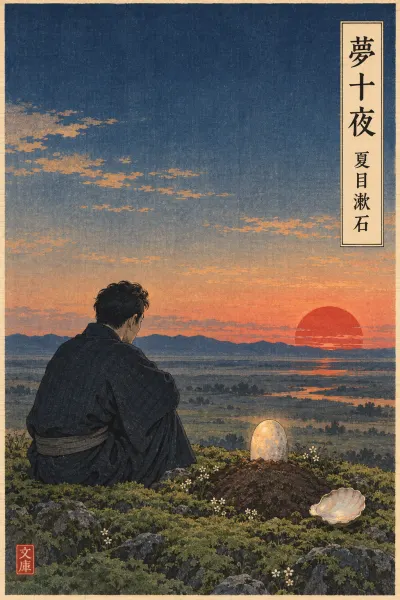
A dying woman asks the narrator to bury her, mark her grave with a fallen star and wait a hundred years for her to return. He buries her by moonlight and counts the red suns as they rise and set until he loses track and begins to fear she lied. Then a white lily grows from under the stone and opens before him, and he realises the hundred years have already passed.
AI translation · independently checked
こんな夢を見た。I had a dream like this.
腕組をして枕元に坐っていると、仰向に寝た女が、静かな声でもう死にますと云う。I was sitting by her pillow with my arms folded when the woman lying on her back said, in a quiet voice, that she was going to die now.
女は長い髪を枕に敷いて、輪郭の柔らかな瓜実顔をその中に横たえている。Her long hair was spread over the pillow, and her oval face, softly contoured, lay within it.
真白な頬の底に温かい血の色がほどよく差して、唇の色は無論赤い。Deep beneath her pure white cheeks the colour of warm blood showed just enough, and her lips, of course, were red.
とうてい死にそうには見えない。She did not look at all like someone about to die.
しかし女は静かな声で、もう死にますと判然云った。But in her quiet voice the woman said clearly that she was going to die now.
自分も確にこれは死ぬなと思った。And I too thought that yes, she really was going to die.
そこで、そうかね、もう死ぬのかね、と上から覗き込むようにして聞いて見た。So I leaned over and looked down into her face and asked, "Is that so? Are you going to die now?"
死にますとも、と云いながら、女はぱっちりと眼を開けた。"Yes, I am going to die," the woman said, and opened her eyes wide.
大きな潤のある眼で、長い睫に包まれた中は、ただ一面に真黒であった。They were large, moist eyes, and within the long lashes that framed them there was nothing but deep black.
その真黒な眸の奥に、自分の姿が鮮に浮かんでいる。Deep in those black pupils, my own figure appeared vividly.
自分は透き徹るほど深く見えるこの黒眼の色沢を眺めて、これでも死ぬのかと思った。I gazed at the lustre of those dark eyes, which seemed so deep I could almost see through them, and thought: can she really die, even so?
それで、ねんごろに枕の傍へ口を付けて、死ぬんじゃなかろうね、大丈夫だろうね、とまた聞き返した。So I put my mouth close beside the pillow and asked again, tenderly, "You're not going to die, are you? You'll be all right, won't you?"
すると女は黒い眼を眠そうに睜たまま、やっぱり静かな声で、でも、死ぬんですもの、仕方がないわと云った。Then, keeping her black eyes open wide as if drowsy, the woman said in the same quiet voice, "But I am going to die. It can't be helped."
じゃ、私の顔が見えるかいと一心に聞くと、見えるかいって、そら、そこに、写ってるじゃありませんかと、にこりと笑って見せた。"Then can you see my face?" I asked earnestly, and she smiled and said, "See it? Why, there it is, reflected right there, isn't it?"
自分は黙って、顔を枕から離した。Without a word, I drew my face back from the pillow.
腕組をしながら、どうしても死ぬのかなと思った。Folding my arms, I wondered whether she really must die.
しばらくして、女がまたこう云った。After a while, the woman spoke again.
「死んだら、埋めて下さい。大きな真珠貝で穴を掘って。そうして天から落ちて来る星の破片を墓標に置いて下さい。そうして墓の傍に待っていて下さい。また逢いに来ますから」"When I die, please bury me. Dig the hole with a large pearl shell. Then place a fragment of a star that has fallen from the sky on the grave as a marker. And then wait beside the grave for me. I will come to see you again."
自分は、いつ逢いに来るかねと聞いた。I asked her, "When will you come to see me?"
「日が出るでしょう。それから日が沈むでしょう。それからまた出るでしょう、そうしてまた沈むでしょう。――赤い日が東から西へ、東から西へと落ちて行くうちに、――あなた、待っていられますか」"The sun will rise, won't it. Then the sun will set. Then it will rise again, and set again. While the red sun goes down from east to west, from east to west... will you be able to wait for me?"
自分は黙って首肯いた。I nodded without a word.
女は静かな調子を一段張り上げて、The woman raised her quiet voice a little,
「百年待っていて下さい」と思い切った声で云った。and said, in a voice full of resolve, "Wait for me a hundred years."
「百年、私の墓の傍に坐って待っていて下さい。きっと逢いに来ますから」"Sit beside my grave and wait for me for a hundred years. I will surely come to see you."
自分はただ待っていると答えた。I simply answered that I would wait.
すると、黒い眸のなかに鮮に見えた自分の姿が、ぼうっと崩れて来た。Then my figure, which I had seen so vividly in her black pupils, began to blur and crumble.
静かな水が動いて写る影を乱したように、流れ出したと思ったら、女の眼がぱちりと閉じた。Just as when still water stirs and breaks up the reflection on it, no sooner had the image begun to flow away than the woman's eyes snapped shut.
長い睫の間から涙が頬へ垂れた。A tear ran from between her long lashes down onto her cheek.
――もう死んでいた。She was already dead.
自分はそれから庭へ下りて、真珠貝で穴を掘った。Then I went down into the garden and dug a hole with a pearl shell.
真珠貝は大きな滑かな縁の鋭どい貝であった。The pearl shell was a large, smooth shell with a sharp edge.
土をすくうたびに、貝の裏に月の光が差してきらきらした。Each time I scooped up the earth, the moonlight fell on the inside of the shell and made it glitter.
湿った土の匂もした。There was a smell of damp earth, too.
穴はしばらくして掘れた。After a while the hole was dug.
女をその中に入れた。I laid the woman in it.
そうして柔らかい土を、上からそっと掛けた。Then I gently covered her from above with the soft earth.
掛けるたびに真珠貝の裏に月の光が差した。Each time I did so, the moonlight fell on the inside of the pearl shell.
それから星の破片の落ちたのを拾って来て、かろく土の上へ乗せた。Then I picked up a fragment of a star that had fallen and brought it back, and set it lightly on the earth.
星の破片は丸かった。The star fragment was round.
長い間大空を落ちている間に、角が取れて滑かになったんだろうと思った。I thought that while it had been falling through the great sky for so long, its corners must have worn away and made it smooth.
抱き上げて土の上へ置くうちに、自分の胸と手が少し暖くなった。As I lifted it in my arms and set it on the earth, my chest and hands grew a little warm.
自分は苔の上に坐った。I sat down on the moss.
これから百年の間こうして待っているんだなと考えながら、腕組をして、丸い墓石を眺めていた。Thinking that from now on I would be waiting like this for a hundred years, I folded my arms and gazed at the round gravestone.
そのうちに、女の云った通り日が東から出た。Before long, just as the woman had said, the sun rose in the east.
大きな赤い日であった。It was a big red sun.
それがまた女の云った通り、やがて西へ落ちた。And again just as the woman had said, it soon went down in the west.
赤いまんまでのっと落ちて行った。Still red, it sank heavily away.
一つと自分は勘定した。"One," I counted.
しばらくするとまた唐紅の天道がのそりと上って来た。After a while a deep crimson sun came slowly climbing up again.
そうして黙って沈んでしまった。And then it sank away in silence.
二つとまた勘定した。"Two," I counted again.
自分はこう云う風に一つ二つと勘定して行くうちに、赤い日をいくつ見たか分らない。As I went on counting like this, one, two, I lost track of how many red suns I had seen.
勘定しても、勘定しても、しつくせないほど赤い日が頭の上を通り越して行った。However much I counted, more red suns than I could ever count passed by over my head.
それでも百年がまだ来ない。Even so, the hundred years had still not come.
しまいには、苔の生えた丸い石を眺めて、自分は女に欺されたのではなかろうかと思い出した。In the end, gazing at the round, moss-covered stone, I began to wonder whether the woman had deceived me.
すると石の下から斜に自分の方へ向いて青い茎が伸びて来た。Then, from under the stone, a green stalk came growing out at a slant towards me.
見る間に長くなってちょうど自分の胸のあたりまで来て留まった。Even as I watched it grew longer, and stopped just at about the height of my chest.
と思うと、すらりと揺ぐ茎の頂に、心持首を傾けていた細長い一輪の蕾が、ふっくらと弁を開いた。And then, at the tip of the gently swaying stalk, a single slender bud, which had been tilting its head slightly, softly opened its petals.
真白な百合が鼻の先で骨に徹えるほど匂った。Right under my nose, a pure white lily gave off a scent that pierced me to the bone.
そこへ遥の上から、ぽたりと露が落ちたので、花は自分の重みでふらふらと動いた。Just then a drop of dew fell from high above, and the flower swayed under its own weight.
自分は首を前へ出して冷たい露の滴る、白い花弁に接吻した。I leaned my head forward and kissed the white petal, from which cold dew was dripping.
自分が百合から顔を離す拍子に思わず、遠い空を見たら、暁の星がたった一つ瞬いていた。As I drew my face away from the lily, I looked up without thinking at the distant sky, and a single morning star was twinkling there.
「百年はもう来ていたんだな」とこの時始めて気がついた。"So the hundred years had already come," I realised then for the first time.
Vocabulary
| Word | Meaning | JLPT |
|---|---|---|
| 枕元まくらもと | bedside, the spot beside one's pillow (元 = 'vicinity, area near')Literally 'pillow-origin'. Often used for sitting by a sick or dying person. | — |
| 腕組うでぐみ | folding one's armsdictionary form: 腕組み腕組みをする. Here it is a recurring gesture of waiting and brooding. | — |
| 瓜実顔うりざねがお | oval face (lit. 'melon-seed face'), a traditional ideal of feminine beautyA classic ideal of feminine beauty in older Japanese writing. | — |
| 無論むろん | of course, naturallyA slightly literary equivalent of もちろん. | N1 |
| とうていとうてい | (not) at all, by no meansdictionary form: 到底Always followed by a negative, here 見えない. | N1 |
| 覗き込むのぞきこむ | to peer into, to look closely down intoThe compound verb 〜込む adds the sense of 'into'. | — |
| ねんごろにねんごろ | kindly, tenderly, with caredictionary form: 懇ろOld-fashioned; it suggests warmth and attentiveness. | — |
| 真珠貝しんじゅがい | pearl shell, pearl oyster shellA key image of the story: the narrator digs the grave with it. | — |
| 墓標はかじるし | grave markerUsually read ぼひょう. The reading はかじるし is given in the original text. | — |
| 勘定かんじょう | countingIn modern usage it most often means 'the bill' at a restaurant (お勘定). | N3 |
| 唐紅からくれない | deep crimsonA poetic colour word; 唐 originally meant 'from China'. | — |
| 天道てんとう | the sunOld-fashioned; compare お天道様 (おてんとさま) 'the sun'. | — |
| 欺されただます | to deceive, to trickdictionary form: 欺すToday it is usually written 騙す. | N2 |
| 暁あかつき | dawn, daybreak暁の星 means the morning star. | — |
Grammar
〜とも N2 certainly, of course (emphatic confirmation)
The sentence-final particle とも strongly affirms what was asked. Here the woman answers the narrator's question with calm certainty.
死にますとも
Yes, I am going to die.
〜(の)じゃなかろう N2 surely not ~, probably isn't ~
なかろう is an older, literary conjectural form of ない (≈ ないだろう). With ね it becomes an anxious request for reassurance.
死ぬんじゃなかろうね、大丈夫だろうね
You're not going to die, are you? You'll be all right, won't you?
〜たびに N3 every time ~
The dictionary form + たびに means that whenever the first action happens, the second follows. It repeats the image of the moonlit shell with each scoop of earth.
土をすくうたびに、貝の裏に月の光が差してきらきらした。
Each time I scooped up the earth, the moonlight fell on the inside of the shell and made it glitter.
〜ほど N3 to the extent that ~, so ... that ~
ほど after a clause gives the degree of what follows. しつくせないほど means 'so many that one could never finish counting'.
勘定しても、勘定しても、しつくせないほど赤い日が頭の上を通り越して行った。
However much I counted, more red suns than I could ever count passed by over my head.
〜たら (discovery) N4 when I did ~, (I found that) ...
たら followed by a past-tense clause describes something the speaker unexpectedly discovers after an action. Here he looks up and finds the morning star.
遠い空を見たら、暁の星がたった一つ瞬いていた。
I looked up at the distant sky, and a single morning star was twinkling there.