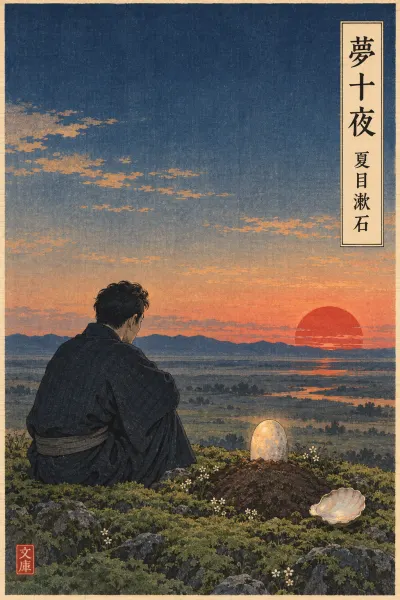
Part 7 of 10 · JLPT N2
夢十夜(第七夜) Yumejūya, part 7: Adrift on an Endless Ship
In this part
The narrator is aboard a huge steamship that seems to chase the setting sun day and night, bound he knows not where. Among passengers who are mostly foreigners, he feels forlorn and finds life so pointless that he throws himself into the sea. The moment his feet leave the deck he regrets it deeply, but it is too late, and he falls slowly toward the black waves.
AI translation · independently checked
何でも大きな船に乗っている。I was on a large ship, it seemed.
この船が毎日毎夜すこしの絶間なく黒い煙を吐いて浪を切って進んで行く。Day and night, without the slightest pause, this ship went forward, belching black smoke and cutting through the waves.
凄じい音である。The noise it made was tremendous.
けれどもどこへ行くんだか分らない。But I had no idea where it was going.
ただ波の底から焼火箸のような太陽が出る。Only, from the bottom of the waves, a sun like a red-hot poker would rise.
それが高い帆柱の真上まで来てしばらく挂っているかと思うと、いつの間にか大きな船を追い越して、先へ行ってしまう。It would climb until it stood right above the tall mast and hang there a while, and then, before I knew it, it had overtaken the great ship and gone on ahead.
そうして、しまいには焼火箸のようにじゅっといってまた波の底に沈んで行く。And in the end it would hiss like a red-hot poker and sink again to the bottom of the waves.
そのたんびに蒼い波が遠くの向うで、蘇枋の色に沸き返る。Each time, far off in the distance, the blue waves seethed up into the dark red of sappanwood.
すると船は凄じい音を立ててその跡を追かけて行く。Then the ship, making its tremendous noise, would go chasing after it.
けれども決して追つかない。But it never caught up.
ある時自分は、船の男を捕まえて聞いて見た。Once I stopped one of the ship's men and asked him.
「この船は西へ行くんですか」"Is this ship going west?"
船の男は怪訝な顔をして、しばらく自分を見ていたが、やがて、The man looked at me for a while with a puzzled face, and at last
「なぜ」と問い返した。asked in return, "Why?"
「落ちて行く日を追かけるようだから」"Because it seems to be chasing the setting sun."
船の男はからからと笑った。The man gave a loud, hollow laugh.
そうして向うの方へ行ってしまった。Then he went off somewhere over there.
「西へ行く日の、果は東か。それは本真か。東出る日の、御里は西か。それも本真か。身は波の上。戢枕。流せ流せ」と囃している。"The sun that goes west, does it end in the east? Is that so, truly? The sun that rises in the east, is its home in the west? Is that so too, truly? Our lives upon the waves. A rudder for a pillow. Let her drift, let her drift!" someone was chanting.
舳へ行って見たら、水夫が大勢寄って、太い帆綱を手繰っていた。When I went to the bow to look, a crowd of sailors had gathered there and were hauling in a thick sail rope hand over hand.
自分は大変心細くなった。I grew terribly forlorn.
いつ陸へ上がれる事か分らない。I did not know when I would ever set foot on land.
そうしてどこへ行くのだか知れない。Nor could I tell where we were going.
ただ黒い煙を吐いて波を切って行く事だけはたしかである。The one thing that was certain was that the ship went on, belching black smoke and cutting through the waves.
その波はすこぶる広いものであった。Those waves were vast beyond measure.
際限もなく蒼く見える。They looked blue without end.
時には紫にもなった。At times they even turned purple.
ただ船の動く周囲だけはいつでも真白に泡を吹いていた。Only around the moving ship was the water always foaming pure white.
自分は大変心細かった。I felt terribly forlorn.
こんな船にいるよりいっそ身を投げて死んでしまおうかと思った。Rather than stay on such a ship, I wondered whether I should simply throw myself overboard and die.
乗合はたくさんいた。There were many passengers.
たいていは異人のようであった。Most of them seemed to be foreigners.
しかしいろいろな顔をしていた。Yet their faces were of every kind.
空が曇って船が揺れた時、一人の女が欄に倚りかかって、しきりに泣いていた。Once, when the sky had clouded over and the ship was rolling, a woman was leaning against the rail, weeping and weeping.
眼を拭く手巾の色が白く見えた。The handkerchief with which she wiped her eyes looked white.
しかし身体には更紗のような洋服を着ていた。But she was wearing a Western dress that looked like printed calico.
この女を見た時に、悲しいのは自分ばかりではないのだと気がついた。When I saw this woman, I realized that I was not the only one who was sad.
ある晩甲板の上に出て、一人で星を眺めていたら、一人の異人が来て、天文学を知ってるかと尋ねた。One night I had gone out on deck and was gazing at the stars alone, when a foreigner came up and asked whether I knew astronomy.
自分はつまらないから死のうとさえ思っている。I was so weary of everything that I was even thinking of dying.
天文学などを知る必要がない。I had no need to know about astronomy or anything like it.
黙っていた。I said nothing.
するとその異人が金牛宮の頂にある七星の話をして聞かせた。Then the foreigner told me about the seven stars at the crown of Taurus.
そうして星も海もみんな神の作ったものだと云った。And he said that the stars and the sea were all things that God had made.
最後に自分に神を信仰するかと尋ねた。Finally he asked me whether I believed in God.
自分は空を見て黙っていた。I looked at the sky and said nothing.
或時サローンに這入ったら派手な衣裳を着た若い女が向うむきになって、洋琴を弾いていた。Once, when I went into the saloon, a young woman in showy clothes was sitting with her back to me, playing the piano.
その傍に背の高い立派な男が立って、唱歌を唄っている。Beside her stood a tall, handsome man, singing a song.
その口が大変大きく見えた。His mouth looked enormous.
けれども二人は二人以外の事にはまるで頓着していない様子であった。But the two of them seemed to pay no attention at all to anything outside the two of them.
船に乗っている事さえ忘れているようであった。They seemed to have forgotten even that they were on a ship.
自分はますますつまらなくなった。I grew more and more weary of it all.
とうとう死ぬ事に決心した。At last I made up my mind to die.
それである晩、あたりに人のいない時分、思い切って海の中へ飛び込んだ。And so one night, at an hour when there was no one about, I summoned my resolve and leapt into the sea.
ところが――自分の足が甲板を離れて、船と縁が切れたその刹那に、急に命が惜しくなった。But—in the very instant that my feet left the deck and my bond with the ship was cut, my life suddenly became precious to me.
心の底からよせばよかったと思った。From the bottom of my heart I wished I had not done it.
けれども、もう遅い。But it was already too late.
自分は厭でも応でも海の中へ這入らなければならない。Like it or not, I had to go into the sea.
ただ大変高くできていた船と見えて、身体は船を離れたけれども、足は容易に水に着かない。It must have been a very tall ship, though, for although my body had left it, my feet did not easily reach the water.
しかし捕まえるものがないから、しだいしだいに水に近づいて来る。But since there was nothing to hold on to, the water came closer and closer.
いくら足を縮めても近づいて来る。However much I drew up my feet, it kept coming closer.
水の色は黒かった。The water was black.
そのうち船は例の通り黒い煙を吐いて、通り過ぎてしまった。Meanwhile the ship, belching black smoke as always, went on past and was gone.
自分はどこへ行くんだか判らない船でも、やっぱり乗っている方がよかったと始めて悟りながら、しかもその悟りを利用する事ができずに、無限の後悔と恐怖とを抱いて黒い波の方へ静かに落ちて行った。Realizing for the first time that it would have been better, after all, to stay aboard, even on a ship bound I knew not where, and yet unable to make any use of that realization, I fell quietly toward the black waves, carrying with me endless regret and terror.
Vocabulary
| Word | Meaning | JLPT |
|---|---|---|
| 絶間たえま | pause, break, intervaldictionary form: 絶え間Usually in the negative: 絶え間なく = ceaselessly. | — |
| 凄じいすさまじい | tremendous, fearsome, terrificdictionary form: 凄まじいModern spelling adds ま: 凄まじい. | — |
| 焼火箸やけひばし | red-hot fire chopsticks (metal rods for handling charcoal); like a red-hot pokerdictionary form: 焼け火箸火箸 are metal chopsticks for handling charcoal in a brazier. | — |
| 帆柱ほばしら | mast帆 (sail) + 柱 (pillar). | — |
| 蘇枋すおう | sappanwood; its dark purplish-red dye colourdictionary form: 蘇芳A traditional colour name; also written 蘇芳. | — |
| 怪訝けげん | puzzled, dubiousCommon set phrase: 怪訝な顔をする = to look puzzled. | — |
| 囃してはやす | to chant in rhythm; to accompany with songdictionary form: 囃すAlso means to jeer or tease with chanting. | — |
| 心細くこころぼそい | forlorn, helpless, uneasydictionary form: 心細いLiterally 'heart thin': the feeling of being alone without support. | N1 |
| 異人いじん | foreignerOld-fashioned Meiji-era word; today 外国人 is used. | — |
| 頓着とんじゃく | concern, paying attentionMostly used with a negative: 頓着しない = not care about. Also read とんちゃく. | — |
| 刹那せつな | instant, momentA Buddhist term for the smallest unit of time. | — |
| 惜しくおしい | dear, hard to part with (命が惜しくなる = to suddenly not want to lose one's life)dictionary form: 惜しい命が惜しい = to cling to one's life, not want to die. | N2 |
| 厭でも応でもいやでもおうでも | like it or not, willy-nillydictionary form: 否でも応でもFixed expression; usually written 否でも応でも. | — |
| 悟りさとる | to realize, to come to understanddictionary form: 悟るNoun form 悟り also means Buddhist enlightenment. | N1 |
Grammar
〜かと思うと N2 no sooner … than; just when it seemed …
Marks one situation that is immediately followed by a contrasting or surprising change. Here the sun seems to hang above the mast, then suddenly passes the ship.
しばらく挂っているかと思うと、いつの間にか大きな船を追い越して、先へ行ってしまう
it would hang there a while, and then, before I knew it, it had overtaken the great ship and gone on ahead
いっそ〜(よ)うかと思う N2 to consider doing something drastic instead
いっそ ('rather, might as well') plus a volitional form with かと思う expresses weighing a drastic alternative. Here he thinks of suicide rather than staying on the ship.
こんな船にいるよりいっそ身を投げて死んでしまおうかと思った
Rather than stay on such a ship, I wondered whether I should simply throw myself overboard and die.
〜さえ N3 even
〜さえ: 'even'. Attaches to nouns (including nominalised clauses with 事), particles or verb forms to mark an extreme example, implying that everything less extreme follows too. Here: they seemed to have forgotten even that they were on a ship.
船に乗っている事さえ忘れているようであった
They seemed to have forgotten even that they were on a ship.
〜ばよかった N3 I should have …; I wish I had …
The conditional ば plus よかった expresses regret about the past. よせば comes from よす (to stop, refrain), so よせばよかった = 'I wish I hadn't done it.'
心の底からよせばよかったと思った
From the bottom of my heart I wished I had not done it.
〜と見えて N1 apparently, it seems that … (so)
A written pattern giving an inference based on what can be observed, followed by its result. The narrator guesses the ship is very tall because he takes so long to hit the water.
ただ大変高くできていた船と見えて、身体は船を離れたけれども、足は容易に水に着かない
It seemed only that the ship had been built very high, for though my body had left the ship, my feet did not easily reach the water.
〜ずに N3 without doing; unable to (and so)
ず is the literary negative; 〜ずに means 'without' and equals 〜ないで. With できる it gives 'being unable to …'.
しかもその悟りを利用する事ができずに
and yet unable to make any use of that realization