Part 4 of 10 · JLPT N2
夢十夜(第四夜) Yumejūya, part 4: The Old Man Who Walked into the River
In this part
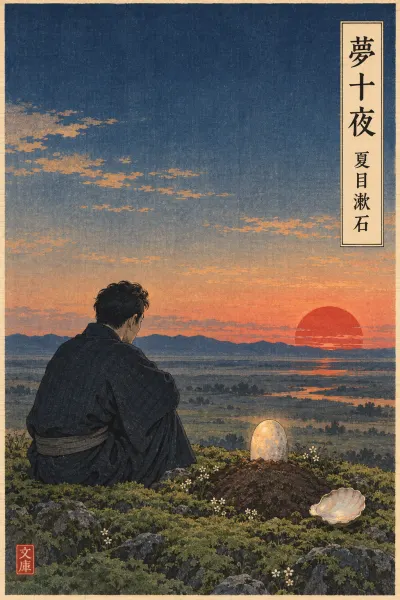
In a tavern with an earthen floor, a boy watches a strange, ageless old man drinking sake who gives riddling answers to the landlady's questions. Outside, the old man promises the children he will turn a twisted hand towel into a snake, but nothing happens, so he puts it in his box and walks away singing. The boy follows him to a river, where the old man wades straight in until he disappears, and the boy waits alone on the bank for a snake that never comes.
AI translation · independently checked
広い土間の真中に涼み台のようなものを据えて、その周囲に小さい床几が並べてある。In the middle of a wide earthen-floored room stood something like an outdoor bench for cooling off in the evening, and small folding stools had been set out around it.
台は黒光りに光っている。The bench gleamed with a black shine.
片隅には四角な膳を前に置いて爺さんが一人で酒を飲んでいる。In one corner an old man sat alone drinking sake, with a square meal tray set in front of him.
肴は煮しめらしい。The food to go with it seemed to be vegetables simmered in soy.
爺さんは酒の加減でなかなか赤くなっている。The sake had turned the old man quite red.
その上顔中つやつやして皺と云うほどのものはどこにも見当らない。What was more, his whole face was glossy, and nowhere could I see anything worth calling a wrinkle.
ただ白い髯をありたけ生やしているから年寄と云う事だけはわかる。Only because he had let his white beard grow as long as it would could you tell that he was old at all.
自分は子供ながら、この爺さんの年はいくつなんだろうと思った。Child though I was, I wondered how old this old man might be.
ところへ裏の筧から手桶に水を汲んで来た神さんが、前垂で手を拭きながら、Just then the woman of the house, who had drawn a bucket of water from the bamboo pipe out at the back, came in wiping her hands on her apron,
「御爺さんはいくつかね」と聞いた。and asked, "How old are you, grandad?"
爺さんは頬張った煮〆を呑み込んで、The old man swallowed the simmered vegetables that filled his cheeks,
「いくつか忘れたよ」と澄ましていた。and said calmly, "I've forgotten how old."
神さんは拭いた手を、細い帯の間に挟んで横から爺さんの顔を見て立っていた。The woman tucked her wiped hands into the gap in her narrow sash and stood looking at the old man's face from the side.
爺さんは茶碗のような大きなもので酒をぐいと飲んで、そうして、ふうと長い息を白い髯の間から吹き出した。The old man gulped down his sake from something as big as a rice bowl, and then, with a long "whoo," blew out a breath from between the hairs of his white beard.
すると神さんが、Then the woman
「御爺さんの家はどこかね」と聞いた。asked, "Where is your home, grandad?"
爺さんは長い息を途中で切って、The old man broke off his long breath halfway
「臍の奥だよ」と云った。and said, "Deep inside my navel."
神さんは手を細い帯の間に突込んだまま、With her hands still thrust into her narrow sash, the woman
「どこへ行くかね」とまた聞いた。asked again, "Where are you going?"
すると爺さんが、また茶碗のような大きなもので熱い酒をぐいと飲んで前のような息をふうと吹いて、Then the old man again gulped hot sake from something as big as a rice bowl, blew out a breath with a "whoo" just as before,
「あっちへ行くよ」と云った。and said, "I'm going over there."
「真直かい」と神さんが聞いた時、ふうと吹いた息が、障子を通り越して柳の下を抜けて、河原の方へ真直に行った。"Straight on?" the woman asked, and at that moment the breath he had blown out passed through the paper screen door, slipped under the willow, and went straight on toward the riverbank.
爺さんが表へ出た。The old man went outside.
自分も後から出た。I went out after him.
爺さんの腰に小さい瓢箪がぶら下がっている。A small gourd hung dangling from the old man's waist.
肩から四角な箱を腋の下へ釣るしている。A square box hung from his shoulder down under his arm.
浅黄の股引を穿いて、浅黄の袖無しを着ている。He wore pale blue-green close-fitting trousers and a pale blue-green sleeveless jacket.
足袋だけが黄色い。Only his split-toed socks were yellow.
何だか皮で作った足袋のように見えた。Somehow they looked like socks made of leather.
爺さんが真直に柳の下まで来た。The old man walked straight to the foot of the willow.
柳の下に子供が三四人いた。Under the willow there were three or four children.
爺さんは笑いながら腰から浅黄の手拭を出した。Smiling, the old man took a pale blue-green hand towel from his waist.
それを肝心綯のように細長く綯った。He twisted it long and thin, like a twisted paper cord.
そうして地面の真中に置いた。Then he laid it in the middle of the bare ground.
それから手拭の周囲に、大きな丸い輪を描いた。Next he drew a large round ring around the towel.
しまいに肩にかけた箱の中から真鍮で製らえた飴屋の笛を出した。Last of all, from inside the box slung over his shoulder, he took out a candy-seller's flute made of brass.
「今にその手拭が蛇になるから、見ておろう。見ておろう」と繰返して云った。"That towel will soon turn into a snake, so watch now. Watch now," he said over and over.
子供は一生懸命に手拭を見ていた。The children watched the towel with all their might.
自分も見ていた。I watched too.
「見ておろう、見ておろう、好いか」と云いながら爺さんが笛を吹いて、輪の上をぐるぐる廻り出した。"Watch now, watch now, ready?" said the old man, and blowing his flute, he began to go round and round on the ring.
自分は手拭ばかり見ていた。I watched nothing but the towel.
けれども手拭はいっこう動かなかった。But the towel did not move at all.
爺さんは笛をぴいぴい吹いた。The old man blew his flute, peep, peep.
そうして輪の上を何遍も廻った。And he went round the ring again and again.
草鞋を爪立てるように、抜足をするように、手拭に遠慮をするように、廻った。He went round as if on tiptoe in his straw sandals, as if stepping stealthily, as if taking care not to disturb the towel.
怖そうにも見えた。He seemed frightened.
面白そうにもあった。He also seemed to be enjoying himself.
やがて爺さんは笛をぴたりとやめた。Before long the old man stopped his flute abruptly.
そうして、肩に掛けた箱の口を開けて、手拭の首を、ちょいと撮んで、ぽっと放り込んだ。Then he opened the lid of the box slung over his shoulder, lightly pinched the towel by its neck, and tossed it in with a plop.
「こうしておくと、箱の中で蛇になる。今に見せてやる。今に見せてやる」と云いながら、爺さんが真直に歩き出した。"If I leave it like this, it will turn into a snake inside the box. I'll show you soon. I'll show you soon," the old man said, and he set off walking straight ahead.
柳の下を抜けて、細い路を真直に下りて行った。He passed under the willow and went straight down a narrow path.
自分は蛇が見たいから、細い道をどこまでも追いて行った。Because I wanted to see the snake, I followed him on and on along the narrow path.
爺さんは時々「今になる」と云ったり、「蛇になる」と云ったりして歩いて行く。As he walked, the old man would sometimes say "It'll turn soon," and sometimes "It'll turn into a snake."
しまいには、In the end,
「今になる、蛇になる、"Soon it'll turn, a snake it'll turn,
きっとなる、笛が鳴る、」surely it'll turn, the flute will sound,"
と唄いながら、とうとう河の岸へ出た。he sang, until at last he came out onto the bank of a river.
橋も舟もないから、ここで休んで箱の中の蛇を見せるだろうと思っていると、爺さんはざぶざぶ河の中へ這入り出した。There was neither bridge nor boat, so I thought he would rest here and show us the snake in the box, but instead the old man began splashing his way into the river.
始めは膝くらいの深さであったが、だんだん腰から、胸の方まで水に浸って見えなくなる。At first the water was only knee-deep, but little by little he sank into it from the waist up to the chest, until he could no longer be seen.
それでも爺さんはEven so, the old man went on,
「深くなる、夜になる、"Deeper it grows, night it grows,
真直になる」straight it grows,"
と唄いながら、どこまでも真直に歩いて行った。singing as he walked on and on, straight ahead.
そうして髯も顔も頭も頭巾もまるで見えなくなってしまった。And then his beard, his face, his head and his hood all vanished from sight completely.
自分は爺さんが向岸へ上がった時に、蛇を見せるだろうと思って、蘆の鳴る所に立って、たった一人いつまでも待っていた。Thinking he would show the snake when he climbed out on the far bank, I stood where the reeds rustled and waited there all alone, for a long, long time.
けれども爺さんは、とうとう上がって来なかった。But the old man never came up out of the water.
Vocabulary
| Word | Meaning | JLPT |
|---|---|---|
| 土間どま | earthen-floored area of a traditional house or shopThe unfloored entrance space at ground level, below the raised wooden floor. | — |
| 床几しょうぎ | small folding stoolOld-fashioned; not related to the board game 将棋 despite the same reading. | — |
| 膳ぜん | small individual meal tray (often with legs)Also used as a counter for pairs of chopsticks and bowls of rice. | N1 |
| 肴さかな | food eaten with drinksWritten differently from 魚 (fish); 酒の肴 means a snack to go with sake. | — |
| 神さんかみさん | woman of the house; landlady; wifedictionary form: かみさんCasual word for a married woman running a household or shop; usually written おかみさん or かみさん today. | — |
| 筧かけひ | bamboo pipe carrying waterOld word; modern reading かけい. | — |
| 前垂まえだれ | aprondictionary form: 前垂れOld-fashioned word for エプロン or 前掛け. | — |
| 澄ましてすます | to look unconcerned, keep a straight facedictionary form: 澄ますAlso means 'to make clear' (as in 耳を澄ます, listen closely). | N1 |
| 股引ももひき | close-fitting work trousersTraditional snug trousers worn by workmen; today also long underwear. | — |
| 手拭てぬぐい | thin cotton hand toweldictionary form: 手拭いThe key object of the story: the towel meant to become a snake. | N2 |
| 飴屋あめや | candy sellerStreet candy sellers played flutes to draw children. | — |
| 遠慮えんりょ | restraint, holding back out of considerationHere the old man moves cautiously as if not to disturb the towel. | N4 |
| 浸ってつかる | to be immersed, soak in (water)dictionary form: 浸かる | — |
| 蘆あし | reedUsually written 葦 or 芦 today; also read よし. | N1 |
Grammar
Noun + ながら (concessive) N2 although, even though
After a noun or adjective, ながら is concessive and means 'although / though' rather than 'while'. 子供ながら means 'child though I was', that is, 'even though I was only a child'. It suggests that wondering about the old man's age was a more thoughtful or grown-up reaction than you would expect from a child.
自分は子供ながら、この爺さんの年はいくつなんだろうと思った。
Child though I was, I wondered how old this old man might be.
〜ておろう N1 archaic urging: 'keep watching', 'watch now'
おろう is an old form built on おる (to be). Attached to the て-form it works as a firm urging or command, much like modern 見ていろ / 見ていなさい. It gives the old man's speech an old-fashioned, showman-like tone.
「今にその手拭が蛇になるから、見ておろう。見ておろう」
"That towel will soon turn into a snake, so watch now. Watch now."
〜たり〜たりする N4 sometimes doing A, sometimes doing B
Lists representative actions that alternate or repeat. Here the old man keeps switching between two phrases as he walks.
爺さんは時々「今になる」と云ったり、「蛇になる」と云ったりして歩いて行く。
As he walked, the old man would sometimes say "It'll turn soon," and sometimes "It'll turn into a snake."
〜と思っていると N3 just as I was thinking ~, (something unexpected happened)
Sets up an expectation that is then broken by what follows. The narrator expects a rest and the snake, but the old man walks into the river instead.
ここで休んで箱の中の蛇を見せるだろうと思っていると、爺さんはざぶざぶ河の中へ這入り出した。
I thought he would rest here and show us the snake in the box, but instead the old man began splashing his way into the river.
〜てしまう N4 to end up completely ~
Marks an action as complete and often irreversible. Here it stresses that the old man vanished entirely under the water.
そうして髯も顔も頭も頭巾もまるで見えなくなってしまった。
And then his beard, his face, his head and his hood all vanished from sight completely.