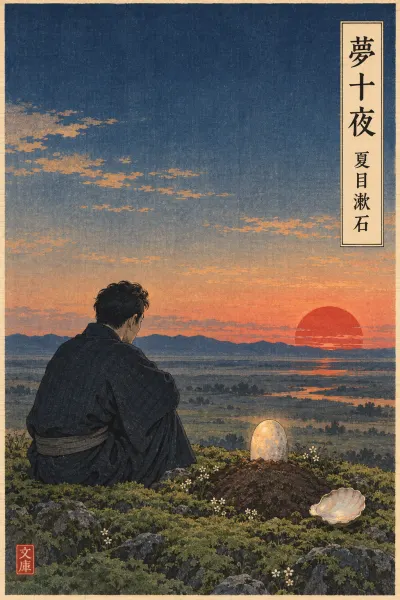
Part 5 of 10 · JLPT N2
夢十夜(第五夜) Yumejūya, part 5: The Captive and the False Cockcrow
In this part
In an ancient age close to the time of the gods, the narrator is captured in battle and chooses death rather than surrender. He asks to see the woman he loves once before he dies, and the enemy general agrees to wait until the cock crows at dawn. The woman gallops toward the camp on a white horse, but a false cockcrow from the trickster Amanojaku makes her pull up, and she and the horse plunge into a deep abyss.
AI translation · independently checked
こんな夢を見た。I dreamed a dream like this.
何でもよほど古い事で、神代に近い昔と思われるが、自分が軍をして運悪く敗北たために、生擒になって、敵の大将の前に引き据えられた。It was, it seems, a very ancient time, an age I believed to be close to the age of the gods. I had fought in a war and, through bad luck, been defeated, so I was taken alive and dragged before the enemy general, where I was forced to sit.
その頃の人はみんな背が高かった。The people of that time were all tall.
そうして、みんな長い髯を生やしていた。And they all wore long beards.
革の帯を締めて、それへ棒のような剣を釣るしていた。They wore leather belts, and from them hung swords like staves.
弓は藤蔓の太いのをそのまま用いたように見えた。Their bows looked as if they had been made from thick wisteria vines, used just as they were.
漆も塗ってなければ磨きもかけてない。They were neither lacquered nor polished.
極めて素樸なものであった。They were extremely plain and simple things.
敵の大将は、弓の真中を右の手で握って、その弓を草の上へ突いて、酒甕を伏せたようなものの上に腰をかけていた。The enemy general gripped the middle of his bow in his right hand, planted the bow on the grass, and sat on something that looked like an upturned sake jar.
その顔を見ると、鼻の上で、左右の眉が太く接続っている。When I looked at his face, I saw that his thick eyebrows, left and right, met above his nose.
その頃髪剃と云うものは無論なかった。Of course, there were no such things as razors in those days.
自分は虜だから、腰をかける訳に行かない。Since I was a prisoner, I could not be allowed a seat.
草の上に胡坐をかいていた。I sat cross-legged on the grass.
足には大きな藁沓を穿いていた。On my feet I wore large straw boots.
この時代の藁沓は深いものであった。The straw boots of that age were deep.
立つと膝頭まで来た。When I stood, they came up to my knees.
その端の所は藁を少し編残して、房のように下げて、歩くとばらばら動くようにして、飾りとしていた。At the top edge, a little of the straw was left unwoven and hung down like tassels, so that it swayed loosely as one walked, as a decoration.
大将は篝火で自分の顔を見て、死ぬか生きるかと聞いた。The general looked at my face by the light of the bonfire and asked whether I would die or live.
これはその頃の習慣で、捕虜にはだれでも一応はこう聞いたものである。This was the custom in those days; every prisoner, whoever he was, was asked this question as a matter of form.
生きると答えると降参した意味で、死ぬと云うと屈服しないと云う事になる。To answer 'live' meant that one had surrendered; to say 'die' meant that one would not submit.
自分は一言死ぬと答えた。I answered with a single word: 'Die.'
大将は草の上に突いていた弓を向うへ抛げて、腰に釣るした棒のような剣をするりと抜きかけた。The general flung away the bow he had planted on the grass and began to draw, smoothly, the staff-like sword that hung at his waist.
それへ風に靡いた篝火が横から吹きつけた。The bonfire, bent by the wind, blew against it from the side.
自分は右の手を楓のように開いて、掌を大将の方へ向けて、眼の上へ差し上げた。I spread my right hand open like a maple leaf, turned the palm toward the general, and raised it above my eyes.
待てと云う相図である。It was the sign for 'Wait.'
大将は太い剣をかちゃりと鞘に収めた。The general slid his thick sword back into its scabbard with a clank.
その頃でも恋はあった。Even in those days there was love.
自分は死ぬ前に一目思う女に逢いたいと云った。I said that before I died I wanted to see the woman I loved, just once.
大将は夜が開けて鶏が鳴くまでなら待つと云った。The general said he would wait, but only until night gave way to dawn and the cock crowed.
鶏が鳴くまでに女をここへ呼ばなければならない。I had to call the woman here before the cock crowed.
鶏が鳴いても女が来なければ、自分は逢わずに殺されてしまう。If the cock crowed and the woman had not come, I would be killed without seeing her.
大将は腰をかけたまま、篝火を眺めている。The general, still seated, gazed at the bonfire.
自分は大きな藁沓を組み合わしたまま、草の上で女を待っている。I sat on the grass with my big straw boots crossed, waiting for the woman.
夜はだんだん更ける。The night grew steadily deeper.
時々篝火が崩れる音がする。Now and then came the sound of the bonfire collapsing.
崩れるたびに狼狽えたように焔が大将になだれかかる。Each time it collapsed, the flames surged toward the general as if in a panic.
真黒な眉の下で、大将の眼がぴかぴかと光っている。Beneath his jet-black eyebrows, the general's eyes glittered.
すると誰やら来て、新しい枝をたくさん火の中へ抛げ込んで行く。Then someone came, threw a great many fresh branches into the fire, and went away.
しばらくすると、火がぱちぱちと鳴る。After a while, the fire began to crackle.
暗闇を弾き返すような勇ましい音であった。It was a brave sound, as if it were beating back the darkness.
この時女は、裏の楢の木に繋いである、白い馬を引き出した。At that moment the woman led out a white horse that was tied to the oak tree behind her house.
鬣を三度撫でて高い背にひらりと飛び乗った。She stroked its mane three times and leapt lightly onto its high back.
鞍もない鐙もない裸馬であった。It was a bare horse, with neither saddle nor stirrups.
長く白い足で、太腹を蹴ると、馬はいっさんに駆け出した。When she kicked its broad belly with her long white legs, the horse broke into a headlong gallop.
誰かが篝りを継ぎ足したので、遠くの空が薄明るく見える。Because someone had fed the bonfire, the distant sky looked faintly bright.
馬はこの明るいものを目懸けて闇の中を飛んで来る。Aiming for that brightness, the horse came flying through the dark.
鼻から火の柱のような息を二本出して飛んで来る。It came flying, breathing out two jets of breath like pillars of fire from its nostrils.
それでも女は細い足でしきりなしに馬の腹を蹴っている。Even so, the woman kept kicking the horse's belly with her slender legs, without pause.
馬は蹄の音が宙で鳴るほど早く飛んで来る。The horse came flying so fast that the sound of its hooves rang out in the air.
女の髪は吹流しのように闇の中に尾を曳いた。The woman's hair streamed out behind her in the darkness like a windsock.
それでもまだ篝のある所まで来られない。And still she could not reach the place where the bonfire was.
すると真闇な道の傍で、たちまちこけこっこうという鶏の声がした。Then, beside the pitch-dark road, there suddenly came a cock's cry: 'Cock-a-doodle-doo!'
女は身を空様に、両手に握った手綱をうんと控えた。The woman threw her body back toward the sky and pulled hard on the reins she gripped in both hands.
馬は前足の蹄を堅い岩の上に発矢と刻み込んだ。The horse's front hooves struck the hard rock and cut deep into it.
こけこっこうと鶏がまた一声鳴いた。'Cock-a-doodle-doo!' the cock cried once more.
女はあっと云って、緊めた手綱を一度に緩めた。The woman cried out and let the tight reins go slack all at once.
馬は諸膝を折る。The horse's knees buckled.
乗った人と共に真向へ前へのめった。It pitched headlong forward, together with its rider.
岩の下は深い淵であった。Below the rock was a deep abyss.
蹄の跡はいまだに岩の上に残っている。The hoofprints remain on the rock to this day.
鶏の鳴く真似をしたものは天探女である。The one who imitated the cock's crow was Amanojaku.
この蹄の痕の岩に刻みつけられている間、天探女は自分の敵である。For as long as these hoofprints remain carved into the rock, Amanojaku will be my enemy.
Vocabulary
| Word | Meaning | JLPT |
|---|---|---|
| 生擒いけどり | being captured alivedictionary form: 生け捕り生擒になる = to be taken prisoner. Usually written 生け捕り today. | — |
| 引き据えられたひきすえる | to drag someone and force them to sitdictionary form: 引き据える引く (pull) + 据える (set in place). | — |
| 虜とりこ | captive, prisonerAlso used figuratively: 恋の虜 'a captive of love'. | — |
| 藁沓わらぐつ | straw bootsOld-fashioned footwear; 沓 is an archaic kanji for shoes. | — |
| 篝火かがりび | bonfire, watch-fireAn open fire lit for light at night, e.g. at a camp; also 篝 alone. | — |
| 降参こうさん | surrender降参する = to give in; also used casually for 'I give up'. | — |
| 屈服くっぷく | submission, yielding屈服しない = to refuse to submit. | — |
| 相図あいず | signal, signdictionary form: 合図Older spelling of 合図. | N3 |
| 一目ひとめ | a single glimpse, one look一目逢いたい = want to see (someone) just once. | N1 |
| 更けるふける | (of night) to grow late, deepenMostly used with 夜: 夜が更ける. | N2 |
| 裸馬はだかうま | bareback horse, unsaddled horse | — |
| 手綱たづな | reins手綱を控える/緩める = pull in / slacken the reins. | — |
| 淵ふち | deep pool, abyssDeep, still water; opposite of 瀬 (shallows). | — |
| 敵かたき | (personal) enemy, foeRead かたき for a personal enemy one bears a grudge against; てき is the general 'enemy'. | N1 |
Grammar
〜訳に行かない N3 cannot (for social or moral reasons)
Verb (dictionary form) + わけにいかない means something is not possible because of circumstances or propriety, not physical inability. Here a prisoner is not permitted to sit on a seat.
自分は虜だから、腰をかける訳に行かない。
Since I was a prisoner, I could not be allowed a seat.
〜たものである N2 used to (habitual past)
Past tense + ものだ/である describes something that was customarily done in the past. It frames the question as an old custom.
捕虜にはだれでも一応はこう聞いたものである。
Every prisoner, whoever he was, was asked this question as a matter of form.
〜かける N3 to start to ~, be about to ~
Verb stem + かける shows an action that has begun but is not completed. The general started to draw his sword but put it back.
棒のような剣をするりと抜きかけた。
He began to draw, smoothly, the staff-like sword.
〜ずに N3 without doing ~
Verb negative stem + ずに is a written equivalent of 〜ないで. 逢わずに means 'without meeting her'.
自分は逢わずに殺されてしまう。
I would be killed without seeing her.
〜たまま N4 while remaining in the state of ~
Past form + まま means a state continues unchanged while something else happens. The general stays seated as he watches the fire.
大将は腰をかけたまま、篝火を眺めている。
The general, still seated, gazed at the bonfire.
〜ほど N3 to the extent that ~, so ~ that ~
Clause + ほど expresses degree: the horse runs so fast that its hoofbeats seem to ring in the air.
馬は蹄の音が宙で鳴るほど早く飛んで来る。
The horse came flying so fast that the sound of its hooves rang out in the air.