Part 3 of 10 · JLPT N2
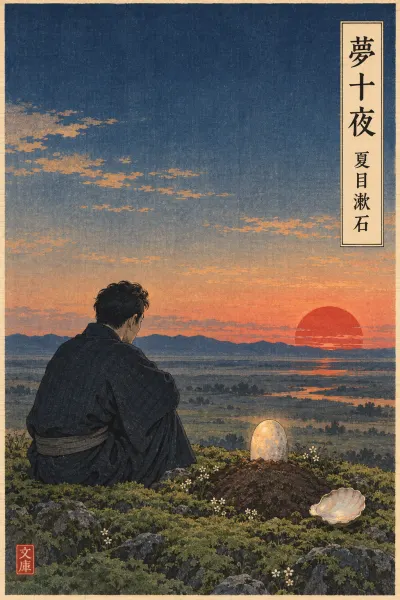
夢十夜(第三夜) Yumejūya, part 3: The Blind Child on My Back
In this part
The narrator carries his blind six-year-old son through dark rice fields at night. The child speaks like an adult and seems to know everything, and the frightened father decides to abandon him in a nearby forest. At the foot of a cedar tree the child reveals that, exactly a hundred years earlier, the father murdered a blind man on that very spot. At that moment the child grows as heavy as a stone statue.
AI translation · independently checked
こんな夢を見た。I had this dream.
六つになる子供を負ってる。I was carrying a child of six on my back.
たしかに自分の子である。He was certainly my own child.
ただ不思議な事にはいつの間にか眼が潰れて、青坊主になっている。The strange thing, though, was that at some point his eyes had been ruined, and his head was shaven bare and bluish like a little monk's.
自分が御前の眼はいつ潰れたのかいと聞くと、なに昔からさと答えた。When I asked him, "When did your eyes go blind?" he answered, "Oh, a long time ago."
声は子供の声に相違ないが、言葉つきはまるで大人である。His voice was certainly a child's voice, but the way he spoke was exactly like a grown man.
しかも対等だ。And he spoke to me as an equal.
左右は青田である。On either side lay green rice fields.
路は細い。The path was narrow.
鷺の影が時々闇に差す。Now and then the shape of a heron flickered in the darkness.
「田圃へかかったね」と背中で云った。"We've come to the rice paddies, haven't we?" he said from my back.
「どうして解る」と顔を後ろへ振り向けるようにして聞いたら、"How can you tell?" I asked, turning my face as if to look back at him,
「だって鷺が鳴くじゃないか」と答えた。and he answered, "Well, the herons are crying, aren't they?"
すると鷺がはたして二声ほど鳴いた。Then, sure enough, a heron cried two or so times.
自分は我子ながら少し怖くなった。Though he was my own child, I grew a little afraid.
こんなものを背負っていては、この先どうなるか分らない。With a thing like this on my back, there was no knowing what might happen from here on.
どこか打遣ゃる所はなかろうかと向うを見ると闇の中に大きな森が見えた。Wondering whether there might be somewhere I could get rid of him, I looked ahead and saw a large forest in the darkness.
あすこならばと考え出す途端に、背中で、The very moment I began to think, "There, perhaps," from my back
「ふふん」と云う声がした。came a voice going, "Heh-heh."
「何を笑うんだ」"What are you laughing at?"
子供は返事をしなかった。The child made no reply.
ただHe only
「御父さん、重いかい」と聞いた。asked, "Father, am I heavy?"
「重かあない」と答えるとWhen I answered, "You're not heavy,"
「今に重くなるよ」と云った。he said, "I'll soon get heavy."
自分は黙って森を目標にあるいて行った。Without a word I walked on, taking the forest as my landmark.
田の中の路が不規則にうねってなかなか思うように出られない。The path through the fields wound about irregularly, and I could not get out of them as easily as I wished.
しばらくすると二股になった。After a while it split into two.
自分は股の根に立って、ちょっと休んだ。I stood where the path forked and rested for a moment.
「石が立ってるはずだがな」と小僧が云った。"There should be a stone standing here," said the boy.
なるほど八寸角の石が腰ほどの高さに立っている。Indeed, a stone eight inches square stood there, as high as my waist.
表には左り日ヶ窪、右堀田原とある。On its face was written: "Left, Higakubo; right, Hottahara."
闇だのに赤い字が明かに見えた。Though it was dark, the red letters could be seen clearly.
赤い字は井守の腹のような色であった。The red letters were the colour of a newt's belly.
「左が好いだろう」と小僧が命令した。"Left would be best," the boy ordered.
左を見るとさっきの森が闇の影を、高い空から自分らの頭の上へ抛げかけていた。When I looked to the left, the forest I had seen earlier was casting its dark shadow from high in the sky down over our heads.
自分はちょっと躊躇した。I hesitated for a moment.
「遠慮しないでもいい」と小僧がまた云った。"You needn't hold back," the boy said again.
自分は仕方なしに森の方へ歩き出した。Having no choice, I began to walk towards the forest.
腹の中では、よく盲目のくせに何でも知ってるなと考えながら一筋道を森へ近づいてくると、背中で、「どうも盲目は不自由でいけないね」と云った。Thinking to myself how well he knew everything for a blind boy, I was drawing closer to the forest along the single path when a voice on my back said, "Being blind really is a nuisance, isn't it."
「だから負ってやるからいいじゃないか」"That's why I'm carrying you, so what's wrong?"
「負ぶって貰ってすまないが、どうも人に馬鹿にされていけない。親にまで馬鹿にされるからいけない」"I'm sorry to make you carry me, but it's no good being made a fool of by people. It's no good being made a fool of even by my own parent."
何だか厭になった。Somehow I grew sick of it all.
早く森へ行って捨ててしまおうと思って急いだ。I hurried, meaning to get to the forest quickly and throw him away.
「もう少し行くと解る。――ちょうどこんな晩だったな」と背中で独言のように云っている。"Go a little further and you'll understand. It was a night just like this, wasn't it," he was saying on my back, as though talking to himself.
「何が」と際どい声を出して聞いた。"What was?" I asked in a sharp, strained voice.
「何がって、知ってるじゃないか」と子供は嘲けるように答えた。"What, you say? You know, don't you?" the child answered, as if mocking me.
すると何だか知ってるような気がし出した。Then I began to feel that somehow I did know.
けれども判然とは分らない。But I could not quite tell what it was.
ただこんな晩であったように思える。It only seemed to me that it had been a night like this.
そうしてもう少し行けば分るように思える。And it seemed to me that if I went a little further, I would understand.
分っては大変だから、分らないうちに早く捨ててしまって、安心しなくってはならないように思える。It seemed to me that if I understood, something terrible would happen, so I had to throw him away quickly, before I understood, and put my mind at ease.
自分はますます足を早めた。I walked faster and faster.
雨はさっきから降っている。The rain had been falling for some time now.
路はだんだん暗くなる。The path grew darker and darker.
ほとんど夢中である。I was almost beside myself.
ただ背中に小さい小僧がくっついていて、その小僧が自分の過去、現在、未来をことごとく照して、寸分の事実も洩らさない鏡のように光っている。There was only the small boy clinging to my back, and that boy shone like a mirror that lit up my whole past, present and future and let not the slightest fact escape.
しかもそれが自分の子である。And what was more, he was my own child.
そうして盲目である。And he was blind.
自分はたまらなくなった。I could not bear it any longer.
「ここだ、ここだ。ちょうどその杉の根の処だ」"Here, it's here. Right at the foot of that cedar."
雨の中で小僧の声は判然聞えた。In the rain the boy's voice was clearly heard.
自分は覚えず留った。I stopped without meaning to.
いつしか森の中へ這入っていた。Before I knew it, I had entered the forest.
一間ばかり先にある黒いものはたしかに小僧の云う通り杉の木と見えた。The black thing about six feet ahead did indeed look like a cedar tree, just as the boy said.
「御父さん、その杉の根の処だったね」"Father, it was at the foot of that cedar, wasn't it?"
「うん、そうだ」と思わず答えてしまった。"Yes, that's right," I found myself answering.
「文化五年辰年だろう」"It was the fifth year of Bunka, the Year of the Dragon, wasn't it?"
なるほど文化五年辰年らしく思われた。It did indeed seem to have been the fifth year of Bunka, the Year of the Dragon.
「御前がおれを殺したのは今からちょうど百年前だね」"It was exactly a hundred years ago that you killed me, wasn't it?"
自分はこの言葉を聞くや否や、今から百年前文化五年の辰年のこんな闇の晩に、この杉の根で、一人の盲目を殺したと云う自覚が、忽然として頭の中に起った。The instant I heard these words, the awareness that on a dark night just like this, a hundred years ago, in the Year of the Dragon, the fifth year of Bunka, at the foot of this cedar, I had killed a blind man, rose suddenly in my mind.
おれは人殺であったんだなと始めて気がついた途端に、背中の子が急に石地蔵のように重くなった。The moment I first realised, "So I was a murderer," the child on my back suddenly grew as heavy as a stone Jizō statue.
Vocabulary
| Word | Meaning | JLPT |
|---|---|---|
| 負ってるおぶう | to carry (a child) on one's backdictionary form: 負うAlso read おう, 'to bear, to owe'. The reading おぶう is specifically for piggyback carrying. てる is the casual form of ている. | N1 |
| 潰れてつぶれる | to be crushed; (of eyes) to go blinddictionary form: 潰れる目が潰れる is an older, blunt expression for losing one's sight. | N2 |
| 青坊主あおぼうず | a freshly shaven head that looks bluish; a child with such a head坊主 means 'monk', so the image is of a little shaven-headed monk. | — |
| 対等たいとう | equal footing, as an equal | N1 |
| 青田あおた | green rice fields (young, unripened rice)In Japanese, 青 can mean fresh green as well as blue. | — |
| 小僧こぞう | boy, youngster (slightly dismissive)Originally meant a young monk-in-training, which fits the child's shaven head. | — |
| 躊躇ちゅうちょする | to hesitatedictionary form: 躊躇するA written, formal word. It is difficult kanji, but a common one. | — |
| 際どいきわどい | tense, on edge; (of a voice) sharp and strainedUsually means 'risky, a close call'. Here it describes the narrator's nervous voice. | — |
| 嘲けるようにあざける | to mock, to sneer atdictionary form: 嘲るModern spelling is 嘲る. The extra け here is an older okurigana. | — |
| 寸分すんぶん | the slightest bitIt is used with a negative: 寸分の〜も…ない means 'not even the smallest…'. | — |
| 自覚じかく | awareness, realisation (of one's own situation or deeds) | N1 |
| 忽然としてこつぜん | suddenly, abruptlydictionary form: 忽然This is a literary word. 忽然と消える means 'to vanish suddenly'. | — |
| 石地蔵いしじぞう | stone statue of JizōJizō is a Buddhist bodhisattva who protects children and travellers. Stone Jizō statues stand by roadsides all over Japan, and they are famously heavy and immovable. | — |
Grammar
〜に相違ない N1 there is no doubt that…; must be…
This is a formal, written equivalent of 〜に違いない. The narrator admits the voice is undeniably a child's, and then contrasts it with が.
声は子供の声に相違ないが、言葉つきはまるで大人である。
His voice was certainly a child's voice, but the way he spoke was exactly like a grown man.
Noun + ながら (concessive) N2 although…; even though it is…
After a noun, ながら means 'although' rather than 'while'. 我子ながら means 'though he is my own child', so the narrator's fear feels unnatural even to him.
自分は我子ながら少し怖くなった。
Though he was my own child, I grew a little afraid.
〜はなかろうか N1 might there not be…?; I wonder if there is…
なかろう is the literary volitional form of ない, meaning 'probably isn't'. With か, it forms a tentative wondering question, like modern ないだろうか.
どこか打遣ゃる所はなかろうかと向うを見ると
Wondering whether there might be somewhere I could get rid of him, I looked ahead
〜くせに N3 even though…; for someone who…
くせに expresses surprise or reproach that something contradicts what you would expect. Here it means that the boy is blind, yet he knows everything.
よく盲目のくせに何でも知ってるな
how well he knows everything for a blind boy
〜や否や N1 as soon as…; the instant that…
This is a literary pattern after the dictionary form of a verb, showing that the second event follows immediately. The realisation strikes the moment he hears the words.
自分はこの言葉を聞くや否や
The instant I heard these words
〜た途端に N3 the moment…; just as…
After the past form of a verb, 途端に marks a sudden, often unexpected event that happens right at that moment. It links the confession to the child's sudden weight.
始めて気がついた途端に、背中の子が急に石地蔵のように重くなった。
The moment I first realised it, the child on my back suddenly grew as heavy as a stone Jizō statue.