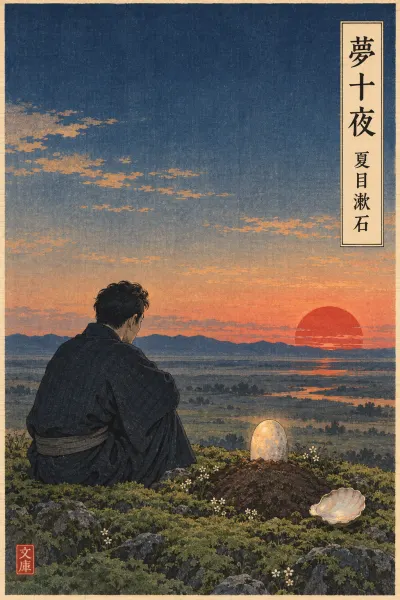
Part 10 of 10 · JLPT N2
夢十夜(第十夜) Yumejūya, part 10: Shōtarō, the Woman and the Pigs
In this part
Shōtarō, a handsome idler who likes to sit outside a fruit shop gazing at women, goes off with an elegant lady and vanishes for seven days. When he returns feverish, he says she led him to a cliff and told him to jump, threatening that pigs would lick him otherwise; he spent seven days and six nights beating back endless herds of pigs until he was licked and collapsed. Ken-san, who tells the story, warns against looking at women too much, but he also wants Shōtarō's Panama hat, and the narrator suspects Shōtarō will not recover.
AI translation · independently checked
庄太郎が女に攫われてから七日目の晩にふらりと帰って来て、急に熱が出てどっと、床に就いていると云って健さんが知らせに来た。Ken-san came to tell me that Shōtarō, who had been carried off by a woman, had wandered home on the evening of the seventh day, suddenly run a fever, and was now laid up in bed.
庄太郎は町内一の好男子で、至極善良な正直者である。Shōtarō was the handsomest man in the neighbourhood, and an exceedingly good-natured, honest fellow.
ただ一つの道楽がある。He had just one indulgence.
パナマの帽子を被って、夕方になると水菓子屋の店先へ腰をかけて、往来の女の顔を眺めている。In the evenings he would put on his Panama hat, sit down at the front of the fruit shop, and gaze at the faces of the women passing in the street.
そうしてしきりに感心している。And he would admire them endlessly.
そのほかにはこれと云うほどの特色もない。Apart from that, there was nothing particularly remarkable about him.
あまり女が通らない時は、往来を見ないで水菓子を見ている。When few women were passing, he looked at the fruit instead of the street.
水菓子にはいろいろある。There were all kinds of fruit.
水蜜桃や、林檎や、枇杷や、バナナを綺麗に籠に盛って、すぐ見舞物に持って行けるように二列に並べてある。Peaches, apples, loquats and bananas were heaped neatly in baskets and set out in two rows, ready to be taken straight away as gifts for someone who was ill.
庄太郎はこの籠を見ては綺麗だと云っている。Shōtarō would look at these baskets and say how pretty they were.
商売をするなら水菓子屋に限ると云っている。If he were to go into business, he said, there was nothing like a fruit shop.
そのくせ自分はパナマの帽子を被ってぶらぶら遊んでいる。And yet he himself idled about in his Panama hat.
この色がいいと云って、夏蜜柑などを品評する事もある。Sometimes he would pass judgement on the summer oranges and such, saying that this one had a fine colour.
けれども、かつて銭を出して水菓子を買った事がない。But he had never once paid money to buy any fruit.
ただでは無論食わない。Nor, of course, did he eat any for free.
色ばかり賞めている。He only praised the colours.
ある夕方一人の女が、不意に店先に立った。One evening a woman suddenly appeared in front of the shop.
身分のある人と見えて立派な服装をしている。She seemed to be a person of some standing, for she was splendidly dressed.
その着物の色がひどく庄太郎の気に入った。The colour of her kimono pleased Shōtarō enormously.
その上庄太郎は大変女の顔に感心してしまった。What was more, Shōtarō was greatly taken with her face.
そこで大事なパナマの帽子を脱って丁寧に挨拶をしたら、女は籠詰の一番大きいのを指して、これを下さいと云うんで、庄太郎はすぐその籠を取って渡した。So he took off his precious Panama hat and greeted her politely, whereupon the woman pointed to the largest of the fruit baskets and said, "I'll have this one, please," and Shōtarō at once took the basket and handed it to her.
すると女はそれをちょっと提げて見て、大変重い事と云った。The woman lifted it a little to try it and said, "How very heavy it is."
庄太郎は元来閑人の上に、すこぶる気作な男だから、ではお宅まで持って参りましょうと云って、女といっしょに水菓子屋を出た。Shōtarō, having plenty of time on his hands and being a most obliging man besides, said, "Then allow me to carry it to your home," and left the fruit shop together with the woman.
それぎり帰って来なかった。And that was the last anyone saw of him.
いかな庄太郎でも、あんまり呑気過ぎる。Even for Shōtarō, this was far too carefree.
只事じゃ無かろうと云って、親類や友達が騒ぎ出していると、七日目の晩になって、ふらりと帰って来た。His relatives and friends were beginning to make a fuss, saying that something must be seriously wrong, when on the evening of the seventh day he came wandering home.
そこで大勢寄ってたかって、庄さんどこへ行っていたんだいと聞くと、庄太郎は電車へ乗って山へ行ったんだと答えた。Everyone crowded round him and asked, "Shō-san, where on earth have you been?" and Shōtarō answered that he had taken a tram to the mountains.
何でもよほど長い電車に違いない。It must have been a very long tram indeed.
庄太郎の云うところによると、電車を下りるとすぐと原へ出たそうである。According to Shōtarō, as soon as he got off the tram he came out onto a plain.
非常に広い原で、どこを見廻しても青い草ばかり生えていた。It was an enormously wide plain, and wherever he looked there was nothing growing but green grass.
女といっしょに草の上を歩いて行くと、急に絶壁の天辺へ出た。He walked across the grass with the woman, and suddenly they came out at the top of a cliff.
その時女が庄太郎に、ここから飛び込んで御覧なさいと云った。Then the woman said to Shōtarō, "Try jumping in from here."
底を覗いて見ると、切岸は見えるが底は見えない。When he peered down, he could see the face of the cliff, but not the bottom.
庄太郎はまたパナマの帽子を脱いで再三辞退した。Shōtarō once more took off his Panama hat and declined again and again.
すると女が、もし思い切って飛び込まなければ、豚に舐められますが好うござんすかと聞いた。Then the woman asked, "If you don't make up your mind and jump, you'll be licked by pigs. Will that suit you?"
庄太郎は豚と雲右衛門が大嫌だった。Shōtarō loathed pigs and Kumoemon.
けれども命には易えられないと思って、やっぱり飛び込むのを見合せていた。But thinking that it was not worth his life, he still held back from jumping.
ところへ豚が一匹鼻を鳴らして来た。Just then a pig came up, snorting.
庄太郎は仕方なしに、持っていた細い檳榔樹の洋杖で、豚の鼻頭を打った。Shōtarō had no choice but to strike the pig on the snout with the slender betel-palm cane he was carrying.
豚はぐうと云いながら、ころりと引っ繰り返って、絶壁の下へ落ちて行った。The pig gave a grunt, rolled right over, and fell away to the foot of the cliff.
庄太郎はほっと一と息接いでいるとまた一匹の豚が大きな鼻を庄太郎に擦りつけに来た。Shōtarō was just catching his breath in relief when another pig came to rub its big snout against him.
庄太郎はやむをえずまた洋杖を振り上げた。Shōtarō had no alternative but to raise his cane again.
豚はぐうと鳴いてまた真逆様に穴の底へ転げ込んだ。The pig grunted and again tumbled headlong to the bottom of the pit.
するとまた一匹あらわれた。Then yet another appeared.
この時庄太郎はふと気がついて、向うを見ると、遥の青草原の尽きる辺から幾万匹か数え切れぬ豚が、群をなして一直線に、この絶壁の上に立っている庄太郎を目懸けて鼻を鳴らしてくる。At that moment Shōtarō suddenly noticed something, and looking ahead he saw, from where the green grassland ended far away, pigs beyond counting, tens of thousands of them, coming in a herd in a straight line, snorting, making for Shōtarō as he stood on top of the cliff.
庄太郎は心から恐縮した。Shōtarō was truly dismayed.
けれども仕方がないから、近寄ってくる豚の鼻頭を、一つ一つ丁寧に檳榔樹の洋杖で打っていた。But there was nothing else for it, so one by one he carefully struck the snouts of the approaching pigs with his betel-palm cane.
不思議な事に洋杖が鼻へ触りさえすれば豚はころりと谷の底へ落ちて行く。Strangely, as long as the cane so much as touched a snout, the pig rolled over and fell to the bottom of the ravine.
覗いて見ると底の見えない絶壁を、逆さになった豚が行列して落ちて行く。When he peered over, he saw the pigs, upside down, falling in a procession down the cliff whose bottom could not be seen.
自分がこのくらい多くの豚を谷へ落したかと思うと、庄太郎は我ながら怖くなった。When he thought that he had sent so many pigs into the ravine himself, Shōtarō grew frightened in spite of himself.
けれども豚は続々くる。But the pigs kept coming, one after another.
黒雲に足が生えて、青草を踏み分けるような勢いで無尽蔵に鼻を鳴らしてくる。They came snorting in endless numbers, with a force as if black clouds had grown legs and were trampling their way through the green grass.
庄太郎は必死の勇をふるって、豚の鼻頭を七日六晩叩いた。Summoning desperate courage, Shōtarō beat the pigs' snouts for seven days and six nights.
けれども、とうとう精根が尽きて、手が蒟蒻のように弱って、しまいに豚に舐められてしまった。But at last his strength was spent, his arms went as limp as konnyaku, and in the end he was licked by the pigs.
そうして絶壁の上へ倒れた。And he collapsed on top of the cliff.
健さんは、庄太郎の話をここまでして、だからあんまり女を見るのは善くないよと云った。Having told Shōtarō's story up to this point, Ken-san said, "So you see, it's no good looking at women too much."
自分ももっともだと思った。I thought he was quite right.
けれども健さんは庄太郎のパナマの帽子が貰いたいと云っていた。But Ken-san was saying that he would like to have Shōtarō's Panama hat.
庄太郎は助かるまい。Shōtarō will probably not recover.
パナマは健さんのものだろう。The Panama will no doubt be Ken-san's.
Vocabulary
| Word | Meaning | JLPT |
|---|---|---|
| 攫われてさらう | to carry off, abductdictionary form: 攫うUsed here in the passive: 攫われる, to be carried off. | N1 |
| 道楽どうらく | hobby, indulgence, pastimeOften suggests a self-indulgent pleasure, even dissipation. | — |
| 水菓子屋みずがしや | fruit shop水菓子 is an old word for fresh fruit, not a kind of sweet. | — |
| 往来おうらい | street, road; passers-byLiterally 'going and coming'. Old-fashioned word for a public street. | — |
| 品評ひんぴょう | judging the quality of something, appraisalHumorous here, since Shōtarō never buys anything. | — |
| 閑人ひまじん | a person of leisure, an idler | — |
| 気作きさく | obliging, easy-going, friendlyNow usually written 気さく. | — |
| 呑気のんき | carefree, happy-go-luckyNow often written 暢気 or のんき. | N2 |
| 只事ただごと | an ordinary matterUsually negative: 只事ではない means 'something serious'. | — |
| 寄ってたかってよってたかる | all together, en masse (everyone crowding around / ganging up)dictionary form: 寄ってたかるFixed expression, usually in the て-form. | — |
| 絶壁ぜっぺき | cliff, precipiceSōseki glosses it here with the older word きりぎし, also written 切岸. | — |
| 恐縮きょうしゅく | to be dismayed, overwhelmedToday usually means 'to feel obliged or apologetic'. Here the older sense of shrinking in fear is used. | N2 |
| 無尽蔵むじんぞう | inexhaustible, endlessLiterally 'a store that never runs out'. | — |
Grammar
〜に限る N2 nothing beats ~; ~ is best
Attached to a noun, に限る states that it is the best choice. Shōtarō declares that a fruit shop is the ideal business.
商売をするなら水菓子屋に限ると云っている。
He says that if you're going into business, there's nothing like a fruit shop.
そのくせ N2 and yet, despite that
Introduces a fact that contradicts what came before, often with a critical or ironic tone. He praises the fruit trade but does no work himself.
そのくせ自分はパナマの帽子を被ってぶらぶら遊んでいる。
And yet he himself idles about in his Panama hat.
〜と見えて N1 apparently ~, so
Gives an outward impression as the reason for the next statement. Here the woman appears to be of high status, and she is dressed accordingly.
身分のある人と見えて立派な服装をしている。
She seemed to be a person of standing, and was splendidly dressed.
〜かろう N1 probably ~ (literary conjecture)
An older conjectural form of i-adjectives: 無い becomes 無かろう, meaning 'probably is not'. Combined with 只事じゃ, it means 'this surely isn't an ordinary matter'.
只事じゃ無かろうと云って
saying it could hardly be an ordinary matter
〜さえ〜ば N2 if only ~; as long as ~
This pattern marks the single condition that is enough for the result. A mere touch of the cane is enough to send a pig over.
洋杖が鼻へ触りさえすれば豚はころりと谷の底へ落ちて行く。
As long as the cane so much as touched a snout, the pig rolled over into the ravine.
〜まい N2 probably will not ~
まい is a literary negative of conjecture or intention. Here it expresses the narrator's guess: Shōtarō will probably not be saved.
庄太郎は助かるまい。
Shōtarō will probably not recover.