Part 2 of 10 · JLPT N2
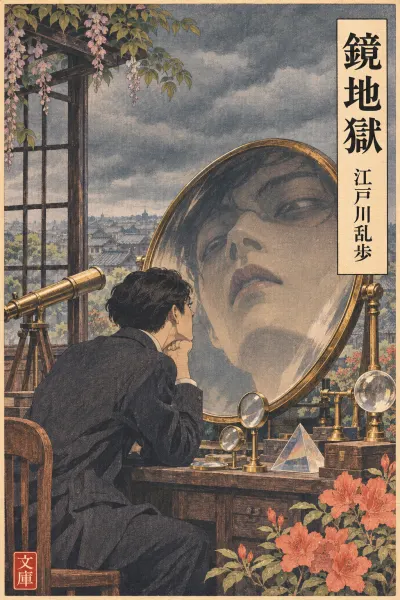
鏡地獄 Kagamijigoku, part 2: From a Magic Mirror to Lens Madness
In this part
The friend explains that the secret of the 'magic' mirror lies in tiny, invisible differences in wear produced by years of polishing. K then describes how his friend's boyhood passion for lenses grew into an obsession once he studied optics in middle school. A concave mirror passed around the classroom horrified K by magnifying his pimples, but it enchanted the friend, who began building elaborate contraptions, including a 'magic banknote'.
AI translation · independently checked
「これはね、魔法でもなんでもないのだよ」"You see, this isn't magic or anything of the sort."
彼は私のいぶかしげな顔を見て、説明をはじめるのでした。Seeing the puzzled look on my face, he began to explain.
「おとうさんに聞いたんだがね、金属の鏡というやつは、ガラスと違って、ときどきみがきをかけないと、曇りがきて見えなくなるんだ。"I heard it from my father. A metal mirror isn't like glass: if you don't polish it now and then, it clouds over and you can't see anything in it.
この鏡なんか、ずいぶん古くから僕の家に伝わっている品で、何度となく磨きをかけている。This mirror has been handed down in my family for a very long time, and it has been polished over and over again.
でね、その磨きをかけるたびに、裏の浮彫りの所と、そうでない薄い所とでは、金の減り方が眼に見えぬほどずつ違ってくるのだよ。And every time it's polished, the metal wears away a little differently, by amounts too small for the eye to see, between the parts with the relief on the back and the thin parts without it.
厚い部分は手ごたえが多く、薄い部分はこれが少ないわけだからね。その眼にも見えぬ減り方の違いが、恐ろしいもので、反射させると、あんなに現われるのだそうだ。わかったかい」The thick parts give more resistance to the polishing, you see, and the thin parts less. That difference in wear, too small even to see, is a fearful thing, and when you make the mirror reflect light, it shows up like that, or so I'm told. Do you understand?"
その説明を聞きますと、一応は理由がわかったものの、今度は、顔を映してもでこぼこに見えない滑らかな表面が、反射させると明きらかに凹凸が現われるという、このえたいの知れぬ事実が、たとえば顕微鏡で何かを覗いた時に味わう、微細なるものの無気味さ、あれに似た感じで、私をゾッとさせるのでした。When I heard this explanation, I did grasp the reason, more or less. But now a new and baffling fact took hold of me: a surface so smooth that a face reflected in it showed no unevenness at all would plainly reveal bumps and hollows once it was made to reflect light. It sent a shiver through me, much like the eeriness of minute things that one feels when peering at something through a microscope.
この鏡のことは、あまり不思議だったので、特別によく覚えているのですが、これはただの一例にすぎないので、彼の少年時代の遊戯というものは、ほとんどそのような事柄ばかりで充たされていたわけです。I remember this mirror especially well because it was so very strange, but it was only one example. His boyhood amusements, you see, were made up almost entirely of things of that kind.
妙なもので、私までが彼の感化を受けて、今でも、レンズというようなものに、人一倍の好奇心を持っているのですよ。It's a curious thing, but even I fell under his influence, and to this day I have more curiosity than most people about anything like a lens.
でも少年時代はまだ、さほどでもなかったのですが、それが中学の上級生に進んで、物理学を教わるようになりますと、御承知の通り物理学にはレンズや鏡の理論がありますね、彼はもうあれに夢中になってしまって、その時分から、病気と言ってもいいほどの、いわばレンズ狂に変わってきたのです。Still, in his boyhood it was not yet so very bad. But when he moved up into the senior classes of middle school and began to be taught physics, which, as you know, includes the theory of lenses and mirrors, he became completely absorbed in it, and from that time on he turned into what one might call a lens maniac, to a degree you could fairly call a sickness.
それにつけて思い出すのは、教室で凹面鏡のことを教わる時間でしたが、小さな凹面鏡の見本を、生徒のあいだに廻して、次々に皆の者が、自分の顔を映して見ていたのです。That brings to mind a lesson in the classroom when we were being taught about concave mirrors. A small sample concave mirror was passed around among the pupils, and one after another everyone looked at his own face in it.
私はその時分ひどいニキビづらで、それがなんだか性欲的な事柄に関係しているような気がして、恥かしくてしようがなかったのですが、なにげなく凹面鏡を覗いて見ますと、思わずアッと声を立てるほど驚いたことには、私の顔のひとつひとつのニキビが、まるで望遠鏡で見た月の表面のように、恐ろしい大きさに拡大されて映っていたのです。At that time my face was badly covered in pimples, and I somehow felt they had something to do with sexual matters, so I was terribly ashamed of them. When I casually looked into the concave mirror, I was so startled that I cried out before I knew it: each and every pimple on my face appeared magnified to a frightful size, just like the surface of the moon seen through a telescope.
小山とも見えるニキビの先端が、石榴のようにはぜて、そこからドス黒い血のりが、芝居の殺し場の絵看板の感じで物凄くにじみ出しているのです。The tip of a pimple that looked like a small hill had burst open like a pomegranate, and from it dark, clotted blood was oozing out horribly, like something on the painted signboard for a murder scene at the theatre.
ニキビというひけ目があったせいでもありましょうが、凹面鏡に映った私の顔がどんなに恐ろしく、無気味なものであったか、それからのちというものは、凹面鏡を見ると、それがまた、博覧会だとか、盛り場の見世物などには、よく並んでいるのですが、私はもう、おぞけを振るって、逃げ出すようになったほどです。Perhaps it was partly because the pimples made me self-conscious, but my face in the concave mirror was so frightening and so uncanny that, from then on, whenever I saw a concave mirror (and they are often on display at exhibitions or among the sideshows of busy amusement quarters), I would shudder with dread and run away.
ですが、彼の方では、その時やっぱり凹面鏡を覗いて、これはまた私とあべこべで、恐ろしく思うよりは、非常な魅力を感じたものとみえ、教室全体に響き渡るような声で、「ホウ」と感嘆の叫びを上げたものなんです。My friend, however, looked into the concave mirror at that time as well, and it seems that, quite the opposite of me, rather than finding it frightening he felt a tremendous fascination. He let out a cry of admiration, "Oho!", in a voice that rang through the whole classroom.
それがあまり頓狂に聞こえたものですから、その時は大笑いになりましたが、さてそれからというものは、彼はもう凹面鏡で夢中なんです。It sounded so comically out of place that the whole class burst out laughing, but from then on he was completely wrapped up in concave mirrors.
大小さまざまの凹面鏡を買いこんで、針金だとかボール紙などを使い、複雑なからくり仕掛けをこしらえては、独りほくそ笑んでいる始末でした。He bought up concave mirrors of every size, large and small, and using wire, cardboard and the like he would build complicated contraptions and then sit by himself chuckling over them; that was how far it had gone.
さすが好きな道だけあって、彼は人の思いもつかぬような、変てこな装置を考案する才能を持っていて、もっとも手品の本などをわざわざ外国から取り寄せたりしたのですけれど、今でも不思議に堪えないのは、これも或るとき彼の部屋をおとずれて、驚かされたのですが、魔法の紙幣というからくり仕掛けでありました。As you might expect from someone pursuing what he loved, he had a talent for devising peculiar devices no one else would ever think of, though, to be fair, he did go to the trouble of ordering books on conjuring tricks from abroad. Yet the thing that still amazes me even now was a contraption called the magic banknote, which astonished me once when I visited his room.
Vocabulary
| Word | Meaning | JLPT |
|---|---|---|
| いぶかしげないぶかしげ | doubtful, puzzled-lookingdictionary form: 訝しげ訝しい (suspicious, doubtful) + げ 'seeming'; a literary word. | — |
| 磨きみがき | polishing磨きをかける means 'to polish', and figuratively 'to refine (a skill)'. | — |
| 手ごたえてごたえ | resistance felt in the handdictionary form: 手応えAlso used figuratively for a 'response' or 'sense that something has worked'. | — |
| えたいの知れぬえたいのしれない | mysterious, of unknown naturedictionary form: 得体の知れない知れぬ is the old -nu negative of 知れない. | — |
| 感化かんか | influence (on character or tastes)Used in the set phrase 感化を受ける, 'to be influenced'. | — |
| 夢中むちゅう | absorbed, crazy about〜に夢中になる: to become absorbed in something. | N3 |
| 凹面鏡おうめんきょう | concave mirror凹 'hollow' is the opposite of 凸 'bulging' (凸面鏡, convex mirror). | — |
| ひけ目ひけめ | feeling of inferiority, self-consciousnessdictionary form: 引け目 | — |
| おぞけを振るっておぞけをふるう | to shudder with fear or disgustdictionary form: 怖気を振るう | — |
| 頓狂とんきょう | wildly out of place, comically oddOften found in 素っ頓狂 (すっとんきょう), meaning 'zany' or 'off-key'. | — |
| ほくそ笑んでほくそえむ | to chuckle to oneself, smirk with satisfactiondictionary form: ほくそ笑む | — |
| 始末しまつ | (sorry) state of affairs〜始末だ means 'it came to the point that…', usually with a critical tone. | N1 |
| 考案こうあん | devising, inventing | — |
| 取り寄せたりとりよせる | to order, have something sentdictionary form: 取り寄せる | N1 |
Grammar
〜たびに N3 every time ~
Attached to the dictionary form of a verb (or to Noun + の), it means that whenever the first action happens, the result follows.
その磨きをかけるたびに
every time it's polished
〜ものの N2 although ~, but
It accepts the first clause as true and then introduces something that falls short of it or contrasts with it. Here the narrator understands the reason, yet the fact still unsettles him.
一応は理由がわかったものの
though I did grasp the reason, more or less
〜てしようがない N3 unbearably ~, can't help feeling ~
After the te-form of an adjective describing a feeling, it expresses a feeling so strong that the speaker cannot control it. しようがない is an older form of しょうがない.
恥かしくてしようがなかったのですが
I was terribly ashamed
〜にすぎない N2 no more than ~, merely ~
It plays something down as only a small part of a larger whole. Here the mirror episode is just one sample of the friend's strange pastimes.
これはただの一例にすぎないので
it was only one example
〜とみえ(る) N1 it seems that ~ (judging from appearances)
The speaker infers something from outward signs. The continuative form みえ links the inference to the next clause in a literary way.
非常な魅力を感じたものとみえ
it seems he felt a tremendous fascination
さすが〜だけあって N2 as you would expect of ~
It says a result is natural given who someone is or what they do. Here the friend's talent fits his devotion to his favourite pursuit.
さすが好きな道だけあって
as you might expect from someone pursuing what he loved