Part 4 of 10 · JLPT N2
鏡地獄 Kagamijigoku, part 4: Telescopes, Fleas and a Giant Face
In this part
At his hilltop laboratory, K's friend first studies the stars, but he soon turns his telescopes on the open windows of houses below and spies on his own servants with a periscope. He also breeds fleas and watches them suffer under the microscope. One day K walks into the darkened laboratory and sees an enormous living human face filling the whole wall, and he cries out, afraid he has lost his mind.
AI translation · independently checked
彼の家は山の手の或る高台にあって、今いう実験室は、そこの広々とした庭園の片隅の、街々の甍を眼下に見下す位置に建てられたのですが、そこで彼が最初はじめたのは、実験室の屋根を天文台のような形にこしらえて、そこに可なりの天体観測鏡を据えつけ、星の世界に耽溺することでした。His house stood on a certain height in the Yamanote uplands, and the laboratory I have just mentioned was built in one corner of its spacious garden, at a spot that looked down on the rooftops of the town spread out below. The first thing he did there was to shape the laboratory roof like an observatory, mount a fairly good astronomical telescope in it, and lose himself in the world of the stars.
その時分には、彼は独学で、一と通り天文学の知識を備えていたわけなのです。By that time, you see, he had taught himself and had acquired a general knowledge of astronomy.
が、そのようなありふれた道楽で満足する彼ではありません。But he was not a man to be content with so ordinary a pastime.
その一方では、度の強い望遠鏡を窓際に置いて、それをさまざまの角度にしては、目の下に見える人家の、あけはなった室内を盗み見るという、罪の深い、秘密な楽しみを味わっているのでありました。At the same time, he had set a powerful telescope by the window and, turning it this way and that, was savouring a sinful, secret pleasure: peeping into the open rooms of the houses he could see below him.
それがたとえ板塀の中であったり、他の家の裏側に向かい合っていたりして、当人たちはどこからも見えぬつもりで、まさかそんな遠くの山の上から望遠鏡で覗かれていようとは気づくはずもなく、あらゆる秘密な行ないを、したい三昧にふるまっている、それが彼には、まるで目の前の出来事のように、あからさまに眺められるのです。Even when they were inside a board fence, or facing the back of another house, so that the people themselves believed no one could see them from anywhere, they could never have dreamed they were being peeped at through a telescope from a hill so far away, and so they went about every kind of secret business exactly as they pleased. And all of it he could view as plainly as if it were happening right before his eyes.
「こればかりは、止せないよ」"This is one thing I can't give up."
彼はそう言い言いしては、その窓際の望遠鏡を覗くことを、こよなき楽しみにしていましたが、考えてみれば、ずいぶん面白いいたずらに違いありません。He would say this again and again, and peering through the telescope by the window was his greatest delight. When you think about it, it must indeed have been a most amusing piece of mischief.
私も時には覗かしてもらうこともありましたけれど、偶然妙なものを、すぐ目の前に発見したりして、いっそ顔の赤らむようなこともないではありませんでした。I too was sometimes allowed to have a look, and now and then I happened upon some curious sight right in front of my eyes, so that, I confess, there were times when I quite blushed.
そのほか、たとえば、サブマリン・テレスコープといいますか、潜航艇の中から海上を眺める、あの装置をこしらえて、彼の部屋に居ながら、雇人たちの、殊に若い小間使いなどの私室を、少しも相手に悟られることなく覗いてみたり、そうかと思うと、虫目がねや、顕微鏡によって、微生物の生活を観察したり、それについて奇抜なのは、彼が蚤の類を飼育していたことで、それを虫目がねや度の弱い顕微鏡の下で、這わせてみたり、自分の血を吸うところだとか、虫同士をひとつにして同性であれば喧嘩をしたり、異性であれば仲良くしたりする有様を眺めたり、中にも気味のわるいのは、私は一度それを覗かされてからというものは、今までなんとも思っていなかったあの虫が、妙に恐ろしくなったほどなのですが、蚤を半殺しにしておいて、そのもがき苦しむ有様を、非常に大きく拡大して見ることでした。Besides this, he built what I suppose you would call a submarine telescope, the device used to look out over the sea from inside a submarine, and with it, without leaving his own room, he peeped into the private rooms of his servants, especially the young maids, without their ever suspecting a thing. Then again, he would observe the lives of microorganisms through magnifying glasses and microscopes. The oddest of these pursuits was that he bred fleas and their kind. He would make them crawl about under a magnifying glass or a low-powered microscope, or watch them suck his own blood, or put the insects together and watch how they fought if they were of the same sex and got along if they were of opposite sexes. Most unpleasant of all was the way he would half kill a flea and then view its writhing agony greatly magnified. I was once made to look at it, and ever since then that insect, which I had never given a thought to before, has frightened me strangely.
五十倍の顕微鏡でしたが、覗いた感じでは、一匹の蚤が眼界一杯にひろがって、口から、足の爪、からだにはえている小さな一本の毛までがハッキリとわかって、妙な比喩ですが、まるで猪のように恐ろしい大きさに見えるのです。It was a microscope of fifty times magnification, but when you looked through it, a single flea filled the entire field of view. Everything could be clearly made out, from its mouth to the claws on its feet and even each tiny hair growing on its body, and, odd as the comparison may be, it looked as frighteningly large as a wild boar.
それがドス黒い血の海の中で(僅か一滴の血潮がそんなに見えるのです)背中半分をぺちゃんこにつぶされて、手足で空をつかんで、くちばしをできるだけ伸ばし、断末魔の物凄い形相をしています。There, in a sea of murky black blood (a mere drop of blood looks like that), with half its back crushed flat, it clutches at the air with its legs, stretches its beak as far as it will go, and wears the hideous look of its death throes.
何かその口から恐ろしい悲鳴が聞こえているようにすら感じられるのであります。You could almost feel that you heard some terrible scream coming from its mouth.
そうしたこまごましたことを一々申し上げていては際限がありませんから、たいていは省くことにしますが、実験室建築当初の、かような道楽は月日と共に深まって行って、ある時はまた、こんなこともあったのです。If I were to tell you every one of these small details there would be no end to it, so I shall leave most of them out. But such pastimes, begun when the laboratory was first built, grew deeper as the months and days went by, and once, something like this happened as well.
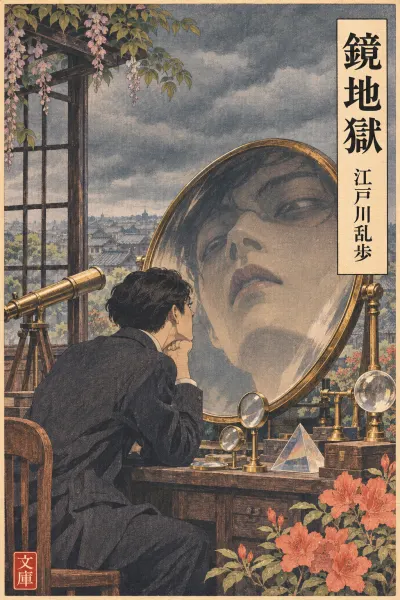
ある日のこと、彼を訪ねて、なにげなく実験室の扉をひらきますと、なぜかブラインドをおろして部屋の中が薄暗くなっていましたが、その正面の壁一杯に、そうですね一間四方もあったでしょうか、何かモヤモヤとうごめいているものがあるのです。One day I called on him and opened the laboratory door without a thought. For some reason the blinds had been drawn and the room was dim, and there, filling the whole wall opposite me, something was hazily stirring. It must have been, let me see, about six feet square.
気のせいかと思って、眼をこすってみるのですが、やっぱりなんだか動いている。I thought it was my imagination and rubbed my eyes, but sure enough, something was moving.
私は戸口にたたずんだまま、息を呑んでその怪物を見つめたものです。Standing there in the doorway, I held my breath and stared at the monster.
すると、見ているに従って、霧みたいなものがだんだんハッキリしてきて、針を植えたような黒い草むら、その下にギョロギョロ光っている盥ほどの眼、茶色がかった虹彩から、白目の中の血管の川までも、ちょうどソフトフォーカスの写真のように、ぼんやりしていながら、妙にハッキリと見えるのです。Then, as I watched, the misty thing gradually grew clearer: a black thicket like a bed of planted needles, and beneath it an eye as big as a washtub, glaring and glittering. Everything, from the brownish iris to the rivers of blood vessels in the white of the eye, was hazy, just like a soft-focus photograph, and yet strangely distinct.
それから棕櫚のような鼻毛の光る、ほら穴みたいな鼻の穴、そのままの大きさで座蒲団を二枚かさねたかと見える、いやにまっ赤な唇、そのあいだからギラギラと白い瓦のような白歯が覗いている。Then came a nostril like a cave, its nose hairs gleaming like hemp-palm fibres, and lips of a dreadfully vivid red that looked like two floor cushions laid one on top of the other at their actual size, and between them gleamed white teeth like white roof tiles.
つまり部屋一杯の人の顔、それが生きてうごめいているのです。In short, it was a human face that filled the room, and it was alive and stirring.
映画なぞでないことは、その動きの静かなのと、生物そのままの色艶とで明瞭です。That it was no film or anything of the kind was plain from the stillness of its movements and from its colour and sheen, exactly those of a living creature.
無気味さよりも、恐ろしさよりも、私は自分が気でも違ったのではあるまいかと、思わず驚きの叫び声を上げたほどです。More than eeriness, more than fear, what I felt was the thought that I might have gone mad, so much so that I let out a cry of astonishment before I knew it.
すると、And then,
Vocabulary
| Word | Meaning | JLPT |
|---|---|---|
| 高台たかだい | high ground, a height overlooking the surrounding area | — |
| 耽溺たんでき | losing oneself in, indulging inLiterary word, often used for unhealthy absorption in a pleasure. | — |
| 道楽どうらく | hobby, pastime pursued for pleasureCan carry a sense of self-indulgence or dissipation. | — |
| 盗み見るぬすみみる | to peep at, to look at secretlyLiterally 'to steal a look'. | — |
| 三昧ざんまい | doing something as much as one likesAfter a verb stem or noun, e.g. したい三昧 'doing whatever one wants'. Originally a Buddhist term for deep concentration. | — |
| こよなきこよない | the greatest, incomparabledictionary form: こよないOld attributive form こよなき; modern こよない. | — |
| 潜航艇せんこうてい | submarineOlder term; modern Japanese usually says 潜水艦. | — |
| 小間使こまづかい | maid, chambermaiddictionary form: 小間使いA maid who attends to personal needs in a household. | — |
| 蚤のみ | flea | — |
| 断末魔だんまつま | death throes, last agony | — |
| 形相ぎょうそう | facial expression, look (usually fearsome)Used for frightening or intense expressions. | — |
| 際限さいげん | limit, endCommon in 際限がない 'endless'. | — |
| うごめいているうごめく | to wriggle, to stir, to squirmdictionary form: 蠢くSuggests slow, creepy movement. | — |
| 盥たらい | washtub, basin | — |
Grammar
〜で満足する彼ではありません N2 he is not the kind of person who would …
A relative clause describing a person is followed by that person plus ではない. The sentence denies that the description fits his character: he is not a man who would settle for this.
そのようなありふれた道楽で満足する彼ではありません。
He was not a man to be content with so ordinary a pastime.
〜ようとは気づくはずもない N3 could not possibly realise that …
はずもない is a strong form of はずがない, meaning there is no way something could happen. ようとは marks the unexpected idea they never suspected, namely that they were being watched.
まさかそんな遠くの山の上から望遠鏡で覗かれていようとは気づくはずもなく
they could never have dreamed they were being watched through a telescope from a hill so far away
〜ぬ N1 classical negative (= 〜ない)
ぬ attaches to the negative stem of a verb in the same way as ない. Here 見えぬ means 見えない, giving the narration an old-fashioned literary tone.
当人たちはどこからも見えぬつもりで
the people inside believed no one could see them from anywhere
〜てからというもの N1 ever since …
Ever since …. This pattern stresses that a lasting change began from a particular event and continued afterwards; here it appears as 〜てからというものは. The narrator was once made to look through the microscope at the tormented flea, and from then on the insect, which he had never minded before, became strangely frightening to him.
私は一度それを覗かされてからというものは、今までなんとも思っていなかったあの虫が、妙に恐ろしくなった
ever since I was once made to look at it, that insect I had never given a thought to became strangely frightening to me
〜のではあるまいか N1 might it not be that …? (anxious supposition)
まい is a literary negative of conjecture, so ではあるまいか means roughly ではないだろうか. It expresses a fearful suspicion, here K's fear that he has gone mad.
私は自分が気でも違ったのではあるまいかと
the thought that I might have gone mad