Part 5 of 11 · JLPT N2
貝の火 Kai no Hi, part 5: Homoi Begins to Give Orders
In this part
The fox grovels before Homoi, who forgives him and makes him a lieutenant, and Homoi goes home delighted. The next day, sent to gather lily-of-the-valley berries, Homoi tries to order a mole to do the work and loses his temper when the mole politely refuses. Five squirrels then eagerly offer to pick the berries for him, and six young horses come running up.
AI translation · independently checked
「へい。存じております。へい、へい。何かご用でございますか」"Yes, sir. I know it well, sir. Yes, sir, yes, sir. Is there something you require of me?"
ホモイができるくらい威勢よく言いました。Homoi spoke as boldly as he possibly could.
「お前はずいぶん僕をいじめたな。今度は僕のけらいだぞ」"You were very cruel to me, weren't you? Now you're going to be my servant!"
狐は卒倒しそうになって、頭に手をあげて答えました。The fox looked as if he might faint, and he put his hands to his head as he answered.
「へい、お申し訳もございません。どうかお赦しをねがいます」"Yes, sir, I have no excuse at all, sir. I beg you, please forgive me."
ホモイはうれしさにわくわくしました。Homoi tingled all over with delight.
「特別に許してやろう。お前を少尉にする。よく働いてくれ」"I'll forgive you, as a special favour. I'm making you a lieutenant. Work hard for me."
狐が悦んで四遍ばかり廻りました。The fox was so pleased that he spun round about four times.
「へいへい。ありがとう存じます。どんな事でもいたします。少しとうもろこしを盗んで参りましょうか」"Yes, sir, yes, sir. Thank you most humbly. I'll do anything at all, sir. Shall I go and steal a little corn for you?"
ホモイが申しました。Homoi said,
「いや、それは悪いことだ。そんなことをしてはならん」"No, that's a wicked thing to do. You must not do anything like that."
狐は頭を掻いて申しました。The fox scratched his head and said,
「へいへい。これからは決していたしません。なんでもおいいつけを待っていたします」"Yes, sir, yes, sir. From now on I'll never do such a thing. I'll be waiting for whatever orders you may have."
ホモイは言いました。Homoi said,
「そうだ。用があったら呼ぶからあっちへ行っておいで」狐はくるくるまわっておじぎをして向こうへ行ってしまいました。"That's right. I'll call you if I need you, so off you go now." The fox spun round and round, bowed, and went away into the distance.
ホモイはうれしくてたまりません。Homoi was so happy he could hardly bear it.
野原を行ったり来たりひとりごとを言ったり、笑ったりさまざまの楽しいことを考えているうちに、もうお日様が砕けた鏡のように樺の木の向こうに落ちましたので、ホモイも急いでおうちに帰りました。He went back and forth across the meadow, talking to himself and laughing and thinking about all sorts of happy things, and before he knew it the sun had sunk behind the birch trees like a shattered mirror, so Homoi hurried home too.
兎のおとうさまももう帰っていて、その晩は様々のご馳走がありました。Father Rabbit had already come home as well, and that evening there were all kinds of delicious things to eat.
ホモイはその晩も美しい夢を見ました。That night, too, Homoi had beautiful dreams.
**
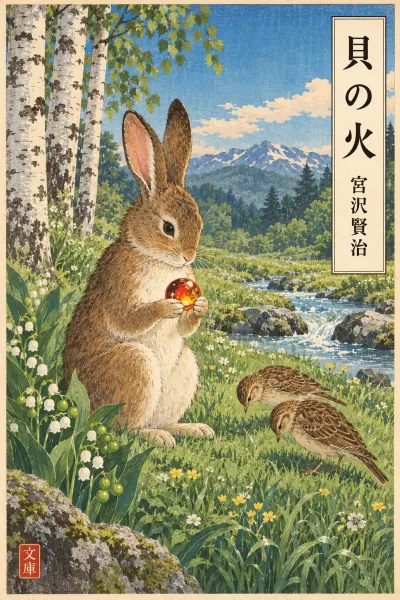
次の日ホモイは、お母さんに言いつけられて笊を持って野原に出て、鈴蘭の実を集めながらひとりごとを言いました。The next day his mother told Homoi to take a basket out to the meadow, and as he gathered lily-of-the-valley berries he talked to himself.
「ふん、大将が鈴蘭の実を集めるなんておかしいや。誰かに見つけられたらきっと笑われるばかりだ。狐が来るといいがなあ」"Hmph, it's ridiculous for a general to be gathering lily-of-the-valley berries. If anyone found me, they'd do nothing but laugh at me, I'm sure. I wish the fox would come along."
すると足の下がなんだかもくもくしました。Just then the ground under his feet began to heave and bulge somehow.
見るとむぐらが土をくぐってだんだん向こうへ行こうとします。He looked, and there was a mole tunnelling through the earth, trying to move further and further away.
ホモイは叫びました。Homoi shouted,
「むぐら、むぐら、むぐらもち、お前は僕の偉くなったことを知ってるかい」"Mole, mole, little mole-in-the-ground, do you know that I've become a great and important person?"
むぐらが土の中で言いました。The mole spoke from under the ground.
「ホモイさんでいらっしゃいますか。よく存じております」"Would that be Master Homoi? I know of you very well."
ホモイは大いばりで言いました。Homoi said, very full of himself,
「そうか。そんならいいがね。僕、お前を軍曹にするよ。そのかわり少し働いてくれないかい」"Is that so? Well then, that's fine. I'm going to make you a sergeant. In return, won't you do a little work for me?"
むぐらはびくびくして尋ねました。The mole asked nervously,
「へいどんなことでございますか」"Yes, sir, what sort of work would that be?"
ホモイがいきなり、Without any warning, Homoi
「鈴蘭の実を集めておくれ」と言いました。said, "Gather lily-of-the-valley berries for me."
むぐらは土の中で冷汗をたらして頭をかきながら、Under the ground the mole broke into a cold sweat, and scratching his head,
「さあまことに恐れ入りますが私は明るい所の仕事はいっこう無調法でございます」と言いました。he said, "Well, I'm truly very sorry, sir, but I am quite hopeless at any work done in the light."
ホモイはおこってしまって、Homoi lost his temper and
「そうかい。そんならいいよ。頼まないから。あとで見ておいで。ひどいよ」と叫びました。shouted, "Oh, is that so? Fine, then. I won't ask you. Just you wait and see. You'll be sorry!"
むぐらは、The mole
「どうかご免をねがいます。私は長くお日様を見ますと死んでしまいますので」としきりにおわびをします。kept apologising over and over: "Please, I beg your pardon. If I look at the sun for long, I shall die."
ホモイは足をばたばたして、Homoi stamped his feet
「いいよ。もういいよ。だまっておいで」と言いました。and said, "Fine. That's enough. Just be quiet."
その時向こうのにわとこの陰からりすが五疋ちょろちょろ出て参りました。Just then, five squirrels came scurrying out from the shade of an elder bush over the way.
そしてホモイの前にぴょこぴょこ頭を下げて申しました。They bobbed their heads before Homoi in quick little bows and said,
「ホモイさま、どうか私どもに鈴蘭の実をお採らせくださいませ」"Master Homoi, please, we beg you, allow us to pick the lily-of-the-valley berries for you."
ホモイが、Homoi said,
「いいとも。さあやってくれ。お前たちはみんな僕の少将だよ」"Certainly. Go on, get to it. You're all my major generals."
りすがきゃっきゃっ悦んで仕事にかかりました。The squirrels squealed with joy and set to work.
この時向こうから仔馬が六疋走って来てホモイの前にとまりました。At that moment, six young horses came running from over the way and stopped in front of Homoi.
その中のいちばん大きなのが、The biggest of them
Vocabulary
| Word | Meaning | JLPT |
|---|---|---|
| 存じておりますぞんじる | to know (humble)dictionary form: 存じるHumble equivalent of 知る/思う; 存じております is a very polite 'I know'. | N2 |
| 威勢いせい | vigour, spirit, boldness威勢よく = in a lively, commanding way. | — |
| けらいけらい | servant, retainer, vassaldictionary form: 家来Usually written 家来; an old-fashioned word for a lord's follower. | N1 |
| 卒倒そっとう | fainting, collapsing卒倒しそうになる = to nearly faint. | — |
| 赦しゆるす | to forgive, pardondictionary form: 赦す赦 is a formal kanji for forgiving an offence; 許す (sentence 7) is the everyday spelling. | N3 |
| 少尉しょうい | second lieutenantHomoi hands out military ranks: 少尉 lieutenant, 軍曹 sergeant, 少将 major general, 大将 general. | — |
| 大将たいしょう | general; the bossHomoi imagines himself as the highest-ranking commander. | — |
| むぐらむぐら | moleDialect or old form of もぐら; むぐらもち (sentence 26) is another old name for the same animal. | — |
| 軍曹ぐんそう | sergeant | — |
| 冷汗ひやあせ | cold sweat冷汗をたらす = to drip with cold sweat from fear or embarrassment. | — |
| 恐れ入りますおそれいる | to be very sorry; to be much obliged (humble)dictionary form: 恐れ入るA deferential opener used before refusing or asking something. | N1 |
| 無調法ぶちょうほう | clumsy, unskilled (humble)Old-fashioned, self-deprecating way to say you are no good at something. | — |
| にわとこにわとこ | elder (bush)Japanese elder, Sambucus; a shrub with white flowers. | — |
| 仔馬こうま | foal, young horse仔 marks a young animal; also written 子馬. | — |
Grammar
〜そうになる N3 to almost (do), to be on the verge of
The verb stem plus そうになる shows that something nearly happened but did not. Here the fox comes close to fainting from fright.
狐は卒倒しそうになって
The fox looked as if he might faint
〜てはならん N3 must not (do)
ならん is a clipped, old-fashioned form of ならない. 〜てはならない expresses a firm prohibition, and the clipped form makes Homoi sound like a stern commander.
そんなことをしてはならん
You must not do anything like that.
〜てたまらない N3 unbearably, extremely (feeling)
An adjective or verb in te-form plus たまらない (here politely たまりません) says a feeling is so strong it cannot be held back. It is used for emotions and physical sensations.
ホモイはうれしくてたまりません。
Homoi was so happy he could hardly bear it.
〜ているうちに N3 while (doing), before one knows it
うちに after an ongoing action shows that something else happened during that time, often without the person noticing. Here the sun sets while Homoi is lost in happy thoughts.
さまざまの楽しいことを考えているうちに、もうお日様が砕けた鏡のように樺の木の向こうに落ちましたので
while he was thinking about all sorts of happy things, the sun had already sunk behind the birch trees like a shattered mirror, so
〜なんて N3 something like ~ (scornful or surprised)
なんて after a clause marks it as something the speaker finds ridiculous, surprising or beneath them. Homoi feels that berry-picking is unworthy of a general.
大将が鈴蘭の実を集めるなんておかしいや。
It's ridiculous for a general to be gathering lily-of-the-valley berries.
お〜させてくださいませ N3 please allow us to (do) (very humble)
The causative 採らせる ('let us pick') with お〜ください asks permission to do something, and ませ adds extra deference. The squirrels humbly ask to be allowed to serve.
どうか私どもに鈴蘭の実をお採らせくださいませ
please, we beg you, allow us to pick the lily-of-the-valley berries for you