Part 3 of 11 · JLPT N2
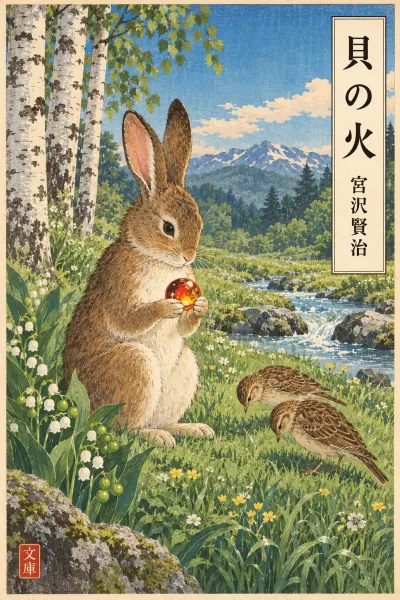
貝の火 Kai no Hi, part 3: The Treasure Comes Home
In this part
Homoi brings the jewel home, and his father recognises it as the famous Shell-Fire, a treasure that very few have kept perfectly all their lives. His parents tell him about the eagle minister who once owned it, and Homoi falls asleep holding it and has splendid dreams. The next morning he gazes at the volcano-like fire inside the jewel, polishes it as promised, and leaves it with his mother.
AI translation · independently checked
ホモイはそっと玉をささげて、おうちへはいりました。Homoi carefully held the jewel up before him and went into his house.
そしてすぐお父さんに見せました。Then he showed it to his father at once.
すると兎のお父さんが玉を手にとって、めがねをはずしてよく調べてから申しました。Then Homoi's father, the rabbit, took the jewel in his hand, took off his spectacles, examined it closely, and said:
「これは有名な貝の火という宝物だ。これは大変な玉だぞ。これをこのまま一生満足に持っている事のできたものは今までに鳥に二人魚に一人あっただけだという話だ。お前はよく気をつけて光をなくさないようにするんだぞ」"This is the famous treasure called the Shell-Fire. This is a remarkable jewel indeed. They say that until now only two birds and one fish have ever managed to keep it just as it is, perfectly, for their whole lives. You must take great care not to lose its light."
ホモイが申しました。Homoi said:
「それは大丈夫ですよ。僕は決してなくしませんよ。そんなようなことは、ひばりも言っていました。僕は毎日百遍ずつ息をふきかけて百遍ずつ紅雀の毛でみがいてやりましょう」"Don't worry about that. I'll never lose it. The lark said something like that too. Every day I'll breathe on it a hundred times and polish it a hundred times with a red sparrow's feather."
兎のおっかさんも、玉を手にとってよくよくながめました。Homoi's mother also took the jewel in her hand and looked at it very closely.
そして言いました。Then she said:
「この玉はたいへん損じやすいという事です。けれども、また亡くなった鷲の大臣が持っていた時は、大噴火があって大臣が鳥の避難のために、あちこちさしずをして歩いている間に、この玉が山ほどある石に打たれたり、まっかな熔岩に流されたりしても、いっこうきずも曇りもつかないでかえって前よりも美しくなったという話ですよ」"They say this jewel is very easily spoiled. And yet they also say that when the late Eagle Minister had it, there was a great eruption, and while the minister was going here and there directing the birds to safety, the jewel was struck by stones as big as mountains and swept along by red-hot lava, and yet it got not a single scratch or cloud on it. On the contrary, it became even more beautiful than before."
兎のおとうさんが申しました。Homoi's father said:
「そうだ。それは名高いはなしだ。お前もきっと鷲の大臣のような名高い人になるだろう。よくいじわるなんかしないように気をつけないといけないぞ」"That's right. That is a well-known story. You too will surely become someone as renowned as the Eagle Minister. Just be careful never to do anything mean or spiteful."
ホモイはつかれてねむくなりました。Homoi was tired and grew sleepy.
そして自分のお床にコロリと横になって言いました。He flopped down on his bed and said:
「大丈夫だよ。僕なんかきっと立派にやるよ。玉は僕持って寝るんだからください」"It'll be fine. I'll do it properly, you'll see. I'm going to sleep with the jewel, so give it to me, please."
兎のおっかさんは玉を渡しました。His mother handed him the jewel.
ホモイはそれを胸にあててすぐねむってしまいました。Homoi held it against his chest and fell asleep straight away.
その晩の夢の奇麗なことは、黄や緑の火が空で燃えたり、野原が一面黄金の草に変ったり、たくさんの小さな風車が蜂のようにかすかにうなって空中を飛んであるいたり、仁義をそなえた鷲の大臣が、銀色のマントをきらきら波立てて野原を見まわったり、ホモイはうれしさに何遍も、How beautiful his dreams were that night! Yellow and green fires blazed in the sky, the whole meadow turned into golden grass, lots of little pinwheels flew through the air humming faintly like bees, and the noble, righteous Eagle Minister went round inspecting the meadow, his silver cloak rippling and glittering, so that Homoi, in his joy, again and again
「ホウ。やってるぞ、やってるぞ」と声をあげたくらいです。very nearly shouted, "Oh! Look at them go, look at them go!"
**
あくる朝、ホモイは七時ごろ目をさまして、まず第一に玉を見ました。The next morning Homoi woke at about seven o'clock, and the very first thing he did was look at the jewel.
玉の美しいことは、昨夜よりもっとです。It was even more beautiful than the night before.
ホモイは玉をのぞいて、ひとりごとを言いました。Homoi peered into the jewel and talked to himself.
「見える、見える。あそこが噴火口だ。そら火をふいた。ふいたぞ。おもしろいな。まるで花火だ。おや、おや、おや、火がもくもく湧いている。二つにわかれた。奇麗だな。火花だ。火花だ。まるでいなずまだ。そら流れ出したぞ。すっかり黄金色になってしまった。うまいぞ、うまいぞ。そらまた火をふいた」"I can see it, I can see it. That's the crater over there. Look, it's spitting fire. It's spitting! How fun. It's just like fireworks. Oh, oh, oh, the fire is billowing up. It's split in two. How pretty. Sparks! Sparks! Just like lightning. Look, it's started to flow. It's turned all golden. Wonderful, wonderful! Look, it's spitting fire again."
おとうさんはもう外へ出ていました。His father had already gone outside.
おっかさんがにこにこして、おいしい白い草の根や青いばらの実を持って来て言いました。His mother came in smiling, bringing delicious white grass roots and green rose hips, and said:
「さあ早くおかおを洗って、今日は少し運動をするんですよ。どれちょっとお見せ。まあ本当に奇麗だね。お前がおかおを洗っている間おっかさんが見ていてもいいかい」"Now, hurry and wash your face. Today you're going to get a little exercise. Let me have a look. My, it really is beautiful. May Mother look at it while you wash your face?"
ホモイが言いました。Homoi said:
「いいとも。これはうちの宝物なんだから、おっかさんのだよ」そしてホモイは立って家の入り口の鈴蘭の葉さきから、大粒の露を六つほど取ってすっかりお顔を洗いました。"Of course. This is our family treasure, so it's yours too, Mother." Then Homoi got up, took about six big drops of dew from the tips of the lily-of-the-valley leaves at the entrance of the house, and washed his face thoroughly.
ホモイはごはんがすんでから、玉へ百遍息をふきかけ、それから百遍紅雀の毛でみがきました。When he had finished eating, Homoi breathed on the jewel a hundred times and then polished it a hundred times with the red sparrow's feather.
そしてたいせつに紅雀のむな毛につつんで、今まで兎の遠めがねを入れておいた瑪瑙の箱にしまってお母さんにあずけました。Then he wrapped it carefully in red sparrow's breast down, put it away in the agate box where the rabbits' telescope had been kept until then, and left it in his mother's care.
そして外に出ました。Then he went outside.
Vocabulary
| Word | Meaning | JLPT |
|---|---|---|
| ささげてささげる | to hold up reverently in both handsdictionary form: 捧げるAlso means 'to offer' or 'to dedicate'. Here it shows how respectfully Homoi carries the jewel. | N1 |
| 宝物たからもの | treasure | — |
| 一生いっしょう | one's whole life; for life | N3 |
| 損じそんじる | to be damaged; to spoildictionary form: 損じるA somewhat formal or old-fashioned word. With 〜やすい it means 'easily damaged'. | — |
| 避難ひなん | evacuation; taking refuge | N1 |
| さしずさしず | directions; ordersdictionary form: 指図さしずをする means 'to give instructions'. | N1 |
| 熔岩ようがん | lavaUsually written 溶岩 today. | N2 |
| いっこういっこう | (not) at alldictionary form: 一向Used with a negative, here つかないで: 'did not get any at all'. | N1 |
| かえってかえって | on the contrary; insteaddictionary form: 却ってIntroduces a result that is the opposite of what you would expect. | N2 |
| 名高いなだかい | famous; renownedA more literary word than 有名. | N1 |
| いじわるいじわる | meanness; spite; being nasty to othersdictionary form: 意地悪 | N2 |
| 仁義じんぎ | benevolence and righteousnessA Confucian ideal of moral virtue. そなえた means the minister 'possessed' these virtues. | — |
| 露つゆ | dew | N1 |
| あずけましたあずける | to leave in someone's care; to entrustdictionary form: 預ける | N3 |
Grammar
〜ないようにする N4 to make sure not to; to take care not to
The plain negative plus ようにする describes a conscious effort to avoid something. The father ends with 〜んだぞ, which turns it into a firm instruction.
お前はよく気をつけて光をなくさないようにするんだぞ
You must take great care not to let its light go out.
〜という話だ N3 they say that; the story goes that
This marks information the speaker has heard from others. It is hearsay, not first-hand knowledge. Both parents use it when they talk about the jewel's legend.
今までに鳥に二人魚に一人あっただけだという話だ
They say that until now there have been only two birds and one fish.
〜たり〜たりする N4 doing things such as A and B
This pattern lists representative actions or events without claiming the list is complete. Here it lists the dangers the jewel went through, and it is followed by 〜ても, meaning 'even though'.
この玉が山ほどある石に打たれたり、まっかな熔岩に流されたりしても
even though this jewel was struck by stones as big as mountains and swept along by red-hot lava
〜ないといけない N4 must; have to
Literally 'if you don't…, it won't do'. It expresses obligation. The father's ぞ adds a stern, emphatic tone.
よくいじわるなんかしないように気をつけないといけないぞ
Just be careful never to do anything mean or spiteful.
〜てしまう N4 to do completely; to end up doing
Attached to a verb's て-form, しまう shows that an action is finished, often quickly or without the person meaning to. Here Homoi falls asleep almost at once.
ホモイはそれを胸にあててすぐねむってしまいました。
Homoi held it against his chest and fell asleep straight away.
Adjective + ことは N3 as for how [adjective] it is…
Noun + の + adjective + ことは — 'as for how [adjective] something is…'. Adding こと to an adjective turns the quality itself into the topic, as in 'the beauty of the jewel'. The narrator uses it for emphatic description, as in the dream passage (その晩の夢の奇麗なことは…) and here in 玉の美しいことは.
玉の美しいことは、昨夜よりもっとです。
It was even more beautiful than the night before.