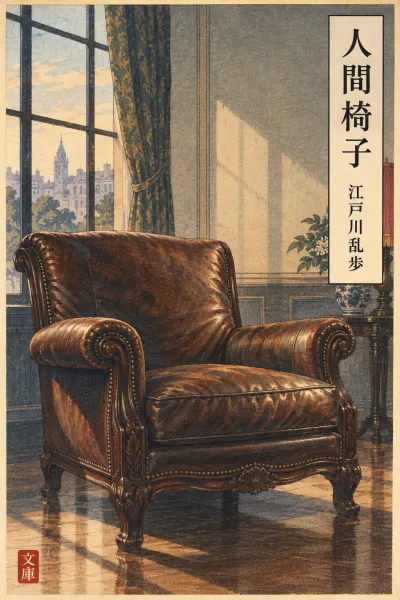
Upper intermediate · JLPT N2
人間椅子Ningenisu — The Man Inside the Chair
- JLPT N2
- 14,835 characters
- 10 parts
- about 124 minutes
人間椅子 is a short tale of psychological horror by Edogawa Ranpo, first published in 1925. Most of it takes the form of a letter. One morning Yoshiko, a famous woman writer, opens a thick envelope from an unknown admirer. Inside is a long confession. The writer is a poor, ugly craftsman of fine chairs, and he reveals, step by step, the secret life he has been leading inside one of his own creations. The story is unsettling but contains no gore. Its effect comes from closeness, touch and slow realisation, and it builds toward a twist that readers still argue about. For learners, the main challenge is the letter's voice. The chair-maker writes in elaborate, self-abasing epistolary keigo (ございます, 申し上げます, お許し下さいませ), with older kanji spellings and many onomatopoeic words. The reward is a chance to see formal written Japanese used to create character and suspense. The writer's politeness grows more disturbing as his story goes on. The short third-person frame around the letter is plain and easy to follow, so you can settle in before the harder voice begins.
Contents
- A Strange Manuscript Arrives for Yoshiko
- An Ugly Craftsman's Secret Dreams
- The Masterpiece Armchair
- Building a Hiding Place Inside the Chair
- A Hermit Crab in the Hotel Lounge
- Strangers Sitting on a Hidden Lap
- A Lover Hidden in the Dark
- Ambassador, Dancer, and the Auction
- Sold Into the Home of a Lady
- The Letter's Confession and Final Twist
Before you read
- Expect two registers. The frame (Parts 1 and 10) is plain written narration ending in 〜た and 〜であった. The letter is humble keigo: learn ございます, 申し上げます, 存じます, 〜でございましょう and お〜下さいませ early, and you will move through it much faster.
- Watch for older spellings that stand in for familiar words: 了う = しまう (as in 〜て了う), 此様 = このよう, 丈け = だけ, 拘らず = かかわらず, 知れない = しれない. Once you recognise them, many 'unknown' kanji turn out to be words you already know.
- The letter-writer's obsessive voice relies on a few patterns that express certainty, compulsion and minimisation: 〜に相違ない, 〜ないではいられない, 〜に過ぎない, 〜ねばならぬ, and the causative AをしてBさせる. Concessive 〜ながら and 〜にも拘らず often mark his contradictions, such as being ugly yet dreaming of beauty.
- Learn the core vocabulary of the chair and the senses before you start: 椅子, 肘掛椅子, 革, 詰め物, 触覚, 膝, 肉体, 感触. Much of the middle section describes sensations felt through leather in the dark.
- Read the onomatopoeia for sound and texture rather than looking up each one. Ranpo uses words like ぐったり and ふっくら to make the hidden man's experience physical, and their general feel usually matters more than an exact translation.
Words to know
The most useful words from the notes across the story.
| Word | Meaning | JLPT |
|---|---|---|
| 予感よかん | to have a presentiment, sense in advance | N1 |
| 無躾ぶしつけ | rude, impertinentUsually written 不躾 today; common in apologies such as ぶしつけなお願い. | — |
| 味気なさあじけない | dreariness, joylessnessdictionary form: 味気ないAlso read あじきない in older texts; さ turns the adjective into a noun. | — |
| 妄想もうそう | fancy, daydream, delusionA key word of the story: his private fantasies. | — |
| 奇怪きっかい | bizarre, grotesqueAlso read きかい. 奇怪極まる means 'utterly bizarre'. | — |
| 愛着あいちゃく | attachment, fondnessAlso used for objects; here a strong, obsessive attraction. | — |
| 競売きょうばい | auction | — |
| 遠慮えんりょ | holding back, refraining out of reserveHere he did not even dare look women in the face. | N4 |
| 書斎しょさい | study (room for reading and writing) | N3 |
| 註文ちゅうもん | order, commission; demanddictionary form: 注文Old spelling of 注文. | N3 |
| 刺戟しげき | stimulation, thrillOlder spelling of modern 刺激. | N3 |
| 合図あいず | signal, sign | N3 |
| 原稿げんこう | manuscript原稿用紙 is squared manuscript paper. | N2 |
| 苦心くしん | pains, painstaking effort | N2 |
| 拵えたりこしらえる | to make, to fashiondictionary form: 拵えるSomewhat old-fashioned or colloquial word for 作る. | N2 |
Plot summary
Show the full summary (contains spoilers)
Yoshiko, a celebrated writer married to a Foreign Ministry official, receives a letter from a stranger. He is a skilled but ugly and poor chair-maker. He made a luxurious armchair for a foreign-run hotel in Y City, built a hollow space inside it, and hid there. At first he crept out to steal. Soon he became obsessed with the guests who sat on him, and he came to know them only by touch. When the hotel was sold, the chair went to auction and was bought by a Japanese official. It was placed in the study used by the official's young wife, and the hidden man fell in love with her. He reveals that she is Yoshiko and asks her for a sign so that he can visit her. Horrified, she flees the study. A second letter then arrives in the same handwriting. It explains that the first was a manuscript the writer hopes to title "The Human Chair."
About the author
His pen name is a Japanese rendering of the name of Edgar Allan Poe, whom he admired. He began with detective stories such as 二銭銅貨 and went on to create the detective Akechi Kogorō. He also wrote many tales of the grotesque and the perverse, of which 人間椅子 is a famous example. Later he wrote the popular Boy Detectives series for young readers and promoted the mystery genre as an editor and critic. Japan's Edogawa Rampo Prize for mystery fiction is named after him.