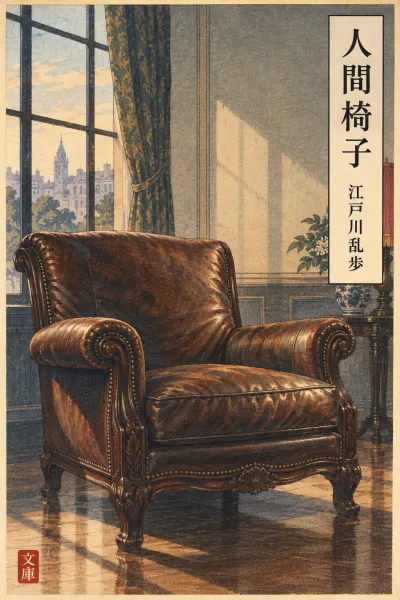
Part 10 of 10 · JLPT N2
人間椅子 Ningenisu, part 10: The Letter's Confession and Final Twist
In this part
The letter-writer confesses that the woman he loves is Yoshiko herself. He begs her to signal with a handkerchief so that he can visit her as an ordinary caller. Horrified, Yoshiko flees the study. Then a second letter arrives in the same handwriting. Its writer says he is a devoted reader of her works and has sent her a manuscript of his own under separate cover, which he would like to title "The Human Chair." This implies that the first letter was that story.
AI translation · independently checked
かようにして、私の情熱は、日々に烈しく燃えて行くのでした。And so my passion burned more fiercely with every passing day.
そして、遂には、ああ奥様、遂には、私は、身の程もわきまえぬ、大それた願いを抱く様になったのでございます。And at last, ah, Madam, at last I came to harbour a wish so presumptuous that it utterly forgot my station.
たった一目、私の恋人の顔を見て、そして、言葉を交すことが出来たなら、其まま死んでもいいとまで、私は、思いつめたのでございます。If I might see my beloved's face but once, and exchange but a few words with her, I would be content to die that very moment. So far, I confess, did my longing drive me.
奥様、あなたは、無論、とっくに御悟りでございましょう。Madam, you have no doubt long since guessed the truth.
その私の恋人と申しますのは、余りの失礼をお許し下さいませ。The one I call my beloved, and I beg you to pardon my unpardonable impertinence,
実は、あなたなのでございます。is, in truth, none other than yourself.
あなたの御主人が、あのY市の道具店で、私の椅子を御買取りになって以来、私はあなたに及ばぬ恋をささげていた、哀れな男でございます。Ever since your honoured husband purchased my chair at that furniture shop in Y City, I have been a wretched man, laying at your feet a love that can never reach you.
奥様、一生の御願いでございます。Madam, I ask this of you as the one great request of my life.
たった一度、私にお逢い下さる訳には行かぬでございましょうか。Might you not consent to meet me, only once?
そして、一言でも、この哀れな醜い男に、慰めのお言葉をおかけ下さる訳には行かぬでございましょうか。And might you not grant this pitiful, hideous man even a single word of comfort?
私は決してそれ以上を望むものではありません。I assure you that I wish for nothing more than that.
そんなことを望むには、余りに醜く、汚れ果てた私でございます。I am far too ugly, far too utterly defiled, to wish for anything more.
どうぞどうぞ、世にも不幸な男の、切なる願いを御聞き届け下さいませ。I beg you, I implore you, grant the earnest plea of the unhappiest man in all the world.
私は昨夜、この手紙を書く為に、お邸を抜け出しました。Last night I slipped out of your house in order to write this letter.
面と向って、奥様にこんなことをお願いするのは、非常に危険でもあり、且つ私には迚も出来ないことでございます。To make such a request of you face to face, Madam, would be exceedingly dangerous, and besides, it is something I could never bring myself to do.
そして、今、あなたがこの手紙をお読みなさる時分には、私は心配の為に青い顔をして、お邸のまわりを、うろつき廻って居ります。And now, at the very moment you are reading this letter, I am wandering about outside your house, my face pale with anxiety.
若し、この、世にも無躾なお願いをお聞き届け下さいますなら、どうか書斎の窓の撫子の鉢植に、あなたのハンカチをおかけ下さいまし、それを合図に、私は、何気なき一人の訪問者としてお邸の玄関を訪れるでございましょう。Should you be so gracious as to grant this most ill-mannered of requests, I pray you hang your handkerchief upon the potted pinks at the study window. At that signal I shall call at the front door of your house, as an ordinary visitor with no particular purpose.
そして、このふしぎな手紙は、ある熱烈な祈りの言葉を以て結ばれていた。The strange letter ended with words of fervent prayer.
佳子は、手紙の半程まで読んだ時、已に恐しい予感の為に、まっ青になって了った。By the time Yoshiko had read halfway through the letter, a terrible foreboding had already turned her deathly pale.
そして、無意識に立上ると、気味悪い肘掛椅子の置かれた書斎から逃げ出して、日本建ての居間の方へ来ていた。Without knowing what she was doing, she rose and fled from the study, where the sinister armchair stood, and found herself in the Japanese-style sitting room.
手紙の後の方は、いっそ読まないで、破り棄てて了おうかと思ったけれど、どうやら気懸りなままに、居間の小机の上で、兎も角も、読みつづけた。She thought of not reading the rest of the letter at all and tearing it up, but it still weighed on her mind, so at the little desk in the sitting room she read on all the same.
彼女の予感はやっぱり当っていた。Her foreboding had proved right after all.
これはまあ、何という恐ろしい事実であろう。What a dreadful truth this was!
彼女が毎日腰かけていた、あの肘掛椅子の中には、見も知らぬ一人の男が、入っていたのであるか。Had a man she had never even seen truly been inside that armchair she sat in every day?
「オオ、気味の悪い」"Oh, how horrible!"
彼女は、背中から冷水をあびせられた様な、悪寒を覚えた。She felt a chill, as if cold water had been poured down her back.
そして、いつまでたっても、不思議な身震いがやまなかった。And no matter how much time passed, the strange shivering would not stop.
彼女は、あまりのことに、ボンヤリして了って、これをどう処置すべきか、まるで見当がつかぬのであった。The shock had left her dazed, and she had no idea at all what she ought to do about it.
椅子を調べて見る(?)どうしてどうして、そんな気味の悪いことが出来るものか。Examine the chair? Never, never! How could she do anything so horrible?
そこには仮令、もう人間がいなくても、食物その他の、彼に附属した汚いものが、まだ残されているに相違ないのだ。Even if the man were no longer there, his food and other filthy things belonging to him must surely still be left inside.
「奥様、お手紙でございます」"A letter for you, Madam."
ハッとして、振り向くと、それは、一人の女中が、今届いたらしい封書を持て来たのだった。She turned with a start. A maid had brought in a sealed letter that seemed to have just arrived.
佳子は、無意識にそれを受取って、開封しようとしたが、ふと、その上書を見ると、彼女は、思わずその手紙を取りおとした程も、ひどい驚きに打たれた。Yoshiko took it without thinking and was about to open it, but when she happened to glance at the address on the envelope, she was struck by such a shock that she let the letter fall from her hand.
そこには、さっきの無気味な手紙と寸分違わぬ筆癖をもって、彼女の名宛が書かれてあったのだ。Her name was written there in a hand exactly the same as that of the sinister letter she had just read.
彼女は、長い間、それを開封しようか、しまいかと迷っていた。For a long time she hesitated over whether or not to open it.
が、とうとう、最後にそれを破って、ビクビクしながら、中身を読んで行った。But at last she tore it open and began to read the contents, trembling as she did so.
手紙はごく短いものであったけれど、そこには、彼女を、もう一度ハッとさせた様な、奇妙な文言が記されていた。The letter was very short, but it held strange words that startled her once again.
突然御手紙を差上げます無躾を、幾重にもお許し下さいまし。I beg you a thousand times over to forgive the rudeness of writing to you so suddenly.
私は日頃、先生のお作を愛読しているものでございます。I am one who has long been a devoted reader of your works, Sensei.
別封お送り致しましたのは、私の拙い創作でございます。What I sent you under separate cover is a humble story of my own composing.
御一覧の上、御批評が頂けますれば、此上の幸はございません。If, after reading it through, you would favour me with your criticism, I could ask for no greater happiness.
ある理由の為に、原稿の方は、この手紙を書きます前に投函致しましたから、已に御覧済みかと拝察致します。For a certain reason I posted the manuscript before writing this letter, and so I humbly presume you have already read it.
如何でございましたでしょうか。What did you think of it?
若し、拙作がいくらかでも、先生に感銘を与え得たとしますれば、こんな嬉しいことはないのでございますが。If my poor work has moved you in even the smallest degree, nothing could make me happier.
原稿には、態と省いて置きましたが、表題は「人間椅子」とつけたい考えでございます。I purposely left it off the manuscript, but I should like to give it the title "The Human Chair."
では、失礼を顧みず、お願いまで。With this, heedless of my discourtesy, I close with my humble request.
匆々。In haste.
Vocabulary
| Word | Meaning | JLPT |
|---|---|---|
| 身の程みのほど | one's place, one's station in lifeUsually appears in 身の程をわきまえない, 'not knowing one's place'. | — |
| わきまえぬわきまえる | to know properly, to be aware of (limits, manners)dictionary form: わきまえる〜ぬ is the old negative, equal to 〜ない. | — |
| 大それたおおそれた | outrageous, presumptuous, audaciousUsed only before a noun, e.g. 大それた願い or 大それたこと. | — |
| 思いつめたおもいつめる | to brood on something until it becomes desperate or obsessivedictionary form: 思い詰める | — |
| 無躾ぶしつけ | rude, ill-mannered, impertinentModern spelling is usually 不躾. Writers often use it in humble apologies, as in 無躾なお願い. | — |
| 合図あいず | signal, sign | N3 |
| 予感よかん | premonition, foreboding | N1 |
| 悪寒おかん | a chill, shivering (from fear or fever)悪 is read お here, not あく. | — |
| 見当がつかぬけんとうがつく | to have an idea, to be able to guessdictionary form: 見当がつくMost often used in the negative: 見当がつかない, 'to have no idea'. | — |
| 筆癖ふでぐせ | a person's characteristic handwriting | — |
| 愛読あいどく | reading with love, being a devoted reader of愛読者 means 'avid reader, fan'. | — |
| 拝察はいさつ | to presume, to surmise (humble)A humble word used in polite letters. | — |
| 匆々そうそう | closing formula of a letter: 'in haste', 'yours hurriedly'It pairs with an opening such as 前略. Modern writers usually spell it 草々. | — |
Grammar
〜ようになる N4 to come to (do), to reach a state where
Attached to a verb, it marks a gradual change in behaviour or feeling. Here it shows how the writer's passion slowly grew into a bold wish.
大それた願いを抱く様になったのでございます
I came to harbour a presumptuous wish
〜わけにはいかない N3 cannot (for social or moral reasons)
It means something cannot be done because circumstances do not allow it. Turned into a humble question with 〜ぬでございましょうか, it becomes a very pleading request: 'Would it be impossible for you to…?'
たった一度、私にお逢い下さる訳には行かぬでございましょうか。
Might you not consent to meet me, only once?
〜ものか N2 as if one could…; certainly not
Attached to a plain form, it makes a rhetorical question that strongly denies the possibility. Yoshiko is insisting to herself that she could never examine the chair.
どうしてどうして、そんな気味の悪いことが出来るものか。
Never, never! How could she do anything so horrible?
〜に相違ない N2 must be; there is no doubt that
This is a written, more formal equivalent of 〜に違いない. It expresses the speaker's strong conviction, here Yoshiko's certainty that something filthy is still left inside the chair.
汚いものが、まだ残されているに相違ないのだ
filthy things must surely still be left inside
〜の上(で) N2 after doing; upon doing
After a noun of action (with の) or a verb in た-form, it means 'after first doing X'. The honorific 御一覧の上 politely asks the reader to look the work over before giving criticism.
御一覧の上、御批評が頂けますれば、此上の幸はございません。
If, after reading it through, you would favour me with your criticism, I could ask for no greater happiness.