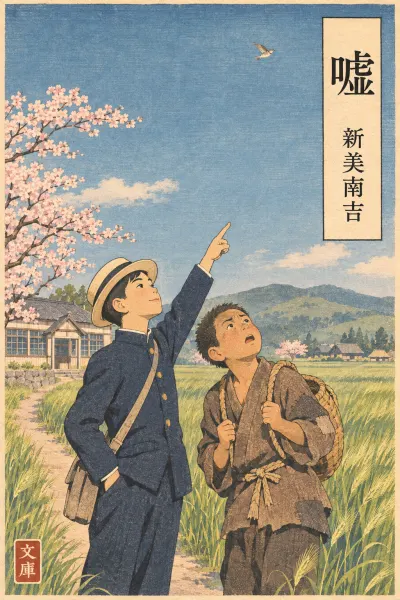
Part 4 of 10 · JLPT N3
嘘 Uso, part 4: The Bitter Pill and the Silent Gate
In this part
Kyūsuke's strange pill keeps turning bitter, then cool and sweet, over and over, until he spits it out and walks home breathing in the fresh air. When his mother remarks that he smells of Jintan, he realises the pill was only ordinary Jintan and feels foolish. He wonders more than ever what kind of boy Tarōzaemon is. One day he follows Tarōzaemon through the old, hushed gate of his house and finds a square, moss-green pond that smells bad and feels cold and unfriendly.
AI translation · independently checked
舌の先でしばらくまわしていると、にがいまずいしるがとけて出たので、なんだ、こんなもん、かぜのとき飲まされるトンプクの玉みたいじゃないかと思って、はき出そうとした。After he had rolled it around on the tip of his tongue for a while, a bitter, nasty juice melted out of it, and he thought, What, this thing? It's just like those pills they make you take when you've got a cold. He was about to spit it out.
するととたんに、そのにがかったものが、すずしいあまさに変わって、じつに口の中が爽快になったので、久助君はひとりで、クックッとわらいだしてしまった。But at that very moment the bitter stuff turned into a cool sweetness, and the inside of his mouth felt so wonderfully fresh that Kyūsuke, all by himself, burst out giggling.
なんだ、こんなもんか。So that's all it is.
ハッカのもとというようなものなんだな。It's something like the essence of peppermint, then.
しかし、すぐにまた、舌の先がにがみをおぼえはじめ、久助君は顔をしかめずにはおれなかった。But soon the tip of his tongue began to taste bitterness again, and Kyūsuke couldn't help screwing up his face.
しかし、いまにまた、すずしくあまくなるだろうと思って、がまんしていた。Still, he put up with it, thinking that before long it would turn cool and sweet again.
はたして、まもなくそのとおりになった。Sure enough, it soon did just that.
これで久助君には、この玉のしかけがわかった。Now Kyūsuke understood the trick of the pill.
にがくなったり、あまくなったり、交互にくり返すようになっているのだ。It was made to go bitter, then sweet, over and over, by turns.
ところで、三どめににがくなってきたとき、久助君はもういやになって、はき出してしまった。Still, when it started to go bitter for the third time, Kyūsuke had had enough, and he spat it out.
それはとけて、茶色のつばになっていた。It had melted into brown spit.
はき出したあとで口をあけて空気をすいこむと、これはまた、なんという爽快なことだろう!And when he opened his mouth after spitting it out and breathed in the air, oh, how wonderfully fresh it was!
久助君の小さな口の中に、すずしい秋の朝が、ごっそりひとつはいりこんだみたいだ。It was as if a whole cool autumn morning had poured into Kyūsuke's small mouth.
久助君はその爽快味を満喫するため、大きく口をあけて、ハアーッハアーッと呼吸しながら、家まできてしまったのである。To enjoy that freshness to the full, Kyūsuke kept his mouth wide open and breathed in and out, haah, haah, all the way home.
「なんだい、久は。仁丹のにおいをさせてるじゃないか」"Well, Kyū, what's this? You smell of Jintan."
と、おかあさんがいった。said his mother.
そこではじめて久助君は、なぞがとけて、そして、ばからしくなってしまった。Only then was the mystery solved for Kyūsuke, and he felt very silly.
仁丹なら、久助君は百も知っていたのだ。Jintan was something Kyūsuke knew all about.
もっとも、たべたことは、こんどがはじめてだけれど。Though, to be fair, this was the first time he had ever eaten any.
どうしてまた久助君は、ありふれた仁丹なんかを、なにかたいへんな、ふしぎなもののように思いこまされてしまったんだろう。How on earth had Kyūsuke been made to believe that plain, everyday Jintan was some marvellous, mysterious thing?
思えば思うほど、久助君にとって、太郎左衛門はきみょうな少年であった。The more he thought about it, the stranger a boy Tarōzaemon seemed to Kyūsuke.
三Three
道から十メートルばかりはいったところに、太郎左衛門の屋敷の門がある。About ten metres in from the road stands the gate of Tarōzaemon's house.
光蓮寺の山門をすこし小さくしたような、さびた金具などのついた古めかしい門である。It is an old-fashioned gate with rusty metal fittings, like a slightly smaller version of the main gate of Kōrenji temple.
横に小さいくぐりがあって、太郎左衛門はそれから出はいりし、門はいつでもしまっている。At the side there is a small wicket door, which Tarōzaemon uses to go in and out; the gate itself is always shut.
太郎左衛門といっしょにそこまできて、太郎左衛門が、「しっけい」とか、「さよなら、またあした」などといって、そのくぐりからすっと中へはいり、あとにぴったりくぐり戸もしめられてしまうと、久助君は、いったいこの門の中で、太郎左衛門はどんなことをしているのだろう、おとなのことばでいえば、どんな生活をしているのだろうと、ちょっと思うのであった。Whenever Kyūsuke walked there with Tarōzaemon, and Tarōzaemon said something like "Pardon me" or "Goodbye, see you tomorrow," slipped smoothly in through the wicket and shut the little door tight behind him, Kyūsuke would wonder for a moment what in the world Tarōzaemon did behind that gate — or, to put it in grown-up words, what sort of life he led.
しかし、あまりその中にはいってみたいとは思わなかった。But he didn't much want to go inside and see.
なにしろ、ばかにしんかんとしているのである。The place was so terribly hushed, after all.
古めかしくてしんかんとしている――、そういうところを、久助君はこのまないのだ。Old-fashioned and hushed — that was the kind of place Kyūsuke didn't like.
あるとき久助君は、太郎左衛門についてその門の中にはいった。One day Kyūsuke followed Tarōzaemon in through that gate.
庭はあんがいせまかった。The garden was smaller than he had expected.
だが、久助君の目をひきつけたものがそこにあった。But there was something there that caught Kyūsuke's eye.
まっ四角な深い池で、底の方に緑色のにごった水がよどんでいた。It was a deep, perfectly square pond, with murky green water lying stagnant at the bottom.
四方の石がきにはこけがいっぱいついて、石の色はすこしも見えない。The stone walls on all four sides were thickly covered in moss, so that not a bit of the stone's own colour could be seen.
つまり、この一升ますのような形の池は、なにからなにまで緑色である。In short, this pond, shaped like a one-shō measuring box, was green from top to bottom.
そして水の中には、こいがいるらしい。And there seemed to be carp in the water.
ところどころ、水の緑色の中に、ぼんやりした赤や、白がみとめられるのは、たしかにそれだ。The blurry patches of red and white that could be made out here and there in the green water were surely carp.
久助君はしばらくのぞいていると、なまぐさいいやなにおいが鼻につきはじめた。As Kyūsuke peered in for a while, a nasty, fishy smell began to get into his nose.
そればかりか、この池全体が、なにか、子どもによそよそしい感じをもっていることがわかったので、じきそばをはなれてしまった。Not only that, he could tell that the whole pond had something cold and unwelcoming about it toward children, so he soon moved away from it.
Vocabulary
| Word | Meaning | JLPT |
|---|---|---|
| 爽快そうかい | refreshing; wonderfully freshA na-adjective used for clean, cool sensations or moods; 爽快味 in a later sentence means 'refreshing feeling'. | — |
| しかめしかめる | to frown; to screw up (one's face)dictionary form: しかめるAlmost always used as 顔をしかめる. | — |
| 交互こうご | alternately; by turnsOften 交互に + verb. | N1 |
| 満喫まんきつする | to enjoy to the fulldictionary form: 満喫するUsed for enjoying a taste, a holiday, freedom and so on. | — |
| 仁丹じんたん | Jintan, tiny silver breath-freshening pillsA well-known Japanese brand sold since 1905, made of herbal ingredients and tasting of mint. English has no equivalent, so the name is kept. | — |
| ありふれたありふれる | common, ordinary, everydaydictionary form: ありふれるAlmost always used in the form ありふれた + noun. | — |
| 屋敷やしき | large house with grounds; residenceSuggests an old, substantial house, not an ordinary home. | N1 |
| 古めかしいふるめかしい | old-fashioned; antiquated-looking〜めかしい means 'having the air of'; compare なまめかしい. | — |
| くぐりくぐり | small wicket door set in a large gateShort for くぐり戸, from くぐる 'to pass through by stooping'. | — |
| しんかんしんかん | deathly quiet; husheddictionary form: 森閑A literary word, usually written 森閑/深閑 and used as しんかんとする. | — |
| よどんでよどむ | to be stagnant; to stand still (of water or air)dictionary form: よどむKanji 淀む. | — |
| こけこけ | mossdictionary form: 苔 | — |
| なまぐさいなまぐさい | smelling of raw fish or blood; fishydictionary form: 生臭いLiterally 'raw-smelling'. | N1 |
| よそよそしいよそよそしい | cold, distant, unfriendlyFrom よそ 'outside, other'. Normally said of people's manner; here it describes the pond. | — |
Grammar
〜(さ)せられる (causative-passive) N3 to be made to do something (against one's will)
The causative 飲ませる 'make someone drink' becomes passive in the form 飲まされる, 'be made to drink'. 思いこまされて in a later sentence works the same way: Kyūsuke was made to believe something.
かぜのとき飲まされるトンプクの玉みたいじゃないか
It's just like those fever pills they make you swallow when you've got a cold.
〜ずにはおれない N2 cannot help doing
This is a negative ず + には + おれない 'cannot stay'. It is a literary variant of 〜ずにはいられない and means the action happens in spite of oneself.
久助君は顔をしかめずにはおれなかった。
Kyūsuke couldn't help screwing up his face.
〜たり〜たり N4 doing A and B (by turns)
Here the two たり forms describe two states that keep alternating. 〜ようになっている adds 'it is designed or set up to work this way'.
にがくなったり、あまくなったり、交互にくり返すようになっているのだ。
It was made to go bitter, then sweet, over and over, by turns.
なんという〜ことだろう N2 how ...!; what a ...!
This is an exclamation of strong feeling. なんという 'what kind of' is placed before an adjective + ことだろう to express surprise or admiration.
これはまた、なんという爽快なことだろう!
Oh, how wonderfully fresh it was!
〜ば〜ほど N3 the more ..., the more ...
The same verb is repeated, first in the ば conditional and then followed by ほど. The second part changes in proportion to the first.
思えば思うほど、久助君にとって、太郎左衛門はきみょうな少年であった。
The more he thought about it, the stranger a boy Tarōzaemon seemed to Kyūsuke.
〜らしい N4 seems to; apparently
The narrator makes an inference from what can be seen, namely the faint red and white shapes. The next sentence confirms the guess with たしかに.
そして水の中には、こいがいるらしい。
And there seemed to be carp in the water.