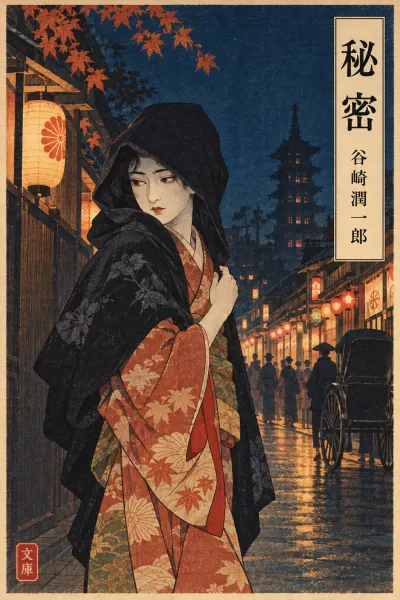
Part 8 of 11 · JLPT N1
秘密 Himitsu, part 8: Blindfolded Ride Through the Rain
In this part
On a night of torrential rain the narrator goes to the Kaminarimon. A rickshaw appears, and the driver blindfolds him and seats him beside a silent woman, almost certainly T. After a long, deliberately winding ride he is led into a house, and the woman comes to him and unties the blindfold.
AI translation · independently checked
明くる日の晩は素晴らしい大雨であった。The following evening brought a magnificent downpour.
私はすっかり服装を改めて、対の大島の上にゴム引きの外套を纏い、ざぶん、ざぶんと、甲斐絹張りの洋傘に、滝の如くたたきつける雨の中を戸外へ出た。I changed my attire completely, drew a rubberised overcoat over my matching suit of Ōshima pongee, and went out of doors into rain that beat down like a waterfall, splash upon splash, on my umbrella of Kai silk.
新堀の溝が往来一円に溢れているので、私は足袋を懐へ入れたが、びしょびしょに濡れた素足が家並みのランプに照らされて、ぴかぴか光って居た。The Shinbori canal had overflowed across the whole street, so I tucked my tabi socks into the breast of my kimono, and my soaking bare feet gleamed and glistened in the lamplight from the row of houses.
夥しい雨量が、天からざあざあと直瀉する喧囂の中に、何もかも打ち消されて、ふだん賑やかな広小路の通りも大概雨戸を締め切り、二三人の臀端折りの男が、敗走した兵士のように駈け出して行く。Everything was drowned out in the roar of the immense volume of water pouring straight down from the heavens. Along Hirokōji, usually so lively, the storm shutters were nearly all closed tight, and two or three men with their kimono hitched up behind went running off like soldiers in rout.
電車が時々レールの上に溜まった水をほとばしらせて通る外は、ところどころの電柱や広告のあかりが、朦朧たる雨の空中をぼんやり照らしているばかりであった。Apart from the occasional streetcar passing by and sending up spray from the water pooled on its rails, there was nothing but the lights of utility poles and advertisements here and there, dimly illuminating the hazy, rain-filled air.
外套から、手首から、肘の辺まで水だらけになって、漸く雷門へ来た私は、雨中にしょんぼり立ち止りながらアーク燈の光を透かして、四辺を見廻したが、一つも人影は見えない。Drenched from overcoat to wrists and on up to my elbows, I at last reached the Kaminarimon. Halting forlornly in the rain, I peered through the glow of the arc lamps and looked all about me, but not a single figure was to be seen.
何処かの暗い隅に隠れて、何者かが私の様子を窺っているのかも知れない。Perhaps someone was hiding in some dark corner, watching to see what I would do.
こう思って暫く彳んで居ると、やがて吾妻橋の方の暗闇から、赤い提灯の火が一つ動き出して、がらがらがらと街鉄の鋪き石の上を駛走して来た旧式な相乗りの俥がぴたりと私の前で止まった。With this thought I stood waiting for a while, until at length a single red lantern began to move out of the darkness in the direction of Azumabashi, and an old-fashioned two-seater rickshaw came speeding over the paving stones of the tramway with a great rattle and clatter and stopped dead in front of me.
「旦那、お乗んなすって下さい。」"Get in, if you please, sir."
深い饅頭笠に雨合羽を着た車夫の声が、車軸を流す雨の響きの中に消えたかと思うと、男はいきなり私の後へ廻って、羽二重の布を素早く私の両眼の上へ二た廻り程巻きつけて、蟀谷の皮がよじれる程強く緊め上げた。No sooner had the voice of the rickshaw man, in a deep bowl-shaped hat and rain cape, faded into the roar of the teeming rain than he stepped smartly round behind me, swiftly wound a strip of habutae silk twice or so over both my eyes, and drew it so tight that the skin at my temples was twisted.
「さあ、お召しなさい。」"There now, in you get."
こう云って男のざらざらした手が、私を掴んで、惶しく俥の上へ乗せた。With these words the man's rough hands seized me and hurriedly bundled me up into the rickshaw.
しめっぽい匂いのする幌の上へ、ぱらぱらと雨の注ぐ音がする。I could hear the rain pattering down on the damp-smelling hood.
疑いもなく私の隣りには女が一人乗って居る。Beyond any doubt, a woman was sitting beside me.
お白粉の薫りと暖かい体温が、幌の中へ蒸すように罩っていた。The scent of face powder and the warmth of a body filled the inside of the hood like steam.
轅を上げた俥は、方向を晦ます為めに一つ所をくるくると二三度廻って走り出したが、右へ曲り、左へ折れ、どうかすると Labyrinth の中をうろついて居るようであった。The rickshaw, its shafts raised, circled round and round on one spot two or three times to throw me off my bearings and then set off, turning right, bending left, until at times it seemed to be wandering about in a Labyrinth.
時々電車通りへ出たり、小さな橋を渡ったりした。Now and then we came out onto a streetcar avenue or crossed a little bridge.
長い間、そうして俥に揺られて居た。For a long time I sat there like that, rocked by the rickshaw.
隣りに並んでいる女は勿論T女であろうが、黙って身じろぎもせずに腰かけている。The woman beside me was surely T, but she sat in silence, without stirring.
多分私の眼隠しが厳格に守られるか否かを監督する為めに同乗して居るものらしい。Most likely she was riding with me to make sure that my blindfold was strictly kept on.
しかし、私は他人の監督がなくても、決してこの眼かくしを取り外す気はなかった。Yet even without anyone watching over me, I had not the slightest intention of removing the blindfold.
海の上で知り合いになった夢のような女、大雨の晩の幌の中、夜の都会の秘密、盲目、沈黙―――凡べての物が一つになって、渾然たるミステリーの靄の裡に私を投げ込んで了って居る。A dreamlike woman I had come to know upon the sea, the inside of a hood on a night of pouring rain, the secrets of the city by night, blindness, silence: all these had fused into one and cast me into a seamless haze of mystery.
やがて女は固く結んだ私の唇を分けて、口の中へ巻煙草を挿し込んだ。Presently the woman parted my tightly closed lips and slipped a cigarette into my mouth.
そうしてマッチを擦って火をつけてくれた。Then she struck a match and lit it for me.
一時間程経って、漸く俥は停った。After about an hour, the rickshaw finally came to a halt.
再びざらざらした男の手が私を導きながら狭そうな路次を二三間行くと、裏木戸のようなものをギーと開けて家の中へ連れて行った。Once more the man's rough hands guided me some few yards along what seemed a narrow alley; then something like a back gate was opened with a creak, and I was led into the house.
眼を塞がれながら一人座敷に取り残されて、暫く座っていると、間もなく襖の開く音がした。Left alone in a room with my eyes still bound, I sat for a while, and before long I heard a sliding door open.
女は無言の儘、人魚のように体を崩して擦り寄りつつ、私の膝の上へ仰向きに上半身を靠せかけて、そうして両腕を私の項に廻して羽二重の結び目をはらりと解いた。Without a word the woman let her body sink and nestled close like a mermaid, leaned the upper half of her body back across my knees with her face turned up, then put both arms round the nape of my neck and, with a flick, undid the knot of the habutae silk.
Vocabulary
| Word | Meaning | JLPT |
|---|---|---|
| 大島おおしま | Ōshima pongee (a fine silk from Amami Ōshima)Short for 大島紬. 対の大島 is a matching kimono and jacket of this silk. | — |
| 纏いまとう | to put on, to wrap oneself indictionary form: 纏うLiterary verb, used for draping clothing over the body. | — |
| 溢れてあふれる | to overflowdictionary form: 溢れる | N2 |
| 夥しいおびただしい | enormous, immense (in amount)Written-style adjective for huge quantities. | N1 |
| 窺ってうかがう | to watch secretly, to spy ondictionary form: 窺うDifferent from 伺う, the humble verb for 'to visit' or 'to ask'. | — |
| 彳んでたたずむ | to stand still, to lingerdictionary form: 彳むUsually written 佇む today. | — |
| 俥くるま | rickshawA kanji made in Japan from 人 + 車. A 相乗り rickshaw seats two. | — |
| 車夫しゃふ | rickshaw man | — |
| 羽二重はぶたえ | habutae, a smooth, glossy plain-weave silkNo exact English equivalent. A soft, lustrous silk used for linings and fine kimono. | — |
| 幌ほろ | folding hood (of a rickshaw or carriage) | — |
| 監督かんとくする | to supervise, to keep watch overdictionary form: 監督するAlso means 'film director' or 'team manager'. | — |
| 靄もや | haze, mist | — |
| 襖ふすま | sliding paper door between rooms | N2 |
| 項うなじ | nape of the neckThe same kanji is read こう when it means 'item' or 'clause'. | — |
Grammar
〜の如く N1 like, as if
A literary equivalent of 〜のように. Here it compares the rain hitting the umbrella to a waterfall.
滝の如くたたきつける雨の中を戸外へ出た
went out of doors into rain that beat down like a waterfall
〜のかも知れない N4 it may be that…, perhaps
Expresses a guess the speaker cannot confirm. The added の frames it as a possible explanation for the empty street.
何者かが私の様子を窺っているのかも知れない
Perhaps someone was watching to see what I would do.
〜たかと思うと N2 no sooner had… than…
Shows that the second action follows the first almost immediately, often unexpectedly. The voice has barely faded when the man is already behind the narrator.
車夫の声が、車軸を流す雨の響きの中に消えたかと思うと、男はいきなり私の後へ廻って
No sooner had the rickshaw man's voice faded into the roar of the teeming rain than he stepped round behind me
〜か否か N1 whether or not
A formal version of 〜かどうか. It is attached here to the verb 守られる, so the clause means 'whether the blindfold is kept or not'.
私の眼隠しが厳格に守られるか否かを監督する為めに
to make sure that my blindfold was strictly kept on
〜つつ N2 while (doing)
A written-style form of 〜ながら, attached to the verb stem. The woman nestles close while doing the other actions.
人魚のように体を崩して擦り寄りつつ
let her body sink and nestled close like a mermaid
〜の儘 N3 remaining in the same state
まま (here written 儘) means that a state continues unchanged. 無言の儘 means she stays silent throughout.
女は無言の儘
Without a word, the woman…